


Google is investing US$160 million in shared water infrastructure in Malaysia’s Negeri Sembilan state. The investment will fund a new reservoir and water treatment plant to improve local water supplies, support future data center operations and help reduce flood risks.
The project comes as technology companies face growing pressure to manage the environmental impact of artificial intelligence (AI). Data centers need large amounts of electricity and water to run servers, process information and keep equipment cool. As a result, companies must find ways to expand their digital infrastructure without putting more pressure on local resources.
Google is developing a data center campus at Springhill Industrial Park in Port Dickson. Alongside this project, it is working with the Negeri Sembilan State Government and local water utility Syarikat Air Negeri Sembilan (SAINS) to build facilities that will also benefit nearby communities.
The investment is part of Google’s wider effort to improve resource efficiency as it expands its AI and cloud computing business.
Google’s $160M Water Project to Supply 65 Million Liters Daily
The project will include an off-river storage reservoir and a water treatment plant. Google has appointed Malaysian engineering company Gamuda Berhad to build both facilities in partnership with the state government and SAINS.
Once completed, the treatment plant will have the capacity to supply 65 million liters of clean drinking water every day. This will help meet demand from the upcoming data center campus while adding to the water available for households and businesses.
The reservoir will be built along the Linggi River. It will collect excess river water and rainfall during periods of heavy flow. The stored water can then be treated and supplied when rainfall and river levels fall.
The project has two main benefits:
- Better water security: Additional storage and treatment capacity will help provide a more reliable water supply for local communities and businesses.
- Lower flood risks: Capturing excess river water during periods of heavy rainfall could help reduce flooding in vulnerable areas.
Importantly, the facilities will become state-owned assets under Menteri Besar Negeri Sembilan (Incorporated), or MBINS, once completed.
Google said the investment supports its goal of replenishing 120% of the freshwater volume it consumes by 2030. The company also noted that its assessment did not identify local water sources as being at high risk of scarcity or depletion.
The project therefore goes beyond meeting the needs of a new data center. It aims to build shared infrastructure that can support both Google’s operations and the surrounding communities.
The PUE Factor of Google’s Data Centers
Water is only one part of the data center sustainability challenge. These facilities also consume large amounts of electricity to run servers and cooling systems.
Google says its planned Port Dickson campus is being designed to rank among its most energy-efficient data centers.
- Its existing global facilities offer a look at the company’s progress. In 2025, Google’s data center fleet recorded an average power usage effectiveness (PUE) of 1.09.
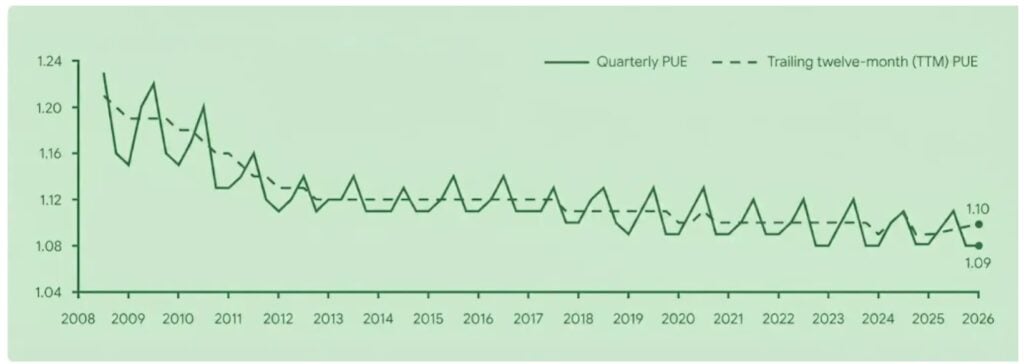
PUE measures how much electricity a data center uses compared with the power needed to run its computing equipment. A score closer to 1.0 means better efficiency because less energy goes toward cooling, lighting, and other supporting systems.
For comparison, the global average PUE was 1.54, according to the Uptime Institute’s 2025 Global Data Center Survey.
Google also reported that its data centers delivered more than three times the computing performance per unit of energy in 2025 compared with five years earlier. Improvements in hardware, software and its Tensor Processing Units (TPUs), which support AI workloads, helped drive these gains.
This matters as demand for AI computing continues to rise. More efficient chips and cooling systems allow data centers to handle more workloads while limiting the increase in energy use.
Sustainability Progress and Challenges
Google’s 2026 Environmental Report, released in June, provides a broader picture of its sustainability performance in 2025.
The report highlights progress in clean energy procurement, water replenishment and waste management. However, it also shows how the expansion of AI infrastructure is increasing the company’s environmental footprint.
Google signed agreements for more than 12 GW of new clean energy in 2025, marking its largest annual procurement to date. These agreements include power purchase agreements, energy storage and environmental attribute certificates.
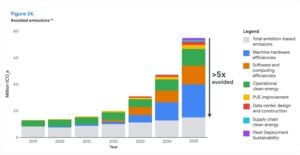
The company also reported that improvements in hardware, software, computing efficiency and clean energy procurement helped avoid more than 58 million tonnes of carbon dioxide equivalent (CO₂e).
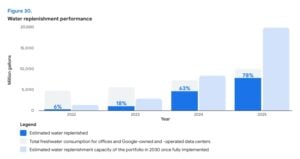
Water management remains another major priority. Google replenished around 7.7 billion gallons of water in 2025, equal to approximately 78% of its freshwater consumption. Its efforts included 165 water stewardship projects across 97 watersheds.
The company aims to replenish 120% of the freshwater volume consumed across its offices and data centers, on average, by 2030.
However, rising computing demand continues to create challenges. Google’s electricity consumption increased by 37% in 2025. Even so, it reduced operational emissions by 2% and matched 100% of its annual electricity consumption with renewable energy purchases for the ninth consecutive year.
Supply chain emissions moved in the opposite direction, rising by 25%. The increase reflects the materials and infrastructure needed to support Google’s growing operations, along with emissions linked to electricity use across parts of its supply chain.
These figures show that efficiency improvements alone cannot address the environmental impact of AI expansion. Google will also need more clean electricity, better water management and lower-carbon supply chains.
Malaysia Expansion Also Supports Renewable Energy and Jobs
Google’s investment in Malaysia extends beyond water infrastructure. The company is also working to increase renewable electricity supply and develop local skills.
It has partnered with groups led by Shizen Energy-Solarvest and TotalEnergies to bring more renewable power to Malaysia’s national grid. These partnerships use power purchase agreements (PPAs), which provide developers with long-term revenue commitments and help support new solar projects.
One example is a 29.99-megawatt solar project in Gurun, Kedah, developed by Solarvest with Shizen Energy and HSS Engineering.
Google has also committed to paying for all the electricity consumed by its upcoming data center campus, along with the direct infrastructure costs needed to connect it to the grid.
Meanwhile, its partnership with SOLS Foundation will support clean energy education and technical training.
Participating public schools are expected to receive solar and energy laboratories with 2.56-kilowatt-peak solar systems and battery storage. A separate 36-hour training program will help young people develop skills for jobs in solar installation, EV charging and energy system operations.
The programs are expected to begin in Negeri Sembilan in early 2027.
Can Google Make AI Expansion More Sustainable?
Google’s US$160 million investment highlights how data center growth is becoming closely linked to local water and energy infrastructure.
The new reservoir and treatment plant could improve water security while supporting the company’s future operations. Its renewable energy partnerships and training programs could also bring wider benefits to Malaysia.
However, the company’s rising electricity use and supply chain emissions show that significant challenges remain.
As AI demand grows, Google must continue improving data center efficiency while securing more clean power and reducing pressure on natural resources. The Negeri Sembilan project is one step toward that goal, but its long-term impact will depend on how well the company manages the environmental costs of its expanding digital infrastructure.