

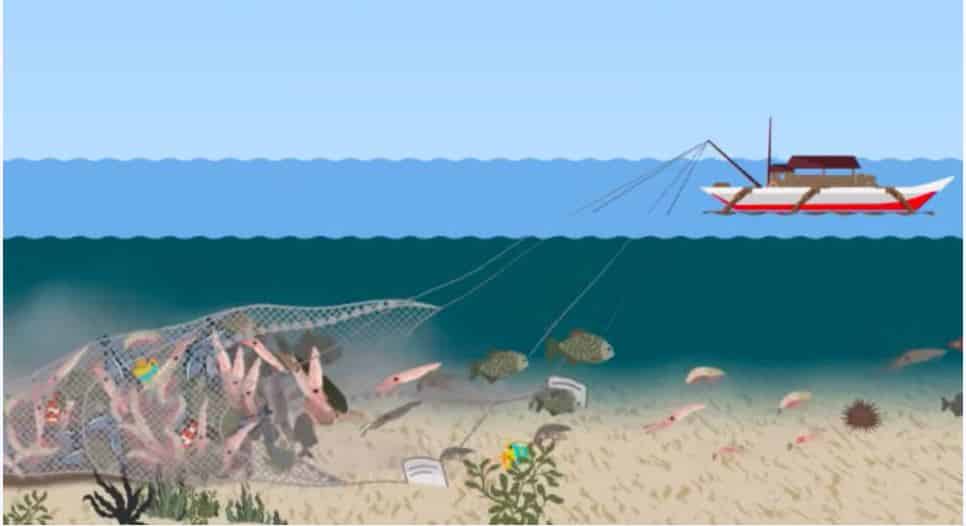
“Bottom trawling” produces as much carbon dioxide emissions as all air traffic, according to a study.
Bottom trawling is a method of fishing that involves dragging heavy nets across the sea floor to catch fish. This fishing practice is very damaging to the ocean.
It destroys sea habitats and catches any species trapped in the nets. And the trawls dragged along the sea floor releases large amounts of carbon.
So bottom trawling contributes to global warming while making the sea more acidic at the same time. Not to mention that it also threatens biodiversity in the oceans.
Bottom Trawling’s Carbon Emission
The ocean seabed is the world’s biggest carbon sink. When fishing vessels trawl the bottom of the sea, coal kept in the sediments is torn up and starts to decompose. And that’s how CO2 finds its way into the waters and then finally into the air above.
Globally, trawling releases between 600 and 1,500 Mt of CO2 each year. This translates into about 900 Mt of CO2 in aviation as per the study by marine biologists, climate experts, and economists.
The study created a way to identify the potential places needing marine protection to help reduce carbon emissions. According to one author,
“…if [they’re] strongly protected – will boost food production and safeguard marine life, all while reducing carbon emissions. It’s clear that humanity and the economy will benefit from a healthier ocean. And we can realize those benefits quickly if countries work together to protect at least 30% of the ocean by 2030.”
The research group further stated that only 7% of the oceans have some form of protection and even less have sufficiently effective protection (2.7%).
They also determined that ending 90% of the risk of disturbing CO2 caused by bottom trawling needs protecting only around 4% of the ocean.
Here are the top 10 countries with the most carbon emissions from bottom trawling:
-
- China
- Russia
- Italy
- the UK
- Denmark
- France
- the Netherlands
- Norway
- Croatia
- Spain
The UK Bans Bottom Trawling
The UK, in particular, intends to ban bottom trawling in its four Marine Protected Areas (MPAs). This will take effect on June 13 this year.
The British government further plans to extend the ban to 13 more MPAs. At the same time, major green groups call to apply the ban to all of the 40 English offshore MPAs.
As per the CEO of Wildlife and Countryside Link:
“One hundred years of industrial fishing have been hugely harmful to our marine environment, thinning out fisheries and leaving great scars in the seabed… The Government has made an important promise to protect 30% of the sea for wildlife… And we welcome the first four bans on bottom trawling, but the vast majority of the sea remains exposed to further damage.”
He also added that the survey findings revealed during World Oceans Day show there’s strong public support to end bottom trawling and cut its carbon emission.
-
More than half of the British public (55%) are pro-bottom trawling ban in all MPAs while 19% are against it.
Sandy Luk of the Marine Conservation Society said:
“As we face both climate and nature crises, it’s of the utmost importance that our ocean – home to incredible biodiversity, and a vital carbon store – is protected. This latest survey shows that we’re not alone in this call for urgent action! Almost three-quarters of people surveyed said that ocean wildlife needs more protection.”
The groups’ analysis revealed sites that need urgent protection. They also urge the UK government to prioritize them as well as the remaining others if it is to meet its 2024 goals for climate and nature protection.
Otherwise, the country will miss the last window it has to stop the damage to the seas by bottom trawling. As such, trawling will continue to lower the ocean’s ability to store carbon and fight the climate crisis.
For instance, the Dogger Bank MPA can store the equivalent of 2.5 million return trips from London to Sydney. It has the highest carbon storage capacity of any English MPAs.
While the Government shows progress on banning bottom trawling, the pace is too slow to meet 2030 climate targets.
A complete and rapid ban across all 40 MPA sites in the UK would allow the protection and recovery of crucial carbon sinks.
With increased protection of the oceans by banning bottom trawling, the loss of species and carbon emissions will be reduced. All the while ensuring good food production, too.