


Bezos Earth Fund, founded by billionaire Jeff Bezos, founder and former CEO of Amazon, launched a major initiative called the AI for Climate and Nature Grand Challenge in April 2024. The program pledges up to $100 million to support teams using artificial intelligence (AI) to solve environmental problems. Recently, it revealed its first grantees or recipients of the fund.
The funding initiative focuses on real-world solutions. It aims to reduce carbon emissions and protect wildlife using smart technology. The goal is to link AI experts with environmental groups. This helps them use AI to solve tough climate and nature problems.
Many of these organizations have strong ideas but lack the tech expertise or funding to apply AI. This is where the Bezos Earth Fund comes in, offering grants and encouraging teamwork across fields.
The challenge focuses on four main areas:
- Sustainable proteins. Finding AI tools that speed up the discovery and production of plant-based or alternative proteins.
- Biodiversity conservation. Using AI to track endangered species, protect ecosystems, and stop threats like illegal logging.
- Power grid optimization: Developing smarter, cleaner ways to store and distribute renewable energy.
- Wildcard innovations. Supporting creative AI ideas that don’t fit into a standard category but have strong environmental potential.
Let’s get to know who these grantees are and what they do.
Grantees Tackling Carbon Removal and Climate Solutions
In May 2025, the Bezos Earth Fund announced its first 24 grantees, each receiving $50,000 to build out their ideas. Some of the most impactful focus on climate mitigation and carbon removal, including:
-
Carbon Sim: CO₂ Removal Accelerator (Yale University)
This project uses AI-powered simulations to test and improve strategies for carbon dioxide removal (CDR). It aims to help scientists quickly evaluate which methods—like soil enhancement or ocean capture—are the most effective at storing carbon.
-
EV Charging Optimization (Cornell University)
Cornell’s team is creating a tool that uses real-time AI to manage charging for electric vehicles (EVs). It adjusts when and how cars are charged so they act as energy storage for the power grid. This can support the shift to renewable energy and help reduce emissions.
-
Livestock GPT
Another Cornell project, Livestock GPT is a generative AI tool that helps dairy farmers cut methane emissions. It includes a chatbot that gives feed and farm advice—especially for use in emerging economies—helping reduce climate-warming gases from livestock.
These climate-focused grantees aim to tackle emissions directly while making climate solutions more scalable and accessible.
Why This Matters for Climate and Nature
AI has the potential to supercharge global environmental efforts—but only if it’s applied wisely and equitably. The AI for Climate and Nature Grand Challenge is helping turn that potential into reality by:
- Giving environmental groups access to cutting-edge AI tools
- Funding early-stage ideas with clear pathways to impact
- Encouraging partnerships between tech and nature experts
- Supporting scalable, verifiable, and science-backed solutions
- Helping meet global climate targets faster and more affordably
The need for innovation in climate and nature solutions has never been greater. According to the Intergovernmental Panel on Climate Change (IPCC), global greenhouse gas emissions must be cut by nearly 50% by 2030 to keep warming below 1.5°C and avoid the worst impacts of climate change.
At the same time, the World Economic Forum estimates that over $44 trillion of economic value—more than half of global GDP—is moderately or highly dependent on nature and its services, underscoring the stakes for biodiversity loss.
The Power of AI in Climate Action
AI is increasingly recognized as a game-changer for environmental action. A 2023 report by Boston Consulting Group found that AI could help reduce global greenhouse gas emissions by up to 10%—the equivalent of 2.6 to 5.3 gigatons of CO₂e—by 2030, if deployed at scale across sectors like energy, transport, and agriculture.

Yet, a 2022 survey by Microsoft and Goldsmiths University revealed that only about 43% of environmental organizations felt “AI-ready”. They cited barriers such as lack of funding, technical expertise, and access to data.
Bridging the Gap: The Role of the Grand Challenge
The Bezos Earth Fund’s AI for Climate and Nature Grand Challenge directly addresses these barriers by providing critical funding and technical support to early-stage projects. By awarding $50,000 seed grants to 24 diverse teams in its first round, the initiative is lowering the entry threshold for nonprofits, universities, and startups to experiment with AI-driven solutions.
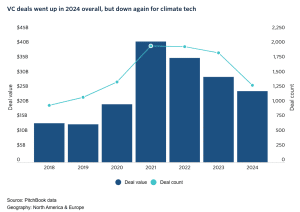
This approach is vital, as early-stage funding for climate tech remains scarce—just 6% of global venture capital in 2023 went to climate-related startups, according to PwC. And in 2024, VC deals for climate tech innovations further drop from 2023, per Pitchbook data.
The Grand Challenge also fosters collaboration between AI experts and environmental practitioners, a proven recipe for success. For example, projects like Carbon Sim (Yale) and Livestock GPT (Cornell) are bringing together machine learning specialists, ecologists, and farmers to co-design tools that are both scientifically robust and practical for real-world use. Such partnerships help ensure that solutions are not only technologically advanced but also grounded in local knowledge and needs.
AI in Action: Use Cases Beyond Carbon
Other grantees use AI to help the environment. They reduce food waste, create better plant-based proteins, and protect forests. Here are some of them and their innovations that attracted Bezos Fund’s investment:
-
University of Leeds – Food Waste to Protein. This project uses AI to turn food waste into sustainable protein. The software finds the best microbes and fermentation methods.
-
Wageningen University – OLiMPuS Platform. This open-source AI platform helps scientists find new plant and fermented proteins that feel and taste like milk and meat.
-
BGCI-US – Forest Monitoring and Illegal Logging Detection. Using drones and AI, this project tracks over 500 endangered timber species and detects illegal logging in real time.
-
AI-powered Forest Monitoring in the Amazon. Another grantee is working in the Amazon rainforest, combining satellite data with AI to detect changes in forest cover.
-
AI for Coral Reef Health (University of Miami). This project uses underwater cameras and AI models to assess the health of coral reefs. It can detect bleaching and pollution damage early.
AI isn’t just about crunching data. It’s also a strong tool for early detection, quick decision-making, and scaling nature-positive solutions.
Scaling Up: What Happens Next?
The $50,000 planning grants are just Phase I. Later in 2025, up to 15 teams will move to Phase II, receiving $2 million each over two years to scale and implement their solutions. This will allow them to move beyond prototypes and test their tools in real-world settings.
The Bezos Earth Fund says it’s also building partnerships with AI labs, tech companies, and universities to support the technical side of the challenge. At the same time, it wants to train environmental groups on how to use and trust AI, ensuring that solutions are not only powerful but practical.
The projects supported by the Bezos Earth Fund are still in early stages, but they point toward a future where smart software can support a healthy planet. Whether it’s managing forests, cleaning up farms, or inventing new kinds of food, AI is now part of the climate and conservation toolbox.