


The shipping industry is working on decarbonization, but progress is slow. New fuels and zero-emission vessels are still being developed. Meanwhile, improving existing ships’ efficiency can lead to immediate emissions cuts.
This is where shipping carbon credits come in.
ClimeCo and Marsoft Global Carbon Solutions (MS-GCS) have launched the first carbon credits from the Marsoft GreenScreen project under the Gold Standard. This project allows shipowners to turn verified emissions reductions from energy-efficiency upgrades into carbon credits for the voluntary carbon market.
This model gives shipowners a new revenue stream while helping finance technologies that cut fuel use and CO2 emissions.
Why Shipping Needs Faster Decarbonization
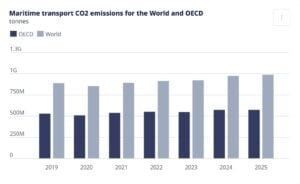
Shipping accounts for most global trade by volume, making it hard to replace with other transport modes. However, this also creates major emissions challenges. The International Maritime Organization (IMO) estimates that shipping produced about 1.06 billion tonnes of CO2 in 2018, roughly 2.9% of global human-caused CO2 emissions. International shipping alone was responsible for around 740 million tonnes.
Despite efficiency improvements, emissions remain high.
The IMO’s 2023 greenhouse gas strategy aims for international shipping to achieve net-zero emissions by 2050. It also sets interim goals: cutting annual emissions by at least 20% by 2030 and at least 70% by 2040, compared to 2008 levels. These targets push shipowners to invest in efficiency now, even as cleaner fuels and technologies are developed.
Marsoft GreenScreen Brings Carbon Finance to Ship Efficiency
GreenScreen targets this immediate opportunity. The program helps shipowners measure fuel and emissions savings from vessel retrofits. These upgrades can enhance hydrodynamics, propulsion efficiency, and overall vessel performance.
- According to MS-GCS, over 350 ships have joined the program, including bulk carriers and chemical tankers. Together, they are expected to save more than 2.3 million tonnes of CO2 emissions during their next docking.
- The program has also analyzed over 200 ship-years of operational data, giving Marsoft valuable performance insights.
After identifying emissions reductions, the GreenScreen model converts these into Gold Standard carbon credits. ClimeCo and MS-GCS manage credit issuance, while ClimeCo handles commercialization in the voluntary carbon market.
This links ship efficiency to carbon markets. Instead of viewing a retrofit as a cost, shipowners can potentially earn revenue from emissions reductions.

Arlie Sterling, President of Marsoft, said:
This is the first issuance of shipping carbon credits using the latest methodology we developed in collaboration with the MIT Sea Grant Design Laboratory, marking a significant milestone for the industry. This issuance, together with others already underway, will deliver funding to accelerate the pace of retrofitting and decarbonization.”
- READ MORE: MOL Becomes the First Japanese Shipping Firm to Retire Tech-Based CDR Credits Through NextGen
How Shipping Carbon Credits Work
The concept is simple. First, GreenScreen evaluates vessel data to estimate fuel and emissions savings from a retrofit. It uses existing data from shipowners, so no new data collection is needed. Next, emissions reductions are measured and verified using the appropriate carbon-credit methodology.
Gold Standard has a specific method for quantifying emissions reductions from energy-efficiency retrofits in shipping. This aligns with Gold Standard requirements for generating carbon credits.
Once verified, credits can be issued.

- Each credit represents one tonne of reduced or removed greenhouse gas emissions, following the relevant methodology and verification steps.
ClimeCo then connects those credits to buyers in the voluntary carbon market. This is crucial because carbon markets can incentivize emission-cutting projects that might struggle to find funding.
ClimeCo Adds Carbon Market Expertise
Erika Schiller, Chief Development Officer at ClimeCo, also noted,
“We’re proud to partner with Marsoft to bring our carbon market expertise to the registration and issuance of these high-quality, third-party verified credits. Together, we’re supporting shipowners in obtaining funding for more advanced retrofits and helping them navigate the voluntary carbon market with confidence.”
ClimeCo brings over a decade of experience in carbon project development and environmental markets to this partnership.
Founded in 2009, the company started with industrial emissions-reduction projects and expanded into carbon project development, environmental commodities, and sustainability consulting. ClimeCo reports that its projects have reduced, avoided, or removed over 50 million tonnes of CO2e since 2009.
This experience is vital for GreenScreen, as shipping retrofits require credible emissions accounting, verification, and access to buyers.
ClimeCo goes beyond selling credits. Its carbon project business focuses on establishing baselines, measuring emissions reductions, and applying methodologies to create credible environmental assets. This expertise could further help GreenScreen grow as more shipowners seek ways to finance efficiency upgrades.
Can Carbon Credits Accelerate Shipping Retrofits?
The shipping industry faces a capital problem as much as a technology one.
Shipowners can invest in efficiency upgrades today, but financial benefits depend on fuel savings and operating conditions. Carbon revenue can provide an additional income stream.
However, carbon credits won’t replace direct emissions reductions. GreenScreen connects the two. Ships first reduce emissions, and then the verified reductions create carbon market value.
This connection is crucial as carbon markets face scrutiny over additionality, measurement, and credibility. High-quality shipping credits need strong monitoring and verification to ensure claimed reductions are real and linked to the retrofit.
GreenScreen’s use of a Gold Standard methodology provides a trusted framework for measuring these reductions.
A New Market for Maritime Decarbonization
Shipping carbon credits are still emerging, but GreenScreen shows how the voluntary carbon market can support decarbonization in a hard-to-abate sector. The industry needs cleaner fuels, new vessel designs, and maybe zero-emission propulsion to hit long-term climate goals. These solutions will require time and investment.
Energy-efficiency retrofits can deliver reductions much sooner.
By turning verified reductions into marketable carbon credits, GreenScreen connects today’s shipping fleet with tomorrow’s low-carbon vessels. Shipowners can cut fuel use and fund retrofits, while carbon buyers gain access to credits linked to measurable shipping emissions cuts.
As the IMO pushes for deeper emissions cuts, it’s essential to find ways to raise funds for rapid efficiency improvements. This will be key in the shipping decarbonization toolkit.