


Silicon Valley startup CarbonZero.Eco reached a major milestone by completing its first commercial biochar facility in Colusa County, California. At the same time, the company signed a landmark carbon credit deal with Climeworks, one of the world’s most trusted carbon removal companies. This deal positions CarbonZero.Eco as a rising player in the fast-growing carbon removal market.
CarbonZero.Eco Teams Up with Climeworks
Climeworks is known globally for its high-quality carbon removals, especially through direct air capture. By partnering with CarbonZero.Eco, Climeworks now adds biochar-based, nature-driven carbon removal to its portfolio. This combination brings together biochar’s natural carbon storage with Climeworks’ tech-based solutions, thereby boosting credibility and offering verified carbon credits to premium buyers.
The deal highlights the strength of CarbonZero.Eco’s technology. While pricing and volumes were not disclosed, the partnership opens doors to high-end buyers and reinforces CarbonZero.Eco’s market reputation.
Climeworks already works with companies like TikTok and NYK. TikTok, for example, is committed to 5,100 tons of carbon removals through 2030, including biochar. Climeworks sees biochar as cost-efficient, scalable, and immediately deployable, with benefits like healthier soil, improved water retention, and lower emissions from agricultural waste.
Why Biochar Matters
Globally, agriculture produces more than 1.5 billion tons of waste every year. Much of it is burned or left to rot, releasing CO₂ and other pollutants. These practices alone contribute about 3% of global greenhouse gas emissions.
Biochar offers a cleaner alternative. Heating agricultural waste in low-oxygen conditions turns it into a stable form of carbon that can last hundreds or even thousands of years. It keeps CO₂ out of the atmosphere and produces a nutrient-rich soil amendment. Over 6,000 studies confirm biochar improves soil fertility, structure, and crop yields.
CarbonZero.Eco is applying biochar in California’s almond industry. Almond shells normally decompose in about two years, releasing carbon. By converting them into biochar instead, the company expects to prevent up to 1.5 million tons of CO₂ emissions.
Scaling Biochar in the Central Valley
The new Colusa County plant is CarbonZero.Eco’s first major production facility. It sits next to almond shell stockpiles, eliminating the need to transport raw material. This lowers emissions and makes the process efficient.
At full capacity, the kilns can produce 30,000 tons of biochar per year, about five times more than most existing technologies. The biochar will be mixed into compost and used by partner farms to enrich soils for future crops.
The facility also helps conserve water. Over 500 aquifers in the Central Valley are drained annually, causing land to sink. Some areas have dropped nearly a foot in a single year. Biochar-amended soils hold 20% more water, reducing irrigation needs and helping stabilize groundwater.
Harper Moss, Founder and CEO of CarbonZero.Eco, said:
“This facility represents a major step toward making carbon-negative agriculture both practical and profitable. By placing our first plant directly where agricultural waste is generated, we’re creating a closed-loop system that benefits farmers, the environment, and the climate. Our mission is to empower American farmers to enhance soil health, improve crop yields, and unlock new revenue streams—while removing atmospheric CO₂ at scale through next-generation biochar production.”
Silicon Valley Backing and Farmer Trust
CarbonZero.Eco emerged from stealth last year with multi-million-dollar backing from leaders at Google, Meta, Amazon, and other tech executives. Since then, it has partnered with hundreds of almond farms across Colusa and Yolo Counties. These farms will divert waste away from landfills and decomposition.
Farmers benefit directly. Biochar stores carbon for centuries, improves water retention, enhances soil health, and boosts crop yields. What used to be waste now becomes both an environmental and financial asset.
Biochar Carbon Credit Market Trends
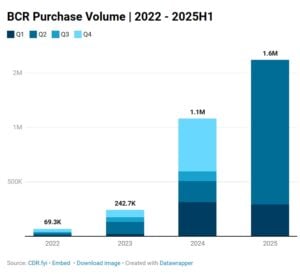
The market for biochar carbon removal (BCR) credits has grown quickly. This year’s CDR.fyi Biochar Carbon Removal Market Snapshot highlighted that from early 2022 to mid-2025, buyers contracted over 3.04 million tons of BCR credits. Of this, 1.6 million tons were purchased in the first half of 2025 alone, the strongest period yet.
Key trends:
-
Average purchase volumes are rising from 542 tons per buyer in 2022 to 762 tons by H1 2025.
-
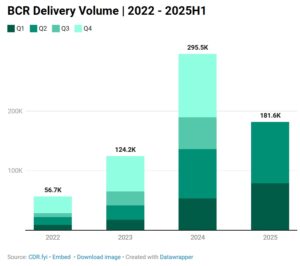
Deliveries and retirements are growing. 658,000 tons have been delivered and 302,000 tons retired since 2022, with the rate roughly doubling each year.
Major buyers dominate the market. Microsoft, Google, BCG, and JPMorgan make up 57% of all purchases. Notably, Exomad Green leads supply. It produced 60% of all BCR credits sold since 2022.
The second quarter of 2025 set a record. Driven by Microsoft purchases, the contracted volume in the first half of 2025 exceeded all previous periods combined.
A New Era for Carbon Removal
CarbonZero.Eco’s first facility and its Climeworks partnership mark a turning point for carbon removal. The company combines agriculture, waste reduction, and climate tech for immediate and long-term impact.
With demand rising for verified, durable carbon credits, CarbonZero.Eco is poised to grow its role in the BCR market. Its work helps farmers, strengthens rural economies, and supports global climate goals.
As the race toward net zero accelerates, scalable solutions like biochar are essential. CarbonZero.Eco is stepping into that role with technology built for real-world impact and partnerships that advance the entire carbon removal ecosystem.