

Nikola Corporation is making headlines with a $100 million common stock sale, a move aimed at stabilizing its finances and advancing hydrogen technology. This bold strategy underscores the company’s commitment to overcoming its challenges, including financial losses and a tarnished reputation from past controversies. Meanwhile, Alpine is exploring hydrogen’s potential in high-performance sports cars, showcasing its Alpenglow concept as a testament to hydrogen’s versatility.
These stories illustrate how hydrogen transforms transportation, offering solutions that blend sustainability with performance across commercial and luxury sectors.
Nikola: Powering the Hydrogen Trucking Era
Nikola, a leader in hydrogen-electric trucking, is redefining commercial transport by addressing the challenges of sustainability and efficiency. Despite recent hurdles—including founder Trevor Milton’s fraud conviction—the company remains committed to advancing hydrogen technology.
Nikola’s progress is reflected in its production of 203 trucks this year, a record achievement. These hydrogen-electric semi-trucks are designed for long-haul operations, leveraging hydrogen’s unique advantages over battery-electric vehicles.
Hydrogen’s fast refueling times and extended driving ranges make it ideal for heavy-duty applications, where downtime can significantly impact productivity.
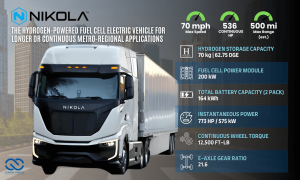
Financial struggles, however, pose challenges. Nikola reported a $481 million net loss this year and is taking steps to stabilize its finances. The company launched a $100 million stock sale to raise capital, intending to invest in complementary technologies and expand its capabilities. By tackling its $656 million debt through innovative financial strategies, Nikola aims to secure its position in the hydrogen market.
The company’s ambitious goal of selling 300–350 hydrogen-electric trucks by 2024 underscores its commitment to sustainability. With a growing demand for green logistics solutions, Nikola is a key player in transforming the commercial transport sector.
The truck giant is also making huge strides in the hydrogen refueling infrastructure. Recently, Nikola has worked with FirstElement Fuel (FEF) to launch the world’s first hydrogen refueling station for commercial trucks near Oakland’s port. Featuring H70 fast-fill technology, it refuels trucks in 10 minutes, serving 200 trucks daily.
This collaboration, backed by California’s NorCal Zero Project, places Nikola as a leader in the U.S. hydrogen economy, supporting federal goals to establish a robust hydrogen network nationwide.
Over in the luxury auto industry, another company is betting on the future of hydrogen-powered mobility.
Alpine: Speed Meets Sustainability in Sports Cars
Alpine, a brand synonymous with high-performance sports cars, is exploring hydrogen as a means to merge speed and sustainability. Its groundbreaking Alpenglow concept car, unveiled at the 2022 Paris Motor Show, embodies this vision.
The Alpenglow features a hydrogen-powered internal combustion engine (ICE), combining the thrill of motorsports with eco-friendly innovation. At its debut during the 2024 6 Hours of Spa-Francorchamps, the Alpenglow Hy4 prototype demonstrated the feasibility of hydrogen ICE technology.
The Hy4’s 2.0-liter turbocharged engine delivered 340 horsepower, powered by three hydrogen tanks integrated into its aerodynamic design.
Alpine has since advanced its hydrogen technology with the Hy6 model, which boasts a 3.5-liter V6 twin-turbo engine producing 730 horsepower. This evolution highlights the brand’s dedication to pushing the boundaries of sustainable performance.

Looking ahead, Alpine envisions adapting its hydrogen-powered technology for road-legal vehicles. By prioritizing hydrogen alongside electric alternatives, Alpine offers a versatile approach to achieving decarbonization in the automotive sector.
Hydrogen vs. Batteries: The Game-Changer for Heavy-Duty Transport
With its zero-emission potential, hydrogen could play a transformative role in decarbonizing the mobility sector. It offers significant advantages for long-range and heavy-duty transportation, complementing battery electric vehicles (BEVs).
Hydrogen fuel cells are particularly suited for vehicles with heavy payloads, such as trucks, buses, and rail, due to their higher energy density and faster refueling capabilities compared to batteries. This makes hydrogen a key option for commercial fleets and near-continuous-use vehicles.
Moreover, hydrogen refueling takes minutes, compared to the hours needed to charge BEVs, making it a practical choice for industries where time is critical. Also, hydrogen vehicles offer greater range, addressing range anxiety commonly associated with electric cars.
While BEVs dominate the passenger car market, hydrogen’s versatility makes it a compelling alternative for specific use cases. For instance, heavy-duty trucks like Nikola’s hydrogen semis and high-performance vehicles like Alpine’s Alpenglow fill niches where BEVs face limitations.
Hydrogen also provides opportunities for industries beyond automotive, including shipping, aviation, and stationary energy storage. By embracing this technology, companies can diversify their energy strategies and contribute to broader decarbonization goals.
The Road Ahead for a Zero-Emission Future
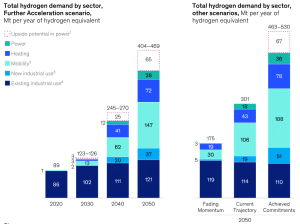
According to McKinsey & Company’s hydrogen outlook, hydrogen adoption could accelerate, supporting an estimated 80 million zero-emission vehicles by 2030. Long-term projections indicate its role will expand in aviation, freight shipping, and railways, replacing diesel and reducing oil consumption by up to 20 million barrels daily.
As seen in the chart, the mobility sector will be the biggest driver of clean hydrogen demand by 2050.
Additionally, as hydrogen infrastructure and production technologies scale, costs are expected to decline, aligning fuel-cell electric vehicles (FCEVs) closer to internal combustion engines in affordability by 2040.
Challenges and Pathways Forward
Despite its promise, hydrogen faces several challenges. High production costs and limited refueling infrastructure are significant barriers to widespread adoption. Addressing these issues requires collaboration among automakers, governments, and energy providers.
Nikola and Alpine’s efforts show the importance of investing in hydrogen research and development. By refining hydrogen technologies and scaling production, these companies are paving the way for a sustainable future. Policies supporting infrastructure development and subsidies for hydrogen projects can accelerate this transition.
The success of Nikola and Alpine demonstrates that hydrogen is more than a theoretical solution—it is a viable pathway in the race toward sustainable mobility. By integrating hydrogen into their portfolios, these companies are setting benchmarks for innovation and responsibility.
As the automotive industry evolves, hydrogen’s role will only grow. Complementing electric vehicles, hydrogen can unlock a cleaner, more efficient future for transportation, blending innovation and decarbonization.