

Northern Trust is making a bold move in the voluntary carbon market (VCM) with its innovative digital platform, The Northern Trust Carbon Ecosystem. This groundbreaking system enables project developers to generate, verify, and transact voluntary carbon credits in near real-time, improving efficiency and transparency in the carbon credit lifecycle.
Northern Trust is a global financial institution offering wealth management, asset servicing, asset management, and banking solutions to corporations, institutions, and high-net-worth individuals. Headquartered in Chicago, the company operates in 24 U.S. states and 22 international locations. The company continues to lead in providing cutting-edge solutions in the digital asset and sustainability sectors.
Transforming Carbon Credit Transactions
The VCM has long been burdened by manual processes, leading to inefficiencies in measuring, reporting, and verifying (MRV) carbon credits. Northern Trust aims to change that with its fully digital platform, which leverages blockchain technology to streamline transactions.
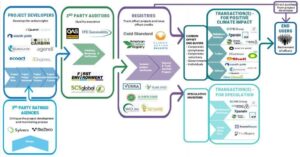
The Northern Trust Carbon Ecosystem is powered by the company’s digital assets platform, Northern Trust Matrix Zenith. This system facilitates seamless tracking, trading, and settlement of carbon credits using a private ledger blockchain.
By eliminating delays and manual intervention, the platform ensures that carbon credits undergo accurate recording and swift transfer to buyers.
Justin Chapman, global head of Digital Assets & Financial Markets, Northern Trust, remarks on this major development in an email to us. He noted that this functionality enables real-time data connectivity with firms that collect and verify project developers’ technical data and recorded credits. It allows them to demonstrate, almost instantly, how much CO2e has been avoided or removed. Specifically, Justin stated that:
“Northern Trust can now be supplied with real-time verified information from the dMRV’s, allowing credits to be created in the Project Developers account and those credits to be instantly transacted. Importantly, The Northern Trust Carbon Ecosystem also captures on each carbon credit the actual data attributes associated with the avoidance or removal of each tonne of CO2e. This provides more transparency to the buyer of the carbon credits: the buyer can link the individual carbon credit back to the exact time, date, and location that the CO2 was captured and stored. The ecosystem provides enhanced transparency and clarity of the carbon credits we record.”
Key Features of The Northern Trust Carbon Ecosystem
- Real-Time Carbon Credit Generation: Project developers can create verified carbon credits almost instantly.
- Full Transparency and Traceability: Each credit comes with precise data attributes, including CO2 capture rates, energy consumption, and location.
- Direct Transactions: The platform connects project developers directly with buyers, reducing the need for intermediaries.
- Smart Legal Contracts: Agreements are executed through Avvoka, ensuring legal compliance and documentation for each transaction.
- Secure and Efficient Settlements: Transactions are settled quickly via blockchain, enhancing market trust.
Partnerships Driving Innovation
Northern Trust has been working closely with various project developers and data collection providers to enhance its platform’s efficiency. Notable partnerships include:
InceptionX: This company specializes in real-time carbon measurement using IoT and machine learning. It recently transmitted carbon data from a wastewater recycling project in San Francisco to Northern Trust’s platform for credit creation.
Mangrove Systems: A digital MRV provider that collaborates with Northern Trust to verify carbon credits from The Carbon Removers, a UK-based project developer. Their system collects real-time data from carbon capture plants at a Scottish distillery to validate credit issuance.
Go Balance Limited: A REDD+ project developer supporting the Trocano Araretama REDD+ Project in Brazil. Northern Trust’s platform streamlines administrative tasks, allowing Go Balance to focus on preventing deforestation.
ReGen III: A clean-tech company converting used motor oil into high-grade lubricants. Their recycling facility could prevent 900,000 metric tons of CO2 emissions annually.
Advancing Sustainability and Profitability
The Northern Trust Carbon Ecosystem aligns with global sustainability goals by making carbon credit trading more accessible, reliable, and efficient. By leveraging blockchain, automation, and smart contracts, Northern Trust is improving market operations while ensuring that project developers receive fair value for their credits transparently.
The platform is still in its early stages, but Northern Trust plans to launch 5 live transactions later this year. As the VCM continues to evolve, solutions like this will play a crucial role in fostering trust, reducing fraud, and expediting the transition to a low-carbon economy.
With over 135 years of financial expertise, Northern Trust is positioning itself as a leader in digital carbon markets. It provides a scalable solution that meets the growing demand for verified carbon credits.
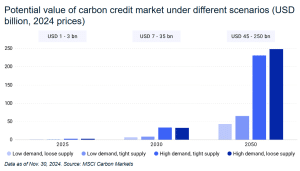
According to industry projections, the VCM will exponentially grow given the near deadline for the short-term net-zero target of businesses. It could reach up to $3 billion this year, then balloon to $35 billion by 2030. Even more, the market could be worth up to $250 billion by 2050, the deadline for the global net-zero goal.
Blockchain’s Role in Enhancing Carbon Market Integrity
The tokenization of carbon credits through blockchain technology is one way to boost integrity and trust in the carbon market. Northern Trust’s digital ecosystem ensures that each credit comes with accurate and verifiable data, reducing the risk of double counting and fraud.
Blockchain technology is increasingly recognized for its potential to enhance the integrity of carbon markets by providing transparent, tamper-proof ledgers for carbon credit transactions. This transparency ensures that each carbon credit gets accurate tracking from issuance to retirement.
- RELATED: The Energy Debate: How Bitcoin Mining, Blockchain, and Cryptocurrency Shape Our Carbon Future
By digitizing carbon credits and recording transactions on a blockchain, stakeholders can access real-time data on the credit’s lifecycle, including its origin, ownership history, and environmental impact. This level of detail fosters trust among market participants and supports the credibility of carbon offset claims.
Moreover, blockchain’s decentralized nature eliminates the need for intermediaries, streamlining the verification and settlement processes. Smart contracts can automate the execution of agreements when predefined conditions are met, further enhancing efficiency and reducing administrative costs.
Other initiatives in the market include:
- CarbonPlace: A global bank-led trading platform that connects carbon credit buyers and sellers with a $45 million investment.
- United Nations Development Programme (UNDP) Carbon Registry: A blockchain-based system using QLDB to help countries manage carbon credit trading.
- UAE’s Blockchain Carbon Registry: A government-backed initiative using the Venom blockchain for transparent credit management.
- Asia’s First Digital Carbon Registry: A joint effort by Carbonbase, HBAR Foundation, and ImpactX to bring blockchain-based transparency to Asia’s carbon market.
As institutional investors and corporations seek reliable ways to offset emissions in their journey to net zero, The Northern Trust Carbon Ecosystem could become a cornerstone in the future of voluntary carbon trading.