


China’s electric vehicle (EV) maker Leapmotor has signed a carbon credit transfer agreement with Italy’s Stellantis. The plan sees Stellantis buying CO₂ credits from Leapmotor, which can generate these credits through producing and selling zero-emission vehicles (ZEVs).
The deal reflects how EV manufacturers are not only cutting emissions but also earning revenue by selling tradable carbon credits. Let’s uncover how.
Trading Carbon and Cars: Inside the Leapmotor-Stellantis Deal
In a strategic move, Leapmotor announced that its subsidiary Leapmotor Power has signed a carbon credit transfer agreement with Stellantis units in China. The deal allows Stellantis’ Chinese units to purchase carbon credits from Leapmotor, helping the global auto giant comply with China’s strict vehicle emission regulations.
Leapmotor’s subsidiary will transfer CO₂ credits to several Stellantis brands, such as Fiat and Jeep, under a plan that likely spans several years. Each credit represents one tonne of CO₂ avoided by selling an EV instead of a fossil-fuel vehicle.
The Italian carmaker aims to be net zero by 2038, and part of this goal is rolling out battery electric vehicles (BEVs) by 2030. Apart from buying carbon credits, Stellantis is also ramping up its EV strategy, investing in battery production and infrastructure. The company aims for 100% battery electric vehicle (BEV) sales in Europe and 50% in the U.S. by 2030.

While specific volumes and pricing weren’t disclosed, Stellantis and Leapmotor called the deal “landmark.” It signals a growing trend: EV makers increasingly rely on carbon credit sales to boost revenue and offset costs.
The transaction highlights the growing importance of carbon credits in global automotive strategy. By selling credits from its zero-emission EVs, Leapmotor not only gains new revenue but also strengthens its relationship with Stellantis, which owns a 20% stake in the Chinese EV maker.
Moreover, the agreement reflects Stellantis’ push to meet regulatory requirements while scaling up its electrification strategy in a cost-effective way. Leapmotor further said the agreement complies with China’s “Parallel Management Method for Passenger Vehicle Corporate Average Fuel Consumption (CAFC) and New Energy Vehicle (NEV) Credits.”
This policy encourages automakers to improve fuel efficiency and expand NEV output to earn tradable credits, aligning with China’s national goals to peak carbon emissions before 2030.
Turning Emissions Into Earnings: How EVs Mint Carbon Credits
Electric vehicles play a crucial role in the global shift to cleaner transportation, not just by reducing tailpipe emissions, but also by generating carbon credits. Because EVs produce zero direct emissions, each vehicle sold contributes to a manufacturer’s carbon offset capabilities.
These offsets can be converted into carbon credits, which are then traded or sold to other companies that need to balance out their carbon footprint. This system provides a major incentive for automakers to go green.
Zero-emission vehicles (ZEVs) automatically earn credits under many emissions rules. Regulators like California, China, and the EU set ZEV quotas, mandating that a share of each automaker’s sales must come from EVs. If carmakers fall short, they must buy credits from those, like Leapmotor, that sell EVs.
Tesla is the most notable case. In 2024, it earned $2.76 billion in carbon-credit revenue, up 54% from 2023 ($1.79B). That credit sales helped Tesla generate nearly 30% of its quarterly profits in late 2024.
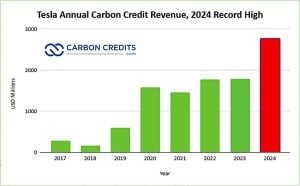
Since 2017, Tesla has made over $10.4B from regulatory credit sales. Its dominance shows how EV-led carbon programs can turn into powerful income streams.
This income supports Tesla’s bottom line and helps fund further investment in clean technology. As more countries introduce stricter emissions regulations and carbon pricing systems, EV makers like Leapmotor and Tesla are well-positioned to benefit.
Leapmotor Cashes In: Joining the Billion-Dollar EV Credit Market
Leapmotor’s deal with Stellantis means it can tap into this same market. As more countries tighten emissions rules, demand for credits is rising. For Stellantis, buying Leapmotor’s ZEV credits helps the company meet regulatory targets, especially in Europe, where non-compliance can trigger fines of €95 per gram of CO₂ per kilometer.
For Leapmotor, this provides steady revenue and strengthens its financial profile. The company can now scale production more confidently and reinvest in EV technology, production capacity, or market expansion.
Bumps in the Fast Lane
EV credit markets can shift quickly. In the U.S., lawmakers are considering phasing out credit programs, which would threaten Tesla’s model. In the EU, pooling credits between automakers is allowed, but regulators may change these rules.
- SEE MORE: EU’s 2025 Emission Rules Led Tesla and Mercedes to Pool Carbon Credits to Avoid $15.6 Billion Fine
Analysts also warn that as every carmaker ramps up EV production, credit prices may drop. Tesla’s revenues rose when others lagged, but as more EVs flood the market, credit demand could weaken and prices fall.
What It Means for the EV Market and Carbon Goals
The Leapmotor-Stellantis carbon credit deal shows how traditional and electric carmakers can work together to meet climate targets. It also reveals a growing trend in the EV space, where clean car companies gain an additional stream of revenue by selling credits to those that lag behind in electrification.
For Leapmotor, the deal boosts credibility and financial flexibility as it expands in and outside China. For Stellantis, the agreement helps it stay compliant in the world’s largest auto market while giving it time to accelerate its own EV rollout.
This model mirrors what Tesla has long benefited from and could soon become a standard revenue model for many EV players. With global carbon credit markets expected to reach hundreds of billions of dollars by 2030, carbon trading between automakers could significantly impact the industry’s economics and the pace of decarbonization.
Bloomberg forecasts global EV sales to take 50% of the market by 2030. China remains the top market globally. 
As global policies tighten and consumer demand for EVs grows, automakers will likely explore more creative ways, like this partnership, to manage their carbon footprints. These deals reinforce how EVs are more than just clean transport—they’re a powerful lever in the global carbon economy.
Looking Ahead: Leapmotor’s Path to Profit and Sustainability
Leapmotor’s deal with Stellantis positions it not only as an EV innovator but also as an energy-efficient exporter of carbon compliance. As global emissions rules tighten, its ability to generate carbon assets may become a key revenue source.
The deal also highlights how the shift to electric vehicles is reshaping global emissions markets. Automakers that sell EVs can now earn substantial revenue through regulatory credits, while legacy firms comply with climate rules.
Tesla’s multi-billion-dollar credit earnings show just how lucrative this business can be. As EV sales grow, the competition for credits will intensify. For EV producers, carbon credits offer not just sustainability merit but real financial value, bolstering their position in the global automotive market and speeding the transition to net-zero transport.