

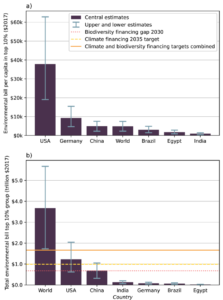
A new study has put a price tag on one of the biggest drivers of environmental damage: consumption by the world’s wealthiest households. Researchers from Leiden University and the University of Oxford found that the top 10% of global consumers cause $1.7 trillion to $5.7 trillion in environmental cost each year.
The study, published in Nature Communications Sustainability, offers one of the clearest estimates yet of how spending patterns translate into environmental costs.
The numbers are striking. At the high end, the annual damage exceeds the combined funding needed to meet major global climate and biodiversity goals. Scientists warn that humanity has crossed seven of the nine planetary boundaries. These boundaries define a safe space for human societies, and so the findings come at a critical moment.
The message of the study is this: a relatively small share of the world’s population is placing a disproportionate burden on the planet.
Climate Change and Nature Loss Drive Most of the Costs
Researchers looked at how consumption impacts various environmental systems. They also estimated the financial cost of that damage. Their analysis covered climate change, biodiversity loss, freshwater use, land-use change, and nutrient pollution.
The highest costs came from biodiversity loss, which accounted for 47% to 56% of total environmental damage. Climate change followed closely, contributing 36% to 45% of the total. Together, these two issues made up more than 90% of the estimated costs.
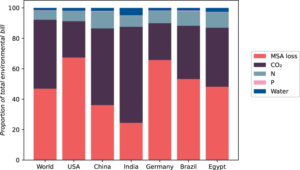
Even the study’s lowest estimate of $1.7 trillion per year is enormous. It exceeds the financing gaps that governments are trying to close through global climate and biodiversity agreements.
The findings show that environmental damage is not only a problem for ecosystems. It is also becoming a major economic challenge.
The More We Consume, the More the Planet Pays
The study found a strong link between wealth and environmental impact. Across the world, the average person in the top 10% of consumers causes between $2,300 and $7,500 in environmental damage every year.
In the United States, where consumption levels are among the highest globally, the damage rises to between $19,000 and $63,000 per person annually. According to the researchers, that equals roughly 6% to 20% of annual income or 0.8% to 3% of personal wealth.
The findings support previous research on emissions inequality.
Oxfam and the Stockholm Environment Institute say that the richest 10% of people worldwide account for almost half of carbon emissions from consumption. By contrast, the poorest half of humanity contributes only a small share despite representing billions of people.
- The evidence points to a clear pattern: environmental impacts rise sharply as consumption increases.
SEE MORE: America’s Richest 0.1% Emits 62x More Than a Typical US Household
Biodiversity Loss Carries the Biggest Price Tag
One of the study’s most important findings is that biodiversity loss now rivals climate change as a global economic risk.
Climate change often dominates environmental discussions, but biodiversity loss actually has the highest cost in the analysis. That matters because modern economies depend heavily on healthy ecosystems.
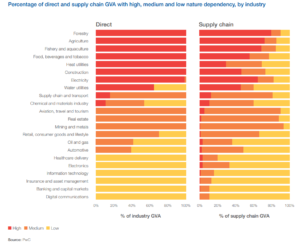
The World Economic Forum reports that over half of global GDP, about $58 trillion, relies significantly on nature and ecosystem services. Agriculture, food production, water supplies, forestry, fisheries, and many industrial sectors rely on functioning ecosystems.
Yet, biodiversity continues to decline rapidly.
The Intergovernmental Science-Policy Platform on Biodiversity and Ecosystem Services (IPBES) estimates that about one million species are at risk of extinction. Many of these could disappear in the next few decades.
Biodiversity loss is speeding up. Because of this, businesses and investors are focusing more on nature-related risks. These risks could disrupt supply chains, food systems, and economic growth.
Nature Still Loses the Funding Battle
Despite growing awareness, funding for nature protection remains far below what experts say is needed.
Earlier this year, the United Nations Environment Programme reported that for every dollar spent on nature protection, about $30 goes into activities that harm ecosystems. At the same time, governments continue to face large funding gaps.
The Kunming-Montreal Global Biodiversity Framework aims to close a biodiversity finance gap estimated at roughly $700 billion per year. Climate finance needs are even larger. Countries recently agreed on goals that could require close to $1 trillion annually for climate action by 2035.
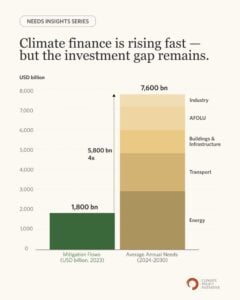
The environmental costs identified in the study are comparable to these funding needs. This comparison shows a big problem: the world spends much more on harmful activities than on those that help nature.
Climate Policy Is Starting to Focus on Consumption
For decades, environmental policies mainly targeted production. Governments regulate power plants, factories, vehicles, and industrial facilities. While those efforts remain important, researchers increasingly argue that consumption patterns also deserve attention.
High-income households often travel more. They buy more goods, live in bigger homes, and use more energy-intensive products and services.
As a result, their environmental footprint is often much larger than the global average. This debate is gaining momentum as countries work toward net-zero goals.
The International Energy Agency reports that global carbon dioxide emissions from energy hit a record 37.8 billion metric tons in 2025. This rise happened even with ongoing growth in renewable energy and clean technologies.
Many experts now believe that cleaner technologies alone may not be enough. Resource efficiency, circular economy strategies, and sustainable consumption are key topics in climate policy talks.
The Bill for Environmental Damage Keeps Growing
The study does not argue against economic growth or rising living standards. Instead, it shows that a small number of high-consuming households cause a great deal of environmental damage.
By putting a dollar value on those impacts, the researchers offer a new way to understand the true cost of crossing planetary boundaries. Their findings arrive at a critical moment. Climate risks are growing, biodiversity continues to decline, and pressure on natural resources is increasing.
At the same time, governments, investors, and businesses are searching for ways to finance climate action and nature restoration.
The study suggests that part of the solution may involve more than raising new funding. It may also need to lower the environmental costs from the world’s biggest households.
Research shows that solving environmental issues might rely on two things: how much money is spent on solutions and how our consumption habits create the problems. This is significant as policymakers are getting ready for future climate and biodiversity talks, especially the upcoming 2026 United Nations Climate Change Conference, COP31, in November.