

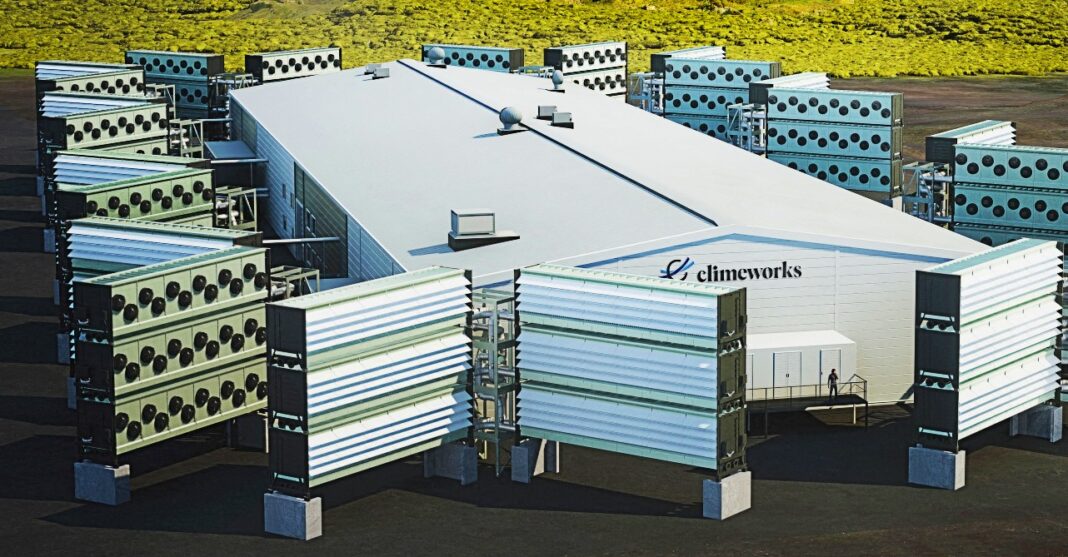
The US government just made a very large bet on giant carbon-sucking machines known as Direct Air Capture (DAC) technology as a climate solution by planning to spend $1.2 billion on two projects led by Occidental Petroleum, Oxy, and Climeworks.
The Department of Energy (DOE) awarded the grant to Project Cypress in Louisiana, a DAC facility run by Battelle, Climeworks, and Heirloom Carbon Technologies. The other DAC plant is in Texas overseen by Occidental Petroleum’s (Oxy) subsidiary 1PointFive, alongside Carbon Engineering and Worley.
Together, the two pioneer DAC hubs will remove over 2 million tons of CO2 from the atmosphere each year.
Leading the Game-Changing Carbon Removal Technology
Rising global temperatures and the lack of rapid carbon reduction efforts put carbon removal into the spotlight. Climate scientists at the UN panel say that billions of tons of carbon must be drawn out of the air every year to stay within the critical 1.5°C threshold.
Direct air capture is one of the emerging carbon removal technologies.
The $1.2bln move places the United States as the world leader in testing DAC as a climate change solution. It represents the first phase of the $3.5 billion funding program of the DOE for developing DAC hubs. The funds were set aside by the Biden Administration last year through the Bipartisan Infrastructure Law.
The billion-dollar investment is the first and largest governmental support worldwide for the nascent carbon capture technology. Speaking for the government’s decision at the reporters’ call, Energy Secretary Jennifer Granholm said:
“These hubs are going to help us prove out the potential of this game-changing technology…If we deploy this at scale, this technology can help us make serious headway toward our net-zero emissions goals while we are still focused on deploying, deploying, deploying more clean energy at the same time”
She further noted that once the projects come to life, they can remove emissions equal to taking 500,000 gas-powered cars off the road.
Rolling Out Support For DAC
The Energy Department has also rolled out several initiatives that will bring the cost of DAC technology down to below $100/metric ton of CO2 within the decade. These efforts include a $35 million procurement program for carbon credits and grants for 14 feasibility studies and 5 engineering and design studies.
Last year, the agency launched 4 programs with $3.7 billion in funding to ramp up the carbon removal industry in the country.
This recent rollout is part of the larger program to develop 4 direct air capture hubs over the next decade. Each of them has the potential to remove and store at least 1 million tons of carbon a year.
The funding is the biggest-ever investment in engineered carbon removal – DAC. It also includes funding for another 19 conceptual and engineering studies of future DAC facilities.
The two awarded DAC plants are on a different scale and use different carbon removal technologies.
Climeworks’ Project Cypress
The Louisiana DAC plant, run by Battelle, will store 1 million tons of CO2 annually. But it will employ technology from two DAC companies – Climeworks and Heirloom. They use solid sorbents in capturing carbon dioxide which is released and pumped underground.
Climeworks runs the largest DAC plant ORCA in Iceland. The company uses giant fans to suck in huge quantities of air through a special chemical that filters out CO2. The captured air is heated to release the pure CO2 stream that is pumped deep underground, where it becomes stone.
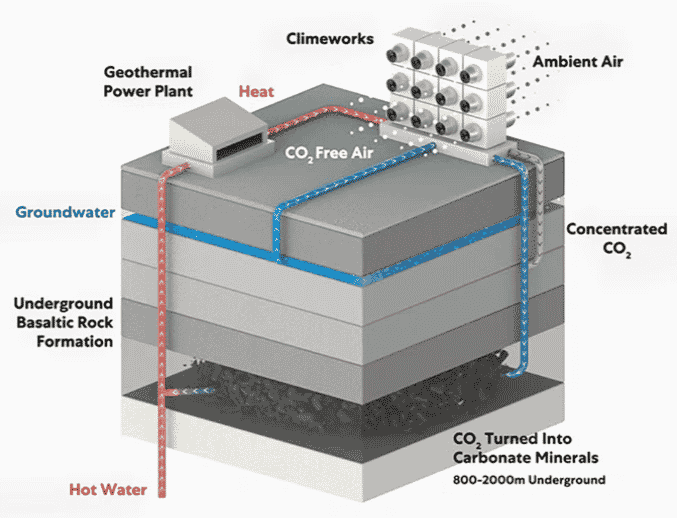 Heirloom’s DAC tech employs the natural carbon mineralization process, speeding it up from millions of years to just days. The company is using a powder from crushed limestone, and mixes it with water to act like a sponge that absorbs CO2 quickly.
Climeworks said its DAC hub construction will start as soon as possible, depending on several factors. They target to begin capturing in 2025 or 2026.
Both versions of DAC technology have been tested and are considered mature, but still need scaling up to lower costs.
Oxy DAC Facility
Occidental will build the other DAC plant in Texas. The facility will use Carbon Engineering’s (CE) DAC technology which also uses fans powered by solar energy to draw in air.
The liquid sorbents suck in carbon that will be heated to get pure CO2 that would be injected underground or used in making valuable products. The image shows how CE’s direct air capture technology works.
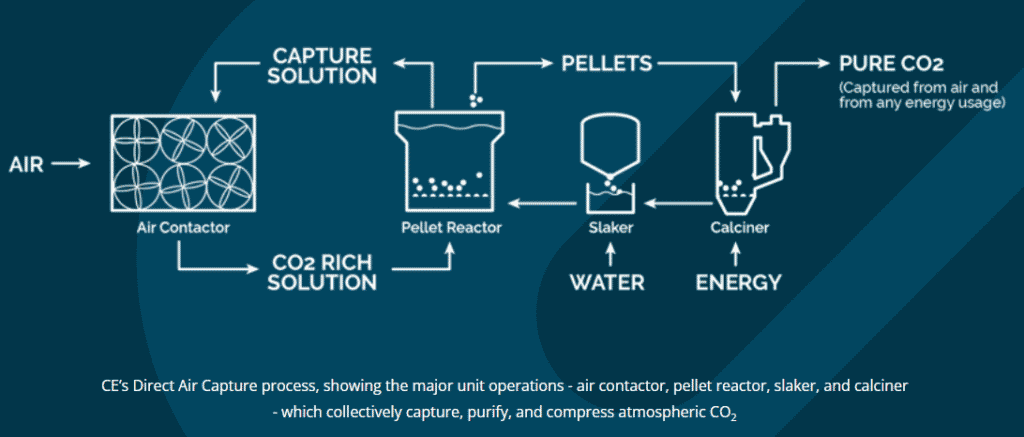 Oxy’s DAC plant can also remove 1 million tons of CO2, which can scale up to 30 million tons yearly. This project represents one of the world’s biggest experiments in DAC.
Will DAC Help Take Us to 1.5°C?
Private sector efforts and government support are ramping up to advance carbon removal solutions and DAC gets the most attention.
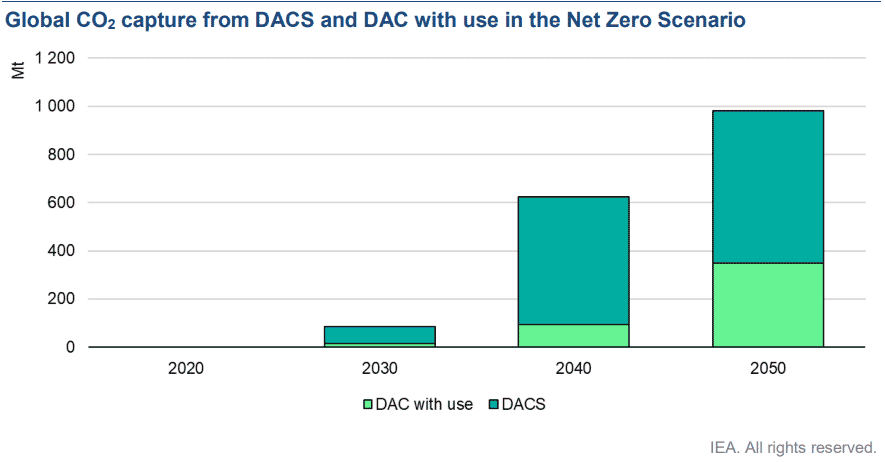 According to the International Energy Agency, 130 DAC plants are under development globally. But they’re all small-scale, with a total carbon removal capacity of just 11,000 tons a year. That’s far way down below what’s required – 1 billion tons or 1 gigaton of CO2 annually by 2030.
Critics of this carbon removal technology argue that spending public money on DAC is a waste. They claim that the process consumes so much energy and is one of the most expensive methods of carbon sequestration. Skeptics further say that DAC won’t get us anywhere because of the difficulty in scaling up this technology.
However, DAC proponents counter that without carbon removal like DAC, it would be impossible to achieve the global climate goal. Some say it serves as a “backstop technology” over limitations of natural carbon removal solutions, e.g. land availability.
Other supporters claim that DAC plants need a smaller land area, easier to calculate the amount of carbon captured, and tend to sequester CO2 permanently.
Amid the debate, other countries are also taking major turns to advance direct air capture and other carbon removal technologies. The EU, UK, and Canada have also recently announced funding support for the technology.
As temperatures rise and climate disasters get worse, a wider consensus emerges that technologies sucking carbon from the air will be key to curbing global warming.