


Bursa Carbon Exchange (BCX), a 100% owned subsidiary of Bursa Malaysia, debuted the Malaysian carbon credits auction on July 25. It is BCX’s first offering of Malaysia Nature-based Carbon Credits Plus (MNC+) from its Kuamut Rainforest Conservation Project. This is indeed a huge achievement for Malaysia as it features domestic carbon credits.
Bursa Malaysia Drives Carbon Credits Market with Kuamut Project
Bursa Malaysia is proactive in engaging with stakeholders, carbon experts, and local developers to boost the carbon credit market in Malaysia.
- Notably, in March 2024, the Kuamut project achieved its first Verified Carbon Units (VCUs) under Verra’s Verified Carbon Standard (VCS), cutting annual emissions nearly by 800,000 tCO2e.
It also provides significant climate, community, and biodiversity benefits, earning Gold Level status for Climate under the Climate, Community, and Biodiversity (CCB) Standards. Furthermore, it has accolades from BeZero Carbon for being one of the most advanced forest management projects.
Leading news agencies revealed that units and organizations committed to reducing their environmental impact had joined the auction. Essentially, they focused on offsetting tough GHG emissions through carbon credits. The auction for the forest protection and regeneration project was cleared at RM50 per contract.
Bursa Malaysia CEO Datuk Muhamad Umar Swift has emphasized,
“It has been a long wait for Malaysia to finally witness the auction of the country’s first domestically produced quality carbon credits. A critical step to accelerate the development of domestic carbon projects is to adopt some form of compliance carbon market.”
He has critically assessed the situation, pointing out that the voluntary renewable energy certificates (RECs) market took five years to expand. Given the complexities of implementing carbon projects, especially nature-based ones, he believes Malaysia’s voluntary carbon market will need ongoing improvements to reach its full potential.
Kuamut Project: The Ultimate Carbon Sink
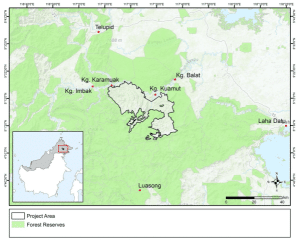
Earlier in May, Bursa Malaysia released a press statement glorifying the geography, ecology, and biodiversity of the Kuamut Project. Located in Sabah’s Tongod and Kinabatangan districts of Malaysian Borneo, it protects and preserves 83,381 hectares of tropical forest.
It is a public-private partnership between the Sabah Forestry Department, Rakyat Berjaya Sdn Bhd, Yayasan Sabah, and Permian Malaysia. Describing further, the project also receives operational support from PACOS Trust and the Southeast Asia Rainforest Research Partnership (SEARRP).
The Kuamut Project is hugely significant for the South Asian nation and is handled by Permian Malaysia, the leading environmental & ecological services for businesses headquartered in London. The project addresses the climate crisis by preventing emissions from deforestation and forest degradation. Safeguarding the forest ensures that carbon remains stored in the biomass. Moreover, as the forest regenerates, it will strengthen its function as a carbon sink.
Bursa Malaysia through this conservation project also aims to improve the livelihood of the locals by creating ample sustainable economic opportunities. They are equally responsible for preserving the rich biodiversity, flora and fauna of the forest.
Image: The Kuamut Forest Conservation Project
 source: Permian Global
Permian Global: In a Mission to Secure Tropical Forests
Permian Global operates across Brazil, Colombia, Indonesia, Malaysia, and Peru. It uses private-sector carbon finance to protect, and regenerate threatened tropical forests. The company halts deforestation, prevents species loss, and empowers local communities through large-scale projects in collaboration with locals.
By generating verified carbon units, these projects help corporations meet their climate goals. They believe that protecting forests keeps biomass carbon locked in vegetation, thereby mitigating climate change. Furthermore, local involvement ensures sustainable economic alternatives are carried out in those specific regions.
Most importantly, tropical forests, rich in biodiversity, benefit from these projects, which also include species research and monitoring.
Stephen Rumsey, founder and Chairman of Permian Global said,
“We are incredibly grateful to Bursa Malaysia for their vision and leadership in developing the Carbon Exchange and especially for their support of the Kuamut Project.”
He further added,
“Climate action requires system-wide transformation. This means the rapid development of high-integrity, high-impact actions on the ground, like the Kuamut Project, but it also means building the financial infrastructure that drives investment in these vital activities. BCX is an enormously important piece in the climate puzzle.”
Last year, BCX auctioned credits from the Linshu Biogas Project in China and Cambodia’s Southern Cardamom Project. However, the Southern Cardamom Project faced backlash for lacking free, prior informed consent from the local community, prompting Verra to investigate in June 2023. So, this time Bursa Malaysia does not want any discrepancy in information. It is rather completely focused on sustained improvement in Malaysia’s voluntary carbon market.
All in all, as Malaysia’s carbon market grows, Bursa Malaysia aims to position the country as a prime spot for nature-based carbon projects, attracting local and international investment. Consequently, the successful launch of the Kuamut project is expected to boost funding for forest conservation and community development. We hope these efforts will solidify Malaysia’s role in global sustainability initiatives.