


Uber’s Q2 Earnings Beat Wall Street Expectations
Uber reported impressive second-quarter earnings on Tuesday, surpassing Wall Street estimates and causing the stock to rise about 6% at market open.
The company reported earnings of 47 cents per share, significantly higher than the 31 cents expected by analysts. Uber also posted better-than-expected revenue of $10.7 billion, slightly above the expected $10.57 billion. This represents a 16% increase from the $9.23 billion reported in the same quarter last year.
Uber reported a net income of $1.02 billion for the quarter, which included a $333 million pretax benefit from revaluations of Uber’s equity investments.
When it comes to strategic partnerships, Uber partnered with Instacart, adding a “restaurants” tab to the grocery delivery app, allowing users to order from restaurants with deliveries fulfilled by Uber Eats. Moreover, in July, Uber and Chinese electric vehicle maker BYD announced a collaboration to bring around 100,000 EVs to Uber drivers in Europe and Latin America. The companies also plan to work on future autonomous-capable vehicles for the Uber platform.
While BYD vehicles are not available in the U.S., Uber offers various incentives to encourage drivers to switch to battery-electric vehicles like those from Tesla, instead of using gas-powered cars.
This strong performance and achievements highlight Uber’s efforts to lead in the mobility and delivery sectors while transitioning towards more sustainable transportation solutions, as evidenced by its carbon emission reduction initiatives and net zero goals.
Uber’s Science-Based Net Zero Targets and Environmental Commitments
Uber has committed to ambitious science-based targets to significantly reduce its greenhouse gas (GHG) emissions. The company aims to cut absolute Scope 1 and 2 emissions by 42% by 2030 and by 90% by 2040, using 2021 as the base year.
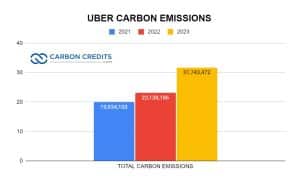
As seen in the chart below, the mobility company’s carbon emissions are jumping to almost 32 million metric tons in 2023.
Additionally, Uber plans to decrease Scope 3 emissions from the use of sold products by 34% per service kilometer by 2030 and by 97% by 2040. These goals align with Uber’s broader objective of achieving net zero emissions across its entire value chain by 2040.
Investments in Zero-Emission Vehicles (ZEVs)
To support its transition to a more sustainable future, Uber is investing $800 million to help drivers switch to zero-emission vehicles (ZEVs). By the end of 2023, the company had allocated or invested over $439 million. This investment aims to ease the financial burden on drivers and accelerate the adoption of ZEVs across Uber’s platform.
Advocacy and Policy Support
Uber recognizes that the challenges of climate change and waste management cannot be tackled by any single entity alone. Thus, the company advocates for policies that support a shared agenda of economic, environmental, and equitable progress.
Historically, the growth of battery EV markets and sustainable packaging solutions has been driven by strong government policies.
- SEE MORE: Is the EV Market’s Momentum Slowing?
Uber’s ambitious targets—achieving a 100% zero-emission platform in the US, Canada, and Europe by 2030, and globally by 2040—reflect its commitment to science-based 1.5 degree–Celsius climate targets.
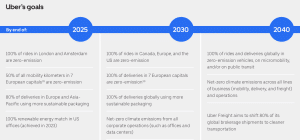
To achieve these goals, Uber supports comprehensive policy frameworks in five critical areas:
- ZEV Supply
- ZEV Incentives
- Battery EV Charging
- Urban Access for Green Vehicles
- Responsible Packaging and Infrastructure
Promoting ZEV Access and Affordability
Uber is working to make ZEVs more accessible and affordable through various partnerships and programs.
For instance, Uber has negotiated exclusive deals with leading companies like Hyundai, Kia, Nissan, Renault, MG, and Tesla. These partnerships aim to bring the upfront cost of an EV closer to that of an internal combustion vehicle.
The mobility company is also working with fleet partners to accelerate the adoption of EVs. In 2023, Uber signed a memorandum of understanding (MoU) with Tata Motors to bring 25,000 EVs to the platform in India by 2025. The company is also expanding its network of fleet partners, including a partnership with Zypp Electric to deploy 10,000 electric two-wheelers by 2024.
Boosting Consumer Access to Sustainable Rides
Uber offers a wide range of green and car-free ride options, providing access to no- and low-emission rides in over 250 metropolitan markets. The use of the following riding platforms (in Latin America) has increased by more than 340% year over year.
- Uber Green: Uber Green is the most widely available on-demand mobility solution for no- or low-emission rides. It is offered at about the same price as UberX.
- Uber Comfort Electric: Uber Comfort Electric allows riders to request a trip in a premium zero-emission vehicle (ZEV), such as a Tesla or Polestar.
- Uber Planet: Uber Planet, pioneered in Latin America, allows riders to offset the carbon footprint of their trips through the app. Riders pay a slight price surcharge on the trip fare to offset their carbon footprint with carbon credits invested in internationally certified projects.
Uber’s expansion of these sustainable ride options aims to enhance consumer access to environmentally friendly transportation choices and reduce carbon emissions globally.
Relying on High-Quality Carbon Offsets
While Uber aims to achieve net zero emissions by 2040 with minimal reliance on carbon offsets, the company recognizes that strategic use of high-quality offsets may be necessary for hard-to-abate emissions. Uber’s approach to carbon offsets focuses on:
Scope 1 & 2 Emissions
Offsets are used where emissions are currently difficult or impossible to eliminate, such as in power generation and natural gas use. The company prefers alternatives like virtual power purchase agreements or 100% renewable power when available and affordable.
Consumer Scope 3 Emissions
Carbon offsets address emissions in markets lacking viable low-carbon solutions, including parts of Africa, Central and Eastern Europe, India, Latin America, the Middle East, and South Asia. This also applies to businesses like Uber Freight or Uber CarShare, where emissions are embedded rather than usage-based.
Uber’s strong Q2 performance, combined with substantial investments in zero-emission vehicles, underscores the company’s commitment to leading the mobility sector while pursuing carbon emission reduction goals. As the company continues to enhance its sustainable ride options and advocate for supportive policies, it can significantly help drive the transition towards a greener future.