


President Donald Trump has signed an executive order to ramp up U.S. production of critical minerals. The order uses emergency powers under the Defense Production Act to increase financing, streamline permits, and encourage domestic mining and processing of minerals vital for national security and economic growth.
The goal is to cut down on dependence on foreign suppliers, especially China. China leads the global supply chain for key minerals. The order has raised worries about its effect on the environment and how it matches climate goals.
What Are The Key Aspects of the Executive Order?
-
Defense Production Act for Critical Minerals
The executive order authorizes the use of the Defense Production Act (DPA) to provide financial support to U.S. mining and mineral processing projects. This includes loans and investments from the U.S. International Development Finance Corporation (DFC) and the Department of Defense. The goal is to speed up the production of key minerals. This includes lithium, cobalt, nickel, rare earth elements, and maybe coal.
-
Faster Permitting for Mining Projects
Trump’s order directs federal agencies to speed up the permitting process for new mining and processing facilities. The Department of the Interior has been tasked with prioritizing critical mineral production on federal lands. The administration wants to cut red tape. This will help private companies invest more in domestic mineral production.
-
Expanding the Scope of Critical Minerals
The order lets the National Energy Dominance Council add uranium, copper, potash, and gold to the list of critical minerals. Additionally, there is speculation that coal could be included. This can potentially lead to increased production of fossil fuels under the guise of national security.
Why Is the U.S. Expanding Mineral Production?
The U.S. gets 70% of its rare earth minerals from China. This makes the supply chain weak for important industries like defense, electronics, and renewable energy. China has also imposed export controls on key materials like gallium and germanium. This further increases the urgency for the U.S. to secure its own resources.
Critical minerals are key for military use, particularly antimony. They support missile systems, fighter jets, and advanced communications technology. By expanding domestic production, the U.S. aims to strengthen its defense capabilities and reduce the risk of supply chain disruptions.
Lastly, lithium, cobalt, and nickel are crucial for battery storage, electric vehicles (EVs), and renewable energy infrastructure. Boosting local production of these materials can speed up the clean energy shift and cut down on fossil fuel use.
Global Market Trends and U.S. Critical Mineral Production and Consumption
The global demand for critical minerals has been on the rise, driven by the transition to clean energy technologies. In 2023, lithium demand surged by 30%, while nickel, cobalt, graphite, and rare earth elements also saw significant increases.
Investment in critical mineral mining grew by 10% in 2023; however, this was a slowdown compared to the 30% growth observed in 2022. This is partly due to declining prices putting pressure on producers.

The United States has significant mineral resources but remains heavily dependent on imports for many critical minerals. According to the U.S. Geological Survey’s 2024 Mineral Commodity Summaries, the U.S. was 100% import-dependent for 15 nonfuel mineral commodities and over 50% import-dependent for 49 such commodities.
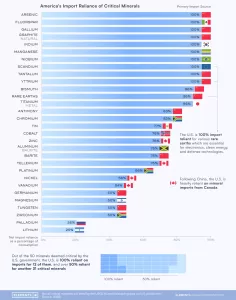
For instance, aluminum consumption in 2024 reached 4.3 million metric tons, underscoring the nation’s reliance on external sources. For other minerals, refer to the following table for US 2023 consumption and production per USGS report.

Trump’s recent executive order targets several critical minerals, including:
- Rare Earth Elements (REEs): Essential for electronics, defense systems, and renewable energy technologies.
- Lithium: Vital for battery production in electric vehicles and energy storage systems.
- Nickel: Used in stainless steel and battery manufacturing.
- Cobalt: Important for battery electrodes.
- Graphite: Used in batteries and fuel cells.
Economic, Environmental, and Climate Implications
The EO has a significant impact on mining companies. Shares of U.S. mining companies surged following the announcement.
MP Materials, a rare earth miner, saw its stock rise by 4.6%, while coal producer Peabody Energy gained more than 2%. However, Australian and Chinese mining companies experienced stock declines, reflecting concerns over reduced demand for imported minerals.
The decision also has the potential to spur international trade conflicts. China and other major mineral-exporting nations may view this policy shift as a direct threat to their economic interests. This could lead to trade tensions and potential retaliatory measures, further complicating global supply chains.
Environmental Concerns and Climate Impacts
Mining and processing critical minerals contribute about 8% of global carbon emissions. Copper production emits 4.6 tonnes of CO₂ per tonne, while nickel ranges between 12 and 78 tonnes per tonne. However, these emissions do not negate clean energy benefits—EVs still produce half the lifecycle emissions of gasoline cars. Using low-carbon electricity can further lower these emissions.
Coal’s potential inclusion as a critical mineral raises concerns. Fossil fuels from federal lands accounted for nearly 25% of U.S. CO₂ emissions over a decade. Expanding mining on public lands risks habitat destruction and toxic contamination, with 22,500 abandoned mine sites already leaking harmful chemicals.
Securing critical minerals is key for national security and clean energy. Yet, experts also stress the need for sustainable practices. This includes recycling, improved mining tech, and carbon-cutting ideas. For example, using CO₂ to weaken rocks could make mining carbon-negative.
The Biden administration used the Defense Production Act before. This was to boost the production of battery materials in the U.S. The goal is to cut emissions and support renewable energy. In contrast, Trump’s order may list coal and other fossil fuels as critical minerals. This could slow down efforts for net-zero emissions and hurt global climate leadership.
Expanding fossil fuel extraction on federal lands may worsen climate change, undermining progress toward emission reduction targets.
Conclusion: A Double-Edged Sword?
Trump’s executive order to boost critical mineral production is a significant policy shift that aims to reduce dependence on foreign sources, enhance national security, and support key industries. However, the inclusion of coal and the potential rollback of environmental safeguards raises concerns about its impact on climate goals.
As the U.S. moves forward with this strategy, it must find a balance between securing essential minerals and ensuring sustainable, environmentally responsible development. The outcome of this policy will shape not only the country’s economic future but also its role in global efforts to combat climate change.