


Rio Tinto has announced it will purchase carbon credits from a newly launched Australian platform, marking a major step in its decarbonization journey. The initiative shows how big companies are using high-integrity carbon markets in their sustainability plans. At the same time, the deal highlights how Australia is positioning itself as a leader in nature-based carbon solutions.
A New Platform for Scalable Carbon Offsets
Meldora, the new platform, just launched with $250 million in funding. This investment comes from the Clean Energy Finance Corporation (CEFC) and Canada’s La Caisse de dépôt et placement du Québec (CDPQ).
The platform will produce Australian Carbon Credit Units (ACCUs) by investing in sustainable agriculture and reforestation projects on a large scale.
Meldora has acquired 15,000 hectares of farmland in Central Queensland. This land will be the starting point for its operations. The land will support productive farming and “Environmental Plantings.” Here, native trees and plants will be grown and cared for over many years. This dual-use model combines farming with carbon sequestration, creating reliable long-term credits.
Heechung Sung, CEFC’s head of natural capital, remarked:
“It’s a great privilege to again be able to work with La Caisse and GAP to invest in this strategy and alongside Rio Tinto, who have demonstrated with their long-term offtake, a commitment to invest in high-integrity carbon credits.”
Rio Tinto is now the first long-term buyer of carbon credits from Meldora. This gives the Australian mining giant a steady supply of carbon offsets. It also shows their commitment to real, science-based climate solutions.
How Meldora Works: The Power of Soil Carbon Sequestration
Soils hold remarkable potential as a natural climate solution. According to the Food and Agriculture Organization, well-managed soils could sequester up to 2.05 gigatons of CO₂ per year. That’s equal to about 34% of the total greenhouse gas emissions from agriculture. Another study estimates that improved cropland practices could remove 0.44 to 0.68 Pg of carbon annually, or roughly 1.6 to 2.5 gigatons of CO₂.
Meldora’s approach centers on integrating agriculture with reforestation. Farmers use their land for food, but they also restore some areas with native trees and plants. These help capture and store carbon dioxide.
The program follows strict rules:
- Trees are maintained for 25 to 100 years, ensuring permanent carbon storage.
- Projects generate ACCUs, the official credits recognized under Australia’s carbon market.
- Native biodiversity is protected, which improves soil health and water retention on farmland.
The CEFC has committed $50 million to the platform, while CDPQ provided the remaining $200 million. They aim to expand projects across Australia. Their goal is to provide credits that meet the rising demand from companies needing high-quality offsets.
This model also addresses a common challenge in carbon markets: the need to balance credibility with scalability. Meldora aims to combine farming and forestry. This way, carbon projects can be practical for landowners and reliable for buyers like Rio Tinto.
Rio Tinto’s Climate Strategy
Rio Tinto has set bold decarbonization goals using operational changes and carbon offsets to achieve them. The company aims to reduce its Scope 1 and Scope 2 emissions by 50% by 2030 and achieve net zero by 2050.


- Investing in renewable energy to power its mining operations, such as solar and wind projects in Australia.
- Partnering with technology developers to explore low-carbon steelmaking.
- Purchasing high-quality carbon offsets is necessary when direct emissions reductions are not yet possible.
Rio Tinto is a key investor in the Silva Fund, which backs nature-based carbon projects. It also owns a 14.15% stake in AiCarbon, an Australian carbon farming company. These investments show how the company is building a portfolio of long-term carbon solutions.
By buying credits from Meldora, Rio Tinto boosts its supply of reliable offsets. Global demand for these credits is rising, but supply is still low.
Integrity First: The Value of Verified Carbon Credits
One of the biggest challenges in carbon markets is the issue of integrity. Many credits on the voluntary market have faced criticism for overstating their environmental benefits. Rio Tinto’s CEO has publicly noted that up to 80% of credits reviewed in the U.S. did not meet the company’s internal standards.
Meldora wants to tackle these issues. They ensure projects are checked by independent parties. This way, they aim for lasting environmental benefits. Under Australia’s carbon market rules, ACCUs must meet strict standards and are subject to government oversight.
For Rio Tinto, the assurance of high-integrity carbon credits is key. As pressure mounts from regulators, investors, and the public, companies need offsets. These should balance emissions on paper and provide real benefits for the climate and local communities.
Australia’s Carbon Market Moment
Australia ranks among the top global issuers of carbon credits. Initiatives like Meldora will likely boost this standing. The country has a unique advantage in nature-based carbon projects. Its vast land resources allow for a mix of environmental restoration and agricultural productivity.
The Australian government is tightening climate rules. Under the Safeguard Mechanism, large emitters must cut their emissions every year. For many companies, purchasing ACCUs is one of the most practical ways to comply with these regulations.
Per S&P Global analysis, Australia’s carbon credit demand will surpass issuances in 2028, as seen in the chart.
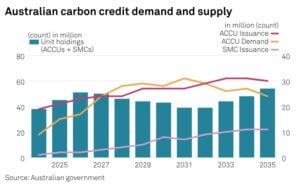
Platforms like Meldora could therefore play a dual role: supporting corporate net zero strategies and helping Australia meet its national climate targets.
Outlook: Scaling Nature-Based Climate Solutions
The Rio Tinto–Meldora agreement shows how companies are shifting to long-term carbon solutions. They are focusing more on scalability instead of just quick offsets. This change shows a bigger trend in corporate climate action. Nature-based projects are now valued more for their lasting impact and benefits to communities.
For Rio Tinto, the deal ensures access to a reliable stream of credits as it works toward its 2030 and 2050 goals. For Australia, it shows how it can use its land and farming resources to help the world move toward net zero.
By supporting projects that merge agriculture with long-term forest restoration, Rio Tinto is helping to advance a model that could benefit businesses, landowners, and the environment. As Australia grows its carbon credit market, platforms like Meldora could be key. They help connect corporate demand with the urgent need for real, verifiable climate solutions.