


Alphabet, the parent company of Google, has entered a new phase in its market journey. In September 2025, the company’s stock surged past a $3 trillion market capitalization, placing it in the same tier as Apple and Microsoft.
Google’s stock rise is not just about financial momentum. The company has gained from positive regulatory decisions, excitement about artificial intelligence (AI), and steady growth in its main advertising and cloud areas.
At the same time, the company continues to face scrutiny over its environmental impact as it expands its infrastructure to power AI applications. Google balances financial performance with net-zero goals. This focus makes it a key player in the ESG space.
Market Drivers Behind Alphabet’s Growth
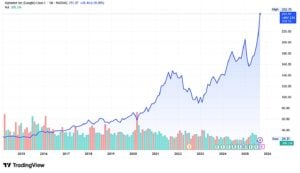
Google’s stock trades at about $251.97, up roughly about 4.5% in the latest session. The rally has lifted its market capitalization above $3 trillion for the first time.
With Monday’s rise, the company’s stock is now up more than 32% this year, making it the strongest performer among the “Magnificent 7” tech giants. It is also well ahead of the 12.5% gain of the S&P 500 (SPX).
Several recent events have shaped investor sentiment around Alphabet. The biggest news came from a U.S. federal court in early September. The court decided that Google would not be broken up. This was despite earlier findings that the tech giant had monopoly power in search and advertising.
The court blocked some of Google’s exclusive contracts but allowed the company to retain control over Android and Chrome. This outcome removed a cloud of uncertainty that had hung over the company for years, giving investors more clarity on its future.
Alphabet’s core businesses are also performing strongly. Advertising revenue continues to grow as YouTube, Search, and other platforms expand their reach. Meanwhile, Google Cloud has become a growth engine, attracting customers seeking to build AI and digital services.
Gemini, the company’s AI platform, is now part of more products. This move boosts its competitive edge. Analysts are raising their price targets. Some expect Alphabet shares to hit $280 in the next year.
Crossing the $3 trillion market capitalization threshold has also provided momentum. These milestones carry symbolic weight, signaling market confidence in Alphabet’s ability to deliver growth at scale.
For investors, it’s not just about company size. It’s also about the sectors they lead, like search, advertising, cloud computing, and now AI.
Governance Gets a Makeover
Google’s governance practices have come under intense scrutiny over the years, particularly in relation to antitrust cases. In mid-2025, the company agreed to spend $500 million over the next decade to revamp its compliance structure. This settlement led to the formation of a special board committee for risk and compliance. This shows how important regulatory oversight is for Alphabet’s operations.
These measures boost the “G” in ESG. They ease worries that Alphabet may lag in corporate accountability. Investors usually overlook companies with high governance risk.
By tackling these issues head-on, Google has become more appealing to long-term institutional investors. The company wants to improve governance. This shows it knows how important it is to link business performance with responsible practices.
Not only that, but the company is also concerned about its growing carbon footprint.
Chasing Carbon-Free Days: Alphabet’s Net Zero Goals and Clean Energy Push
Google has set some of the most ambitious environmental targets in the technology sector. It aims to reach net-zero emissions across its operations and value chain by 2030.
A key part of this goal is running all operations on 24/7 carbon-free energy (CFE) in every region where the company operates. This means matching every unit of electricity consumed with clean energy sources, rather than relying on offsets alone.
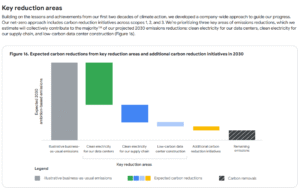
The company has made progress. In 2024, Google signed power agreements totaling 8 gigawatts of new clean energy, and it brought around 2.5 gigawatts of capacity online. Its data centers power AI and cloud services. They’ve become more efficient, cutting emissions intensity by about 12% each year.
At the supply chain level, Google has asked major hardware suppliers to commit to 100% renewable energy by 2029. These steps show how the company is adding sustainability to its operations and partnerships.
The AI Energy Dilemma
Despite these achievements, Google faces serious challenges. Total emissions have jumped about 51% since 2019. This rise comes mainly from Scope 3 emissions in the supply chain and the growing energy needs of AI.
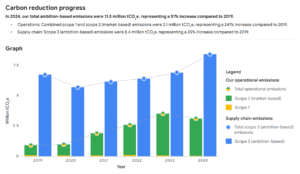
Even though data center efficiency has gotten better, total energy use keeps rising. This is because AI applications need more computing power. This raises questions about whether Google can truly meet its net-zero goals. It may need more drastic changes in technology or energy sources.
The regional nature of electricity grids also complicates Google’s clean energy ambitions. In North America and parts of Europe, the company has made significant progress toward 24/7 carbon-free energy.
However, in Asia-Pacific markets, where grids rely more heavily on fossil fuels, progress has been slower. Alphabet knows that reaching its global goal needs changes that it can’t control. This includes faster permits for renewable projects and regulatory reforms.
Scope 3 emissions remain the hardest to tackle. These include emissions from suppliers, manufacturing, logistics, and product use. In 2024, these rose ~22% year-over-year, and account for about 73% of Google’s “ambition-based” total carbon footprint. Thua, the company is urging its partners to use renewable energy to lower this emission source.
Overall, here are the company’s efforts in tackling its environmental footprint:
-
Cut its data center energy emissions by 12% in 2024, even though electricity demand rose sharply.
-
Added 2.5 gigawatts of new clean energy capacity in 2024 via over 25 projects that came online, helping to expand its clean energy procurement.
-
In 2024, signed contracts for 8 GW of clean energy — its largest single-year clean energy procurement so far.
-
Google’s AI hardware efficiency improved: its new TPU “Ironwood” chip is nearly 30× more power efficient than its 2018 Cloud TPU.
-
Some of its products (e.g. Nest thermostats, Solar API, fuel-efficient routing in Maps, etc.) enabled users, cities, and partners to avoid an estimated 26 million metric tons of CO₂ equivalent in 2024.
-
Water usage rose, but so did conservation/replenishment: Google replenished 4.5 billion gallons of freshwater in 2024. This increased the replenishment rate from 18% to 64% of its freshwater consumption.
Investor Outlook: Balancing Growth and ESG Risk
Google’s strong stock and market performance show that investors think the company can lead in AI, search, and cloud services. Recent court rulings offer clear regulations. This lowers one of the biggest uncertainties for the company.
However, ESG considerations add complexity to the investment case. The same AI boom driving Alphabet’s growth is also responsible for its rising energy use and emissions. This duality highlights the tension between innovation and sustainability.
Investors will watch closely for progress on several fronts:
- Evidence that Google can expand clean energy procurement fast enough to match AI-driven energy growth.
- Clearer reductions in Scope 3 emissions, especially within its hardware supply chain.
- Continued improvements in governance, ensuring that compliance measures reduce future legal and regulatory risks.
Google’s ability to balance these factors will determine not only its ESG ratings but also its long-term market performance. The company’s future lies in proving that innovation and sustainability can advance together. Whether Google can meet its 2030 net-zero target will be one of the defining questions for both the company and the broader technology sector.