

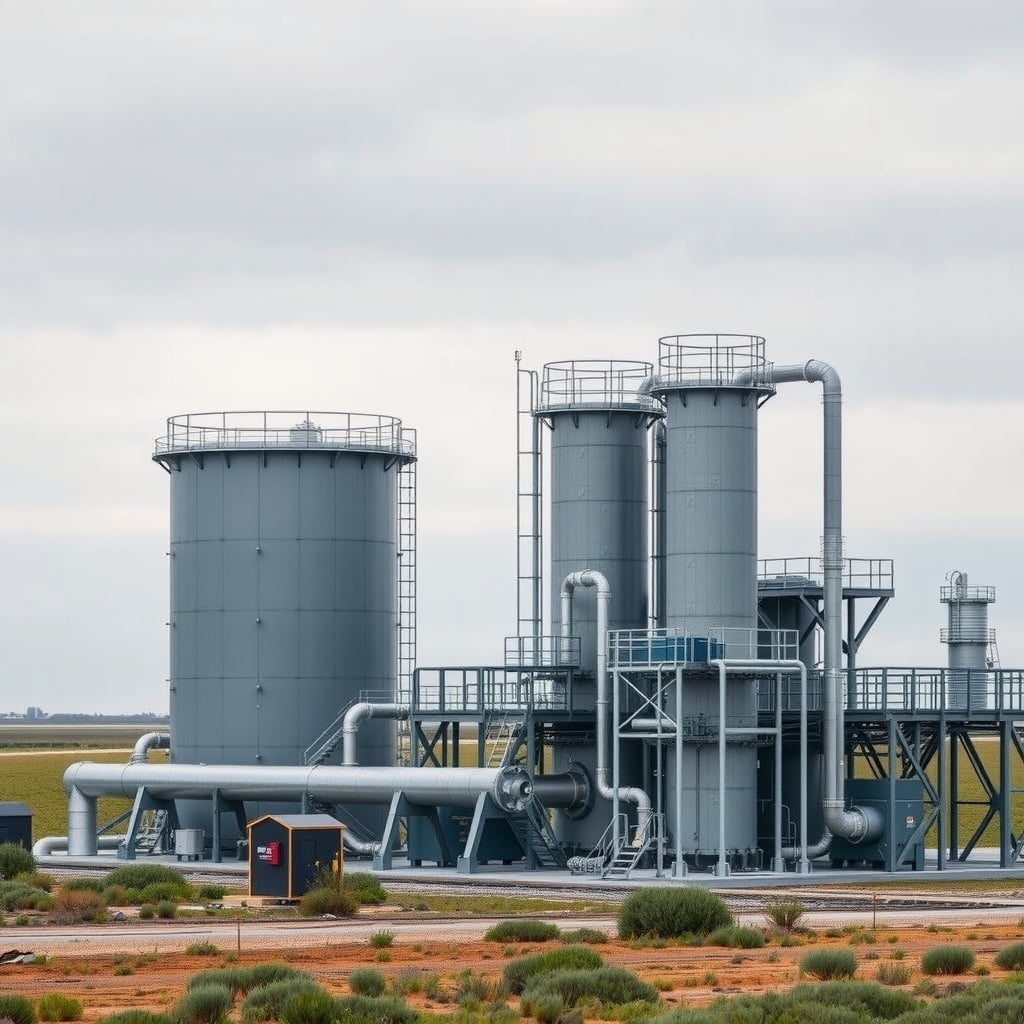
On April 18th, Reuters reported that the U.S. direct air capture (DAC) sector received a major boost after the Department of Energy (DOE) decided to retain funding for two flagship carbon removal hubs originally backed under the Biden administration.
The move removes months of uncertainty and protects more than $1 billion in federal support for the South Texas DAC Hub and Louisiana’s Project Cypress. The decision also reinforces that carbon removal remains part of the United States’ long-term climate and industrial strategy, even as policy priorities evolve.
From Funding Risk to Revival: DOE Keeps Landmark Direct Air Capture Hubs Moving Forward
The Department of Energy had previously placed several clean energy awards under review, including major carbon capture, hydrogen, and industrial decarbonization projects. Among the most closely watched were the two large DAC hubs in Texas and Louisiana, both of which risked losing federal backing.
- South Texas DAC Hub, developed with Occidental’s carbon management arm 1PointFive, holds a $500 million federal award.
- Project Cypress in Louisiana received $550 million in support.
Although both projects were awarded significant funding, only an initial $50 million tranche had been disbursed so far, leaving most capital still pending deployment.
Once fully operational, both facilities are expected to remove more than 2 million metric tons of CO₂ annually from the atmosphere. That scale places them among the most ambitious carbon removal projects globally and positions the United States as a leader in early DAC commercialization.
Energy Secretary Chris Wright noted that the agency retained projects with credible delivery pathways following extensive review discussions with applicants. The DOE’s Hydrocarbons Geothermal and Energy Office will now help guide next steps, including fund disbursement and project execution.
U.S. Direct Air Capture Market Gains Policy and Investment Support
The funding confirmation strengthens confidence across the growing U.S. DAC ecosystem, which depends heavily on long-term policy signals and federal incentives.
The country already leads global carbon removal development, supported by programs such as the $3.5 billion DAC Hubs initiative and the Section 45Q tax credit, which can provide up to $180 per ton for permanent carbon storage under current structures.
In parallel, corporate demand for high-quality carbon removals continues to expand. Technology firms, airlines, and industrial players are signing long-term agreements to secure carbon removal supply, reflecting a shift from low-cost avoidance credits toward durable carbon storage solutions.
- ALSO READ:
- Bain & Company Inks First Direct Air Capture Carbon Removal Deal With Oxy’s 1PointFive
- Maritime Decarbonization: Japanese Shipping Giant NYK Partners with 1PointFive for DAC Credits
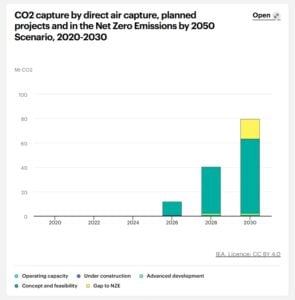
According to the International Energy Agency (IEA), more than 130 large-scale DAC facilities are now in development globally, with the United States holding a significant share of planned capacity. This pipeline highlights growing commercial interest even as the technology remains in its early deployment phase.
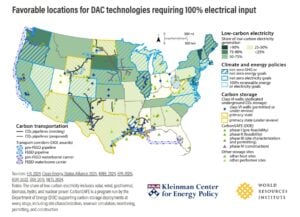
At the same time, regional DAC clusters are beginning to take shape. West Texas, for example, has emerged as a leading hub due to its combination of renewable energy access, subsurface storage potential, and industrial infrastructure. Projects like STRATOS, targeting 500,000 tons of annual CO₂ capture, illustrate how scaling could evolve through concentrated deployment.
DAC Cost Challenges and Fuel Market Link Drive Long-Term Outlook
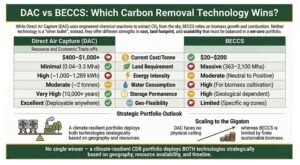
Despite strong policy backing, cost remains the most significant barrier for direct air capture expansion. Current estimates place DAC costs between $500 and $1,000 per ton of CO₂ removed, depending on technology type, energy sourcing, and storage logistics. While costs are expected to decline with scale and innovation, near-term economics remain challenging.
From Carbon Credits to SAF, DAC’s Business Case Is Getting Stronger
However, the value proposition is expanding beyond carbon credits. Captured CO₂ is increasingly viewed as a potential feedstock for synthetic fuels, including sustainable aviation fuel (SAF). This integration could improve project economics while also supporting fuel supply diversification.
Recent geopolitical tensions affecting global oil markets have added further urgency to alternative fuel development. In this context, DAC-linked synthetic fuel production could play a dual role by reducing emissions while supporting energy security.
Texas and Louisiana Lead the Transition
Texas and Louisiana are particularly well-positioned for this transition. Both states offer strong industrial infrastructure, access to geologic storage formations, and proximity to energy and chemical industries. Texas also benefits from expanding renewable energy capacity, which is important for powering energy-intensive DAC systems.
Even so, scaling from today’s million-ton projects to gigaton-scale removal pathways will require sustained investment, policy support, and continued technological improvements. Some research suggests that large-scale DAC deployment may still require carbon prices or subsidies above $200 per ton for economic viability in the early phases.