

The European Union is looking south for its next major clean energy opportunity. The European Commission (EC) has launched the Trans-Mediterranean Renewable Energy and Clean Tech Cooperation Initiative, known as T-MED. The program plans to gather up to €25 billion in investment by 2035. This funding will boost renewable energy, clean tech manufacturing, hydrogen projects, and electricity infrastructure in the Mediterranean region.
The initiative comes at a critical time for Europe. The bloc is working to cut emissions, strengthen energy security, and reduce dependence on imported fossil fuels.
Many countries along the southern Mediterranean have some of the best solar and wind resources in the world. However, these resources are still mostly underdeveloped. Brussels aims to link European capital with Mediterranean renewable energy. This new clean energy corridor will benefit both regions.
The Mediterranean: Europe’s Untapped Clean Energy Goldmine
The Mediterranean has some of the most attractive renewable energy resources in the world.
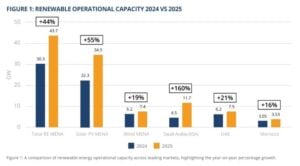
According to European Commission-backed assessments, the region’s technical solar and wind potential exceeds 2,300 gigawatts (GW). That is more than twice the European Union’s current installed electricity generation capacity. Yet, much of this potential remains untapped.
In several Southern Mediterranean countries, renewable energy still accounts for only 1% to 3% of the energy mix. Meanwhile, the region enjoys some of the world’s highest solar irradiation levels and strong wind resources along coastlines and desert areas.
The economics is also compelling.
Solar and wind power in parts of North Africa and the Southern Mediterranean can be produced at costs that are 30% to 40% lower than in many parts of Europe, per the EC data. Lower land costs, stronger solar resources, and favorable weather conditions all contribute to the advantage.
For Europe, this presents a major opportunity. Expanding partnerships in renewable energy can diversify energy supplies. It also supports the regional economic growth of the region.
What the €25 Billion Initiative Will Deliver
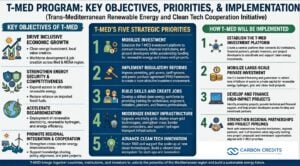
The EU’s T-MED initiative is designed to turn renewable potential into real projects. The European Commission has pledged over €5 billion in guarantees via the European Fund for Sustainable Development Plus (EFSD+).
Officials hope these guarantees will draw in public and private funds. They aim to help gather up to €25 billion in total investment by 2035.
The initiative focuses on several key areas, including:
- Renewable energy generation,
- Clean technology manufacturing,
- Green hydrogen development,
- Modern electricity grids and interconnections, and
- Workforce training and skills development.
By 2035, T-MED aims to support at least 15 GW of new renewable energy capacity across Europe. It also seeks to create more than 100,000 jobs in clean energy sectors and advance energy-sector reforms in partner countries.
The first investment platform will likely start operating later this year. Early clean technology partnerships might kick off as soon as 2027.
Why Energy Security Is Rewriting the Climate Agenda
While climate goals remain important, energy security has become an equally powerful driver. Europe’s energy landscape changed dramatically after the 2021-2023 energy crisis. High fuel prices and supply disruptions exposed the risks of relying heavily on imported fossil fuels.
Since then, the EU has accelerated efforts to diversify energy sources and strengthen domestic clean energy production. T-MED supports that strategy.
European officials say the initiative is not simply about importing renewable electricity. It is also about building stronger energy connections, more resilient supply chains, and new industrial opportunities across the Mediterranean.
The program also aligns with the EU’s broader Clean Industrial Deal. This year, the European Commission suggested using €100 billion in funding to boost clean technology manufacturing and help decarbonize industry in Europe.
Together, these initiatives show how the bloc is increasingly linking climate policy, industrial competitiveness, and energy security.
Can Mediterranean Renewables Power Europe’s Net-Zero Future?
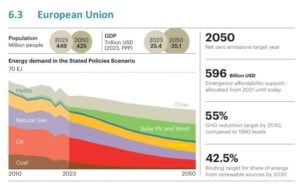
The timing of T-MED is significant. The European Union has legally committed to reducing net greenhouse gas emissions by at least 55% by 2030 compared with 1990 levels. It also aims to reach climate neutrality by 2050.
Meeting those goals will require a massive expansion of clean electricity.
The International Energy Agency says global electricity demand will rise sharply in the next decade. This growth comes as transport, industry, and buildings get more electrified. Renewable energy will need to provide most of that growth.
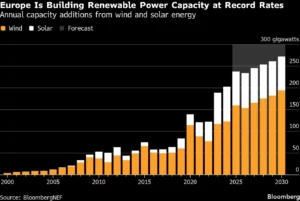
The growth of renewable power in Europe has been growing at record levels, as shown below.
The Mediterranean could play a major role.
Beyond solar and wind power, the region is also emerging as a potential hub for green hydrogen production. Morocco, Egypt, and Tunisia have announced big hydrogen projects. These projects aim to supply local industries and European markets.
At the same time, stronger electricity connections could help renewable power flow better between Europe and its southern neighbors. This would boost grid flexibility and support more renewable energy on both sides of the Mediterranean.
The Investment Barriers Standing in the Way
Despite the opportunity, significant barriers remain. Many investors have been cautious about renewable energy projects in parts of North Africa and the Middle East. Regulatory uncertainty, permitting delays, financing challenges, and infrastructure gaps have often slowed investment.
According to EU estimates, Africa holds roughly 40% of the world’s solar potential but attracted less than 2% of global renewable energy investment in 2024.
T-MED aims to address these challenges through technical assistance, regulatory cooperation, and investment guarantees.
The initiative includes a Regulatory Accelerator designed to help partner countries improve permitting processes, strengthen energy regulations, and attract private capital. EU financial support will also be linked to measurable reform progress.
Whether these measures can unlock large-scale investment remains one of the key questions facing the program.
The Birth of Europe’s New Renewable Energy Corridor
The Mediterranean’s renewable resources have long been recognized. What has been missing is the investment needed to develop them at scale. The EU’s new €25 billion initiative is an attempt to change that.
If successful, T-MED could add 15 GW of new renewable capacity, strengthen regional energy security, and accelerate decarbonization across Europe and the Southern Mediterranean.
The initiative also reflects a broader shift in climate policy. Clean energy is no longer viewed only as an environmental goal. It is increasingly seen as an economic, industrial, and geopolitical priority.
For Europe, unlocking the Mediterranean’s vast solar and wind resources could become one of the most important energy opportunities of the next decade.
The sun and wind are already there. The challenge now is turning that potential into projects, investment, and clean power on a scale that can help meet the region’s climate and energy goals.