


Microsoft is scaling up its climate strategy with two parallel moves: expanding clean energy and buying more carbon removal. Recent agreements with MN8 Energy and Alt Carbon show how the company is combining renewable power and carbon removal to support its long-term net-zero goals.
The approach reflects a wider shift in corporate climate action, where emissions cuts alone are no longer seen as enough.
Microsoft’s Dual Net-Zero Strategy: Reduce Emissions, Then Remove What’s Left
Microsoft has one of the most ambitious climate roadmaps in the corporate world. In 2020, the company set two major goals.
First, it aims to become carbon negative by 2030. This means it plans to remove more carbon than it emits each year. Second, it pledged to remove all historical emissions—both direct and electricity-related—since its founding in 1975 by 2050, according to its sustainability framework.
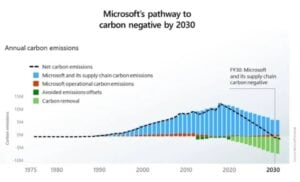
These targets place Microsoft in a small group of companies attempting not just to reduce emissions, but to reverse them over time.
But the challenge has grown more complex. The rapid rise of artificial intelligence (AI) and cloud computing has increased energy demand across Microsoft’s global data center network. This has made both clean electricity and carbon removal more important than ever.
260 MW of New Solar Power Expands Clean Energy Portfolio
Microsoft’s latest renewable energy deal adds 260 megawatts (MW) of solar capacity through MN8 Energy projects in the United States. The portfolio includes:
- 120 MW Long Point Solar in Texas
- 140 MW American Beech Solar in North Carolina
Both projects are now operational and deliver electricity through long-term power purchase agreements. These projects feed into two major U.S. power markets.
Long Point supports the ERCOT Houston load zone in Texas. Meanwhile, American Beech supplies the PJM Interconnection, which serves much of the eastern United States.
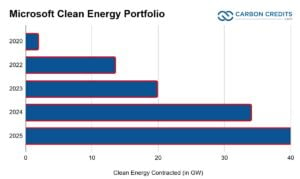
Microsoft already operates one of the largest corporate renewable energy portfolios globally. According to its sustainability reporting, it has 40 gigawatts (GW) of contracted capacity across 26 countries. This scale puts Microsoft among the world’s largest corporate buyers of clean electricity.
Beyond emissions reduction, the projects also support local economies. MN8 Energy reports that each project created hundreds of construction jobs and will generate long-term tax revenue for host communities.
Moe Hanifi, SVP, Head of Revenue and Commodities at MN8 Energy, remarked:
“As digital infrastructure scales across the U.S., energy solutions must scale with it. These projects deliver new capacity to two critical power markets while helping Microsoft achieve their energy goals.”
Clean Energy Alone Is Not Enough for Fast-Growing AI Demand
Microsoft’s renewable energy push is closely tied to the growing electricity needs of digital infrastructure.
Data centers already consume a significant share of global electricity. In the United States, they account for over 4% of total electricity use, according to recent energy studies. This share is expected to rise as AI workloads expand.
Microsoft has reported that its Scope 1 and Scope 2 emissions fell 6.3% from its 2020 baseline, showing progress in direct operational emissions. However, supply chain emissions (Scope 3) remain a major challenge, especially as hardware demand for AI increases.
This creates a structural tension. Even as efficiency improves, overall electricity demand continues to grow. That is why Microsoft is pairing renewable energy procurement with longer-term carbon removal strategies.’
- RELATED: Microsoft and Avangrid Team Up on 140MW Solar Project to Power AI Growth and Net Zero Goals
Carbon Removal Investment Hits 45 Million Tons
Alongside clean energy expansion, Microsoft is one of the world’s largest corporate buyers of carbon removal credits.
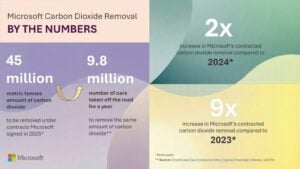
In fiscal year 2023, the company contracted more than 5 million metric tons of carbon removal, with delivery spread over the next 15 years. That amount rose to 800% or 9x more in 2025 to 45 million metric tons.
Its portfolio includes multiple carbon removal approaches:
- Direct air capture,
- Bioenergy with carbon capture,
- Reforestation and afforestation,
- Soil carbon projects, and
- Enhanced rock weathering.
One of its largest agreements includes a purchase of more than 7 million tons of credits from Chestnut Carbon’s U.S. afforestation projects. It also signed a major deal for 2.85 million soil carbon credits with Indigo Ag (Indigo Carbon).
This positions Microsoft as a key early buyer in a still-developing global carbon removal market. The sector remains small today, but it is expanding as companies search for ways to address hard-to-abate emissions.
First Enhanced Rock Weathering Deal Expands Into Asia
Microsoft’s latest agreement with Alt Carbon marks an important geographic and technological expansion. The deal will remove 36,920 metric tons of carbon dioxide using enhanced rock weathering (ERW) in India. This is Microsoft’s first ERW carbon removal project in Asia.
Phil Goodman, Program Director, Carbon Removal at Microsoft, said:
“Our contract with Alt Carbon for high-quality carbon removal uses field deployments to collect primary and secondary quantification methods for carbon quantification, while using a high standard to safeguard against environmental impacts. We are encouraged by Alt’s efforts to build durable carbon removal capacity in India given their past success in delivering carbon credits.”
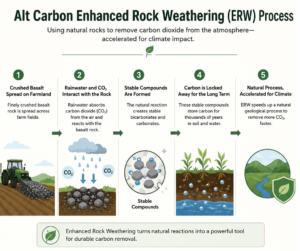
ERW works by spreading crushed basalt rock on farmland. When rainwater and carbon dioxide interact with the rock, they form stable compounds that lock carbon away for long periods. The method is based on natural geological processes but is accelerated for climate use.
The project is part of Alt Carbon’s Darjeeling Revival initiative in West Bengal. It spans more than 80,000 acres of farmland and involves over 35,000 farmers. The agreement also includes an option for Microsoft to scale up purchases if the project meets future delivery and verification standards.
This deal highlights a broader trend: carbon removal supply is increasingly coming from the Global South. Alt Carbon estimates that suppliers in these regions now account for about 26% of carbon removal credit issuance, up from around 2% in 2022.
A “Reduce and Remove” Model Is Emerging Across Corporates
Microsoft’s latest deals reflect a wider shift in corporate climate strategies. Companies are increasingly adopting a dual approach:
- Reduce emissions through renewable energy and efficiency.
- Remove emissions through carbon removal technologies.
This combined model is becoming more common as net-zero deadlines approach across industries. At the same time, investors and regulators are pushing for more transparent emissions reporting. Companies are now expected to show measurable progress, not just long-term commitments.
As a result, climate strategies are becoming more data-driven, more diversified, and more dependent on long-term carbon accounting.
The Road Ahead: Multiple Solutions, One Target
Microsoft’s recent investments underline a key reality of corporate climate action: there is no single solution to net zero.
Solar power helps reduce emissions from electricity use. Carbon removal addresses emissions that cannot yet be avoided. Together, they form a more complete climate strategy.
The company’s 260 MW solar expansion strengthens its clean energy base in fast-growing U.S. power markets. Its 36,920-ton carbon removal deal in India expands its global portfolio of engineered and nature-based solutions.
Taken together, these moves show how large companies are reshaping their climate strategies. Instead of relying on one tool, they are building layered approaches that combine clean energy, new technologies, and carbon removal.
For Microsoft, this is part of its long-term net-zero roadmap. For the wider corporate world, it reflects where climate strategy is heading next.