


The race to scale carbon removal received another major boost. Artificial intelligence (AI) company Anthropic has joined Frontier, a carbon removal advanced market commitment (AMC) coalition that includes Google, Stripe, Shopify, H&M Group, and Salesforce. They announced a new commitment of $915 million for carbon removal credits.
The new funding comes on top of Frontier’s original $1 billion advance market commitment (AMC) launched in 2022, bringing total commitments to $1.8 billion. Frontier says the goal is to accelerate the development of technologies that permanently remove carbon dioxide from the atmosphere.
Why Carbon Removal Is Becoming a Climate Priority
The announcement shows rising corporate support for carbon removal. Governments and scientists now agree that just cutting emissions won’t meet global climate goals.
Most climate strategies focus on reducing emissions. However, many experts now believe that removing carbon dioxide already in the atmosphere will also be necessary.
The Intergovernmental Panel on Climate Change (IPCC) says the world must limit global warming to 1.5°C. This will likely need billions of tons of carbon removal every year by mid-century.
Today, the industry remains small. CDR.fyi reports that 30 million tons of durable carbon removal have been contracted worldwide so far. That is only a tiny fraction of the gigatons that scientists believe may eventually be needed.
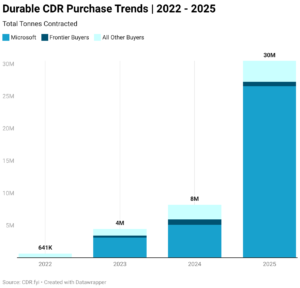
This gap between current supply and future demand explains why Frontier was created. The coalition uses an advance market commitment model. Instead of waiting for technologies to mature, buyers commit money upfront. That demand signal helps startups attract investment, build facilities, and scale production.
The concept has worked before. Similar advance purchase agreements helped accelerate vaccine development and deployment in global health programs.
Inside Frontier’s Plan to Scale Carbon Removal Technologies
Since launching in 2022, Frontier has become one of the most influential buyers in the carbon removal market. Stripe, Alphabet, Shopify, Meta, and McKinsey Sustainability started the group. They committed about $925 million, which later grew to over $1 billion.
Randy Spock, Head of Carbon Credits and Removals at Google, remarked:
“At Google, we believe in the power of science and technology to mitigate planetary warming. Frontier’s mission is a cornerstone of this approach, and we’re excited to expand our support for these critical solutions alongside other leading companies.”
The organization focuses on technologies that can permanently store carbon for hundreds or thousands of years. Frontier has already facilitated agreements with more than 50 carbon removal startups. These projects cover a wide range of approaches, including:
- Direct air capture (DAC),
- Enhanced rock weathering,
- Ocean alkalinity enhancement,
- Bioenergy with carbon capture and storage (BECCS), and
- Carbon mineralization.
The group has funded several record-breaking purchases and has the following progress so far:
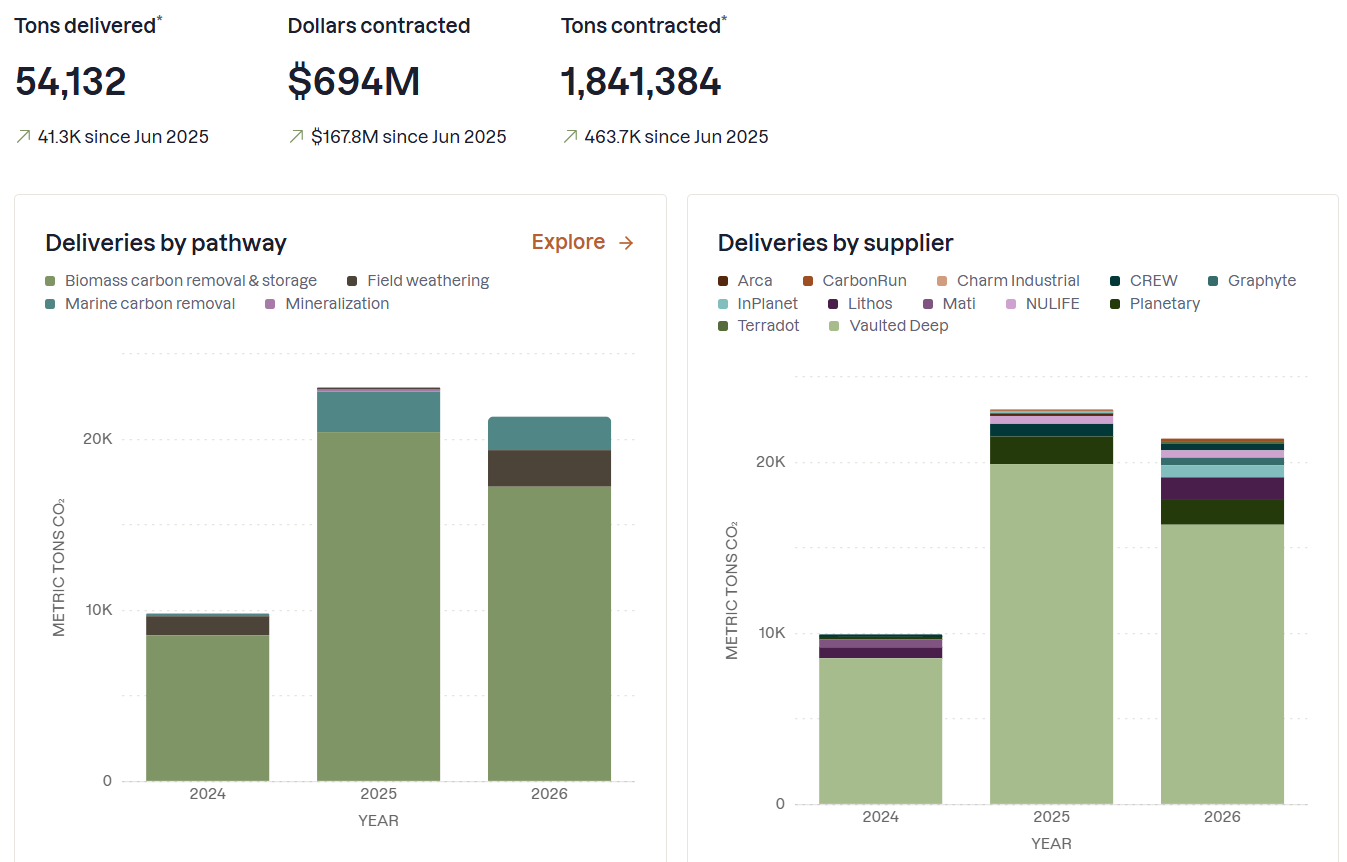
One of the largest deals included 154,240 tons of carbon removal from Lithos Carbon. This was worth $57.1 million, making it one of the largest enhanced-weathering purchases ever. Frontier has also signed multimillion-dollar agreements with direct air capture companies such as Heirloom and CarbonCapture.
The new $915 million commitment will support the best projects as they scale. This comes at a time when venture capital funding for climate tech is becoming more selective.
The AI Boom Creates a New Climate Challenge
Anthropic’s decision to join Frontier comes as AI companies face growing scrutiny over their environmental footprint. AI systems require massive amounts of computing power, which is driving rapid growth in data centers and electricity demand worldwide.
A recent United Nations University (UNU) report found that global data centers used around 448 terawatt-hours (TWh) of electricity in 2025. They also generated about 189 million metric tons of CO₂ emissions. That’s similar to Argentina’s yearly emissions.
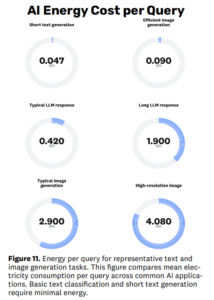
The report predicts that data center electricity use may hit 945 TWh by 2030. This would make the sector one of the biggest power consumers in the world. AI is expected to account for an increasing share of that demand, rising from about 20% of data center energy use today to 40% by 2030.
Anthropic is among the companies expanding AI infrastructure. Earlier this year, it announced plans to secure multiple gigawatts of new computing capacity through partnerships with Google and Broadcom to support future Claude AI models.
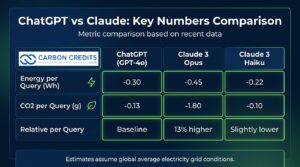
As AI adoption accelerates, many technology companies are finding it harder to meet climate goals. This is one reason carbon removal is gaining attention.
Renewable energy cuts emissions, but carbon removal tackles the leftovers. This is important as AI infrastructure expands.
Corporate Buyers Are Fueling a Carbon Removal Surge
The broader carbon removal market is growing quickly. According to CDR.fdyi data, approximately 49 million carbon removal credits have been sold globally, representing around $12 billion in transactions. While much of that volume consists of early-stage agreements, it shows growing buyer interest in long-term carbon removal solutions.
Corporate demand remains the main driver. Microsoft has emerged as the largest buyer of carbon removal credits worldwide. The company has signed agreements covering millions of tons of future removals across direct air capture, enhanced rock weathering, biochar, forestry, and bioenergy projects.

Other major buyers include Google, Stripe, Shopify, JPMorgan Chase, H&M Group, and Airbus. At the same time, governments are beginning to show greater interest.
The European Union is creating a Carbon Removal Certification Framework. Meanwhile, some countries are looking into policies to support future carbon removal markets.
Industry leaders believe government participation will eventually be necessary to scale removals from today’s levels to billions of tons per year. Frontier executives have repeatedly stated that private-sector purchases alone will not be enough to build the market at the scale required for global climate goals.
Can Carbon Removal Scale Fast Enough?
Despite the momentum, carbon removal still faces major obstacles. Costs remain high for many technologies.
Direct air capture projects often cost hundreds of dollars per ton today, although developers expect costs to decline as facilities scale. Other approaches, such as enhanced weathering and ocean alkalinity enhancement, are still proving their performance at commercial scale.
Measurement and verification also remain important challenges. Buyers increasingly want strong evidence that carbon has been permanently removed and stored. This has led to greater focus on monitoring systems, scientific validation, and transparent reporting standards.
Despite these challenges, experts expect the carbon removal market to grow rapidly. The International Energy Agency says billions of tons of carbon removal may be needed each year by 2050 to help achieve global net-zero goals.
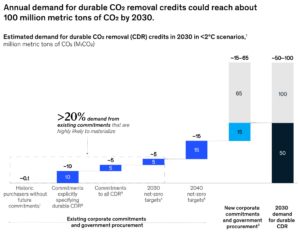
McKinsey estimates that annual demand for carbon removal credits could reach 100 million metric tons by 2030 and 1.5 billion to 2 billion metric tons by mid-century. This creates a market worth as much as $1.2 trillion. These forecasts show both the size of the opportunity and the scale of the challenge facing the industry.
What Anthropic’s Move Means for the Future of Climate Tech
Anthropic’s decision to join Frontier reflects a broader shift taking place across the technology sector. Companies that are helping drive the AI boom are also becoming important buyers of climate solutions.
The new $915 million commitment sends one of the strongest market signals yet that corporate demand for carbon removal continues to grow. It shows growing confidence that durable carbon removal technologies could be key in future climate strategies.
For the climate sector, one message is clear: cutting emissions is the top priority. However, removing carbon from the atmosphere will also likely be critical to achieving global net-zero goals.