


Artificial intelligence is causing a huge rise in computing demand. Today’s AI models already use a lot of electricity. The next generation of AI agents could need 10,000 to 40,000 times more computing power for each task than today’s chatbots, according to a new report from Wood Mackenzie.
This rapid growth is stressing power grids and data centers around the world. As electricity demand increases and suitable land becomes harder to find, some big tech companies are looking beyond Earth. They are exploring orbital data centers powered by constant solar energy in space.
The report explains why this futuristic idea is getting attention. It also points out a major challenge. Building an orbital data center is still much more expensive than one on Earth.
- Currently, an orbital facility costs more than 3X as much as a similar data center on land, making it a long-term opportunity, not a short-term solution.
AI Is Pushing Data Center Power Demand to New Highs
The rapid adoption of AI is reshaping global electricity demand.
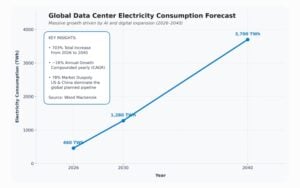
Wood Mackenzie estimates that global data centers will consume about 460 terawatt-hours (TWh) of electricity in 2026—roughly half of Japan’s annual electricity generation.
That figure is expected to rise dramatically:
- 2026: 460 TWh
- 2030: 1,280 TWh
- 2040: 3,700 TWh
- That represents a 703% increase between 2026 and 2040, equal to an annual growth of around 16%. The United States and China dominate this expansion, accounting for nearly 78% of the world’s planned data center pipeline.
However, keeping all of those facilities on Earth is becoming increasingly difficult.
Space Solves Many Problems—Except the Cost
Building large data centers has become far more complicated than it was just a few years ago.
Across the United States, developers often wait up to seven years to secure power grid connections. At the same time, gas turbines face delivery backlogs stretching through 2030, while many regions struggle with limited water supplies needed for cooling systems.
Additionally, construction costs are also higher because of higher labor and material prices. These challenges are encouraging companies to explore alternatives—including orbital data centers powered by uninterrupted solar energy in space.
Unlike terrestrial facilities, orbital data centers would avoid many of today’s infrastructure bottlenecks. They would not compete for land, freshwater, or overloaded electricity grids.
The challenge, however, is economics.
The Massive Price Tag of Orbital Data Centers
Wood Mackenzie estimates that building a hypothetical 1-gigawatt orbital data center would require around US$170 billion in investment.
More than 60% of that cost would come from launching equipment into orbit and building satellite infrastructure.
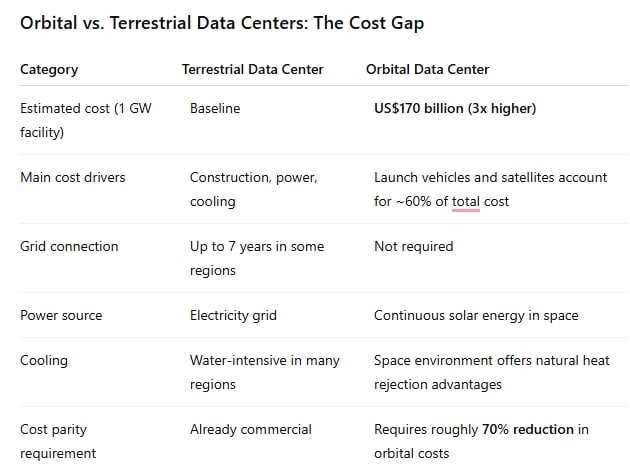
According to Wood Mackenzie, orbital facilities would only become cost-competitive if launch costs continue falling at historical rates. The report estimates that total costs must decline by about 70% before space-based computing can compete with terrestrial infrastructure.
Jeff Bezos Says Cost Is the Only Real Barrier
The debate over orbital computing gained fresh attention after Jeff Bezos spoke at the VivaTech conference in Paris.
The Blue Origin founder argued that the science behind orbital data centers is largely solved. Instead, he believes economics remains the only major obstacle.
According to Bezos, future computing infrastructure could eventually be built using materials mined from asteroids, the Moon, and other space resources. Chips could even be manufactured in orbit using abundant solar energy before transmitting computing results back to Earth.
He has previously said two milestones are needed before orbital computing becomes practical:
- Launch costs must fall by roughly tenfold.
- Energy must become a much larger share of total data center operating costs.
Blue Origin is working toward both goals through its next-generation launch systems.
Bezos also emphasized a gradual approach to space development, arguing that building sustainable infrastructure around the Moon should come before more ambitious plans for Mars.
Market Potential
Despite today’s high costs, analysts believe orbital computing could become a major industry over the next decade.
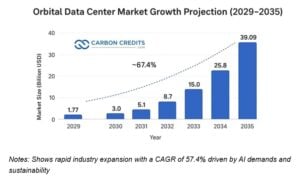
- Analysts expect the orbital data center industry to grow from $1.77 billion in 2029 to $39.09 billion by 2035. This shows a remarkable compound annual growth rate (CAGR) of 67.4%.
SpaceX Is Betting Big on Orbital Computing
Among companies pursuing orbital data centers, SpaceX appears to have the most ambitious plans.
Together with xAI, the company has announced a long-term goal of deploying 100 gigawatts of orbital computing capacity every year.
According to Wood Mackenzie, that target is roughly ten times larger than the combined announced pipeline of every other orbital data center developer worldwide.
Outside the United States, announced projects remain limited, totaling less than 0.5 GW of planned capacity. The report expects launch activity among leading developers to begin accelerating between 2027 and 2028, although commercial deployment remains several years away.
A Booming Space Economy Could Slash Orbital Computing Costs
Although orbital computing remains expensive, the broader space economy is advancing rapidly. Global orbital launch attempts climbed to 324 missions in 2025, up 25% from the previous year. Commercial companies carried out roughly 70% of those launches.
Meanwhile, reusable rockets have already reduced launch costs by approximately 90% compared with traditional expendable launch systems.
Satellite deployment is also accelerating. A record 4,517 satellites entered orbit during 2025, representing a 58% increase over the previous year. Nearly 87% were launched by private companies rather than governments.
These trends suggest that launch costs could continue falling over time, improving the economics of orbital infrastructure. And much of that growth depends on continued advances in reusable launch systems, satellite manufacturing, and lower transportation costs.
Despite the Hype, Orbital Data Centers Are Still a Long-Term Bet
Wood Mackenzie concludes that orbital computing remains a promising long-term technology rather than an immediate replacement for traditional data centers.
Space offers clear advantages, including abundant solar power, freedom from grid congestion, and reduced pressure on land and water resources. However, those benefits are currently outweighed by the enormous cost of getting computing infrastructure into orbit.
For now, the industry’s money is still flowing to Earth-based facilities.
The firm’s Research Director, Robert Liew, notes that the infrastructure challenges facing terrestrial data centers are real, but they are unlikely to shift investment away from the ground until launch costs fall dramatically.
Earth Remains the Main Investment Destination
While interest in orbital computing is growing, companies continue investing heavily in conventional data centers.
AI company Anthropic, for example, recently committed US$45 billion over three years to access SpaceX’s 300-megawatt Colossus 1 terrestrial data center, which will operate with 220,000 Nvidia GPUs.
- Wood Mackenzie forecasts approximately US$9 trillion in cumulative investment between 2026 and 2040 to build nearly 395 GW of new terrestrial data center capacity.
That spending highlights where the industry still sees the strongest near-term opportunities.
Last but not least, in the coming decades, orbital data centers could become an important part of the AI ecosystem. Until then, they remain a bold vision whose success depends less on technology than on making space transportation dramatically cheaper.