

China is ramping up its clean energy efforts with a new roadmap under its 15th Five-Year Plan (2026-2030). The National Development and Reform Commission (NDRC) and the National Energy Administration (NEA) released the plan, which aims to create a cleaner, low-carbon, and efficient energy system by the decade’s end.
To achieve this, Beijing plans to invest over 20 trillion yuan ($2.94 trillion) in energy infrastructure in the next five years. NEA head Wang Hongzhi stated that this investment will expand renewable energy and modernize the country’s power system.
At the same time, China will boost domestic coal, oil, and natural gas production to enhance energy security. This highlights the challenge of balancing clean energy growth with reliable supplies.
China Targets 5.4 Billion kW Power Capacity by 2030
China’s power sector is growing rapidly. The NEA reports that total installed power generation capacity reached 4.01 billion kilowatts by May 2026, the highest globally. Wang noted this figure is set to rise to 5.4 billion kilowatts by 2030, driven by ongoing investments in renewables and grid infrastructure.
Record Growth in Solar and Wind
China has built the world’s largest renewable energy system. During the 14th Five-Year Plan (2021-2025), the country added about 951 GW of solar and 359 GW of wind capacity. These additions accounted for roughly 43% of global solar and 66% of global wind capacity installed during this period.
Fossil Fuels Still Matter
The share of non-fossil energy in China’s total energy use rose from 16.7% in 2021 to 21.7% in 2025. Clean energy use grew by 69%. However, overall energy demand also increased by 24%, leading to a 10% rise in fossil fuel use. This shows that while China adds renewable energy, fossil fuels remain crucial for meeting growing demand.
By 2030, China aims for non-fossil sources to produce 50% of its electricity. It also plans to peak coal and oil use before 2030, moving closer to its carbon neutrality goal by 2060.
A More Modest Growth Target Ahead
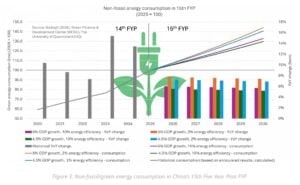
The draft released in March sets two key energy targets for China’s clean energy transition by 2030:
- A 10% reduction in energy intensity to boost efficiency.
- A 25% share of non-fossil energy in total energy consumption.
These goals aim to increase clean energy use while reducing energy needed for economic growth.
Assuming a GDP growth of about 5%, non-fossil energy consumption needs to grow by roughly 5.9% per year through 2030. This is below the 11% annual growth rate from the 14th Five-Year Plan.
In other words, the official target may be conservative. If current renewable trends continue, China could exceed its goals for clean energy.
The Emissions Puzzle
A key question is whether China’s greenhouse gas emissions will peak before 2030.
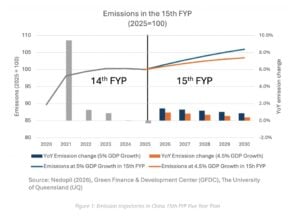
China still relies on emissions intensity targets instead of absolute emissions caps. The previous plan aimed for an 18% reduction in carbon intensity, and the new framework has a similar focus.
- Analysts estimate that with GDP growth and emissions intensity targets, absolute emissions could rise by 3% to 6% by 2030.
This trend could make it hard for China to meet its goal of peaking emissions before 2030. However, if renewables continue to grow faster than expected, emissions could plateau or decline by the decade’s end.
Why Fossil Fuels Are Still Growing
Despite its clean energy ambitions, China is the world’s largest coal consumer and a major oil and gas importer.
The country uses about:
- 56% of global coal
- 15% of global oil
- 9-10% of global natural gas
Import dependence remains high, especially for oil, with about 72% of consumption coming from imports.
Energy security is central to the 15th Five-Year Plan. Beijing aims to reduce exposure to geopolitical disruptions by boosting domestic coal, oil, and gas production while continuing to expand renewables.
The plan aims for crude oil output near 200 million tons per year, with natural gas production rising. Domestic energy production capacity is expected to grow from 5.13 billion to 5.8 billion tons of standard coal equivalent by 2030.
The Contradiction at the Heart of the Plan
Here lies the core tension in China’s strategy.
Renewables are becoming cheaper and more competitive than fossil fuels. However, the government prioritizes energy self-sufficiency.
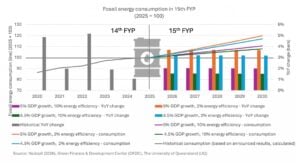
If China sticks to its fossil fuel targets, analysts estimate fossil fuel consumption could rise by 7.9% to 10.5% by 2030. This would be a significant increase and could undermine emission reduction efforts.
The government links energy security to food security. Fertilizer production relies on fossil fuels, and Beijing has raised grain production targets as a priority. Although China is exploring low-carbon alternatives like green ammonia, large-scale deployment is still in early stages.
What the Market Should Watch
For investors and energy companies, the key focus should be on the gap between official goals and actual deployment trends.
China’s renewable sector has consistently outpaced government targets. If this continues, several outcomes are possible:
- Non-fossil electricity generation could exceed 50% before 2030.
- Coal demand could plateau sooner than expected.
- Power-sector emissions could decline even if industrial emissions stay high.
- China could strengthen its global leadership in solar, wind, batteries, and grid technologies.
The Bottom Line
China’s 15th Five-Year Plan represents a strong commitment to clean energy and energy security. The country plans to invest nearly $3 trillion in new energy infrastructure and aims for non-fossil sources to dominate electricity generation.
Yet, the plan does not impose a hard cap on absolute emissions. Instead, it focuses on reducing carbon intensity while continuing to support domestic fossil fuel production.
Whether China’s emissions peak before 2030 will depend less on formal targets and more on how quickly renewables, storage, grid upgrades, and electrification can outpace coal, oil, and gas demand.
The next five years will be crucial in testing whether the world’s largest energy consumer can balance decarbonization, economic growth, and energy security.