


As reported by JaxDailyRecord, Elon Musk has bought APR Energy, based in Jacksonville. This deal could boost Tesla’s presence in the growing data center energy market.
Though Musk and Tesla haven’t confirmed this, filings indicate the deal might exceed $1 billion. If accurate, this acquisition would merge APR Energy’s fast gas-powered generation with Tesla’s expanding battery storage. Together, they could provide strong solutions for (artificial intelligence) AI-driven data centers needing reliable power.
The acquisition comes as demand for electricity from AI and cloud computing surges. Companies are looking for alternatives to traditional utility connections.
FTC Filing Points to Elon Musk as Buyer
The first reports of the acquisition appeared in a Federal Trade Commission (FTC) filing. It identified Elon Musk as the buyer of New APR Energy LLC. In May, the FTC allowed the deal to proceed without further antitrust review.
Duos Technologies Group, which held a 5% stake in APR Energy, reported receiving about $50.4 million from the sale. This suggests the total transaction value exceeds $1 billion.
Neither APR Energy nor Musk has commented on the purchase.
APR Energy has changed hands several times in the last decade. It went private in 2016, was acquired by Atlas Corp. in 2020 for $750 million, and was later sold to Fortress Investment Group in late 2024. The company was then renamed New APR Energy, but it continues to operate under the APR Energy brand.
Inside APR Energy’s Rapid-Deployment Power Business
APR Energy specializes in quickly deploying temporary and permanent power plants worldwide.
Its modular systems can provide electricity in weeks, making them appealing to utilities, governments, industries, and AI data centers. Unlike traditional power plants, which often take years to build, APR claims some of its plants can be operational in just 30 days.
Its portfolio includes:
- Mobile gas turbines
- Modular natural gas power plants
- Flexible generation systems
- Temporary and bridge power solutions
- Integrated engineering, construction, operation, and maintenance services
The company offers multiple fuel options, including natural gas, LNG, LPG, and hydrogen blends. Its systems work well with battery energy storage systems (BESS), enhancing grid stability and reducing emissions while ensuring reliable electricity.
This flexibility is increasingly important as AI infrastructure grows across North America.
AI Is Driving Massive Power Demand
Artificial intelligence is reshaping electricity demand. Modern AI training clusters require vast amounts of continuous power, often exceeding local utilities’ capacity.
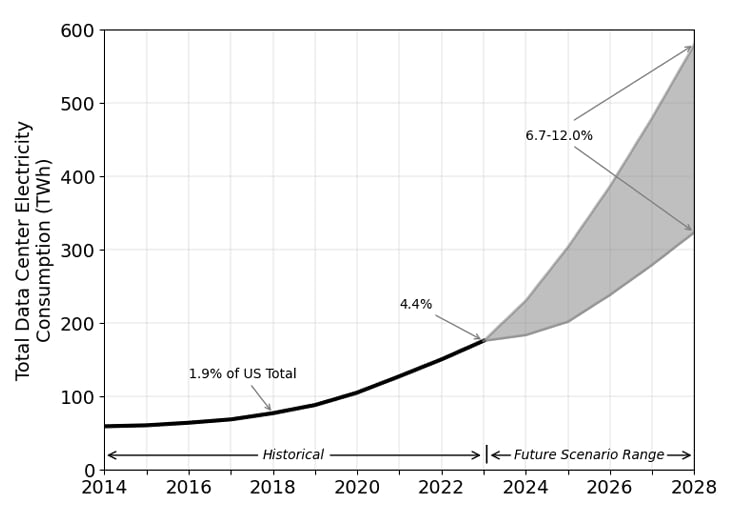
- Recent U.S. energy estimates show that data centers used about 176 terawatt-hours (TWh) of electricity in 2023, making up roughly 4.4% of total U.S. electricity use.
- This demand could rise to between 325 TWh and 580 TWh by 2028, depending on AI growth.
Total data center electricity use from 2014 through 2028
- MUST READ: AI’s Environmental Cost: Data Centers Now Rival Entire Nations in Energy, Water, and Land Use
Utility interconnection queues are a major hurdle for hyperscale data centers, with new facilities sometimes waiting years for enough grid capacity.
APR Energy aims to solve this issue.
Its behind-the-meter power solutions let data centers start operating while awaiting permanent utility connections. The company claims to have delivered 250 MW of behind-the-meter generation for a major AI facility in under 30 days, allowing operations to begin before grid upgrades were complete.
- It currently supplies APR currently supplies 375 megawatts of power to one of the world’s largest AI data centers. This capability will be increasingly valuable as AI companies race to expand computing capacity.
Tesla Energy Is Growing Rapidly
Musk’s Tesla is known for electric vehicles, but its energy division is one of its fastest-growing sectors. Tesla Energy creates utility-scale battery storage systems, residential batteries, and solar products.
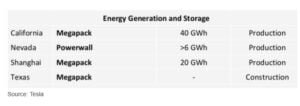
Its flagship Megapack is now a leading grid-scale battery system. Designed for utilities and large customers, each Megapack stores significant amounts of electricity and helps stabilize power grids by balancing supply and demand.
The company reveals that Megapack systems now operate in over 65 countries, supporting multi-gigawatt-hour energy storage projects worldwide.
Demand is rising as governments and utilities invest in renewable energy and seek reliable backup power.
Tesla has increased its manufacturing capacity to meet this need. Its dedicated Megapack factory in Lathrop, California, has ramped up production, while a second facility in Shanghai boosts global supply.
This growth has resulted in impressive financial performance. Tesla’s Energy Generation and Storage segment has become one of its fastest-growing areas, generating billions in annual revenue as Megapack deployments accelerate.
How APR Could Complement Tesla
If the acquisition is confirmed, APR Energy would add capabilities that Tesla does not fully provide. Tesla, as we know, also specializes in battery storage, while APR focuses on rapid power generation with mobile gas turbines and modular plants.
Together, they could offer a more complete energy solution.
For instance, an AI data center could use APR’s modular gas generation for immediate electricity while integrating Tesla Megapack batteries to balance power output, improve reliability, reduce fuel use, and support grid services. This was again analyzed by the Jacksonville Daily Record.
Once utility infrastructure becomes available, battery storage could operate alongside renewable energy, while temporary generation is scaled back or moved.
This hybrid approach is gaining interest as developers seek reliable power without delaying costly AI projects.
Assessing the Potential Impact of the Reported Acquisition
The global data center industry is entering a rapid expansion phase. AI, cloud computing, and digital services are driving record investments in new facilities, but electricity access is a major growth constraint.
Many utilities struggle to build transmission infrastructure quickly enough to meet demand. Consequently, companies are increasingly investing in behind-the-meter generation, battery storage, and microgrids for reliable power.
This trend opens opportunities for providers that can deploy energy infrastructure swiftly.
APR’s expertise in fast-track generation, combined with Tesla’s battery storage, could position them to serve one of the fastest-growing segments of the global energy market.
The acquisition isn’t confirmed yet, but the reported deal highlights how AI is reshaping the energy sector. Tech companies are looking for integrated, flexible energy solutions that can be deployed in months, not years.
For Tesla, enhancing its energy business with rapid-deployment power generation could strengthen its role as a provider of electricity infrastructure for the AI era.