

The European Union has proposed its biggest carbon market overhaul in years. The European Commission wants to keep the EU Emissions Trading System (EU ETS) at the center of Europe’s climate strategy while giving heavy industry more time and support to cut emissions.
The proposal is part of the EU’s plan to reduce net greenhouse gas emissions by 90% by 2040 and reach climate neutrality by 2050. If approved, the reforms would reshape how Europe prices carbon, funds industrial decarbonization, and supports new technologies such as permanent carbon removals.
Ursula von der Leyen, President of the EC remarket:
“The best way to reduce Europe’s fossil energy dependency is to power our economy with electricity from clean, homegrown sources. Today, we are proposing to make Europe the world’s first electro-powered continent. From lowering electricity prices to adapting our carbon market to the changing global realities, this is also an investment and independence plan. To keep the clean transition on track, bring relief to our industry, and support decarbonisation. Let’s switch it on.”
Europe Slows Carbon Cuts to Protect Industry
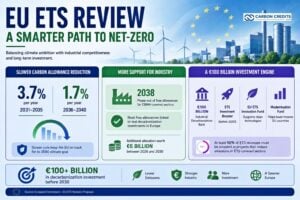
The biggest change is a slower reduction in the number of carbon allowances after 2030. The Commission proposes a new Linear Reduction Factor (LRF) of:
- 3.7% per year from 2031 to 2035
- 1.7% per year from 2036 to 2040
This is a more gradual path than the current trajectory. Brussels says the change will reduce pressure on industry while still keeping the EU on track for its 2040 climate goal.
The proposal recognizes that cutting emissions becomes harder as the easiest reductions are already made.
Heavy Industry Gets More Time to Decarbonize
The review also extends support for energy-intensive industries. Free carbon allowances for sectors such as steel, cement, and chemicals would continue beyond 2030, with the phase-out slowed until 2038 for sectors covered by the Carbon Border Adjustment Mechanism (CBAM).
However, companies will not receive these permits automatically. Most free allowances will be linked to real decarbonization investments in Europe.
The Commission says the principle is simple: money paid by industry into the ETS should help industry invest in cleaner production.
- A separate proposal would increase free allocation worth about €6 billion between 2026 and 2030.
A New €100 Billion Investment Engine
The review puts much more emphasis on investment. The Commission plans to create a €100 billion Industrial Decarbonisation Bank to help fund clean industrial projects across Europe.
Before 2030, the first phase of this bank will be the ETS Investment Booster.
The EU ETS Innovation Fund will continue supporting first commercial deployments of technologies such as hydrogen, carbon capture, batteries, and other clean industrial solutions.
The Modernisation Fund will keep helping lower-income EU countries upgrade energy systems and industry.
Member states would also be required to spend at least 50% of their ETS revenues on investments that reduce emissions in ETS-covered sectors.
Together, the Commission says these measures could mobilize more than €100 billion in decarbonization investment before 2030.
Europe’s Carbon Market Reaches More Sectors
The proposal also broadens the scope of the carbon market. The ETS would be strengthened for aviation and maritime transport and extended to municipal waste incineration.
The Commission says this will reduce loopholes, create a more level playing field, and align the EU system with international climate rules.
- The EU ETS already covers about 40% of the bloc’s greenhouse gas emissions.
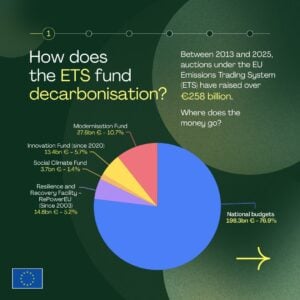
According to the Commission, emissions from ETS-covered sectors have fallen by around 50% since 2005, while the system has generated more than €260 billion in auction revenue since 2013.
That track record is one reason Brussels still sees carbon pricing as a core climate tool.
Carbon Removals Make a Historic Entry
One of the most important changes is the planned integration of permanent carbon removals into the EU ETS. The proposal would allow these removals to provide additional flexibility for sectors that are hardest to decarbonize.
The Commission says this will also help scale up carbon removal technologies across Europe. Potential beneficiaries could include:
- Direct Air Capture (DAC),
- Biochar,
- Bioenergy with carbon capture and storage (BECCS), and
- Mineralization projects.
This is significant because the EU ETS has historically focused on emissions reductions, not carbon removals. The change could create a new long-term demand source for high-quality removal credits.
Ben Rubin, Co-Founder and Executive Director of The Carbon Business Council, remarked on this:
“Today’s decision recognises something that science has long made clear: deep emissions reductions and carbon removal solutions are both needed to reach net zero. Residual emissions from hard-to-abate industries such as steel, cement, and chemicals require a durable, high-integrity solution, and the ETS now provides the start of a credible pathway to deliver one… A level playing field across carbon removal pathways will spur innovation, accelerate deployment, and ensure the ETS builds on the method-neutral foundations established through the CRCF framework.”
International Carbon Credits Return Under Strict Limits
The proposal also reopens the door to international carbon credits. From 2036 to 2040, companies could use up to 2% high-quality international credits.
The Commission says these credits would help finance decarbonization projects abroad while providing flexibility during a period when emissions reductions in Europe become more difficult.
The credits would be tightly limited and subject to quality rules. Even so, the move is important because the EU largely phased out international offsets from its carbon market years ago.
For global carbon markets, it signals that carefully controlled international credits may again play a role in European climate policy.
Brussels Wants More Stable Carbon Prices
The review also targets carbon price volatility. The Commission proposes reforms to the Market Stability Reserve (MSR) to improve liquidity, strengthen predictability for investors, and reduce excessive price swings.
This comes after recent debates about how carbon prices affect industrial competitiveness and energy costs.
EU carbon prices remain among the highest in the world. According to ICE data, benchmark EU Allowance (EUA) futures traded around €80–82 per tonne in July.
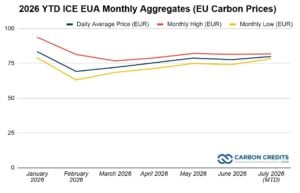
Analysts expect future prices to remain sensitive to policy changes, economic growth, and the balance between permit supply and demand.
Electrification Takes Center Stage in Europe’s Climate Plan
Alongside the ETS review, the Commission released a new Electrification Action Plan. The plan argues that many low-carbon technologies already save consumers money:
- Driving a battery-electric vehicle can cost up to 78% less than driving a comparable fossil-fuel vehicle.
- Replacing a gas boiler with a heat pump can cut heating bills by up to 60% on average across the EU.
The Commission says adoption remains too slow because electricity is often taxed more heavily than gas, grid connections can take years, and upfront costs are high.
The plan would allow countries to reduce certain electricity taxes and network charges, expand smart meter deployment, support heat pumps and electric vehicles, and accelerate grid upgrades.
The goal is to make electricity cheaper relative to fossil fuels.
A New Phase for the World’s Largest Carbon Market
With all these new proposals in place, the EU ETS is no longer just a pollution-pricing system. The latest review turns it into a broader investment and industrial policy tool. It combines:
- a slower emissions cap decline,
- continued free allocation,
- carbon removal integration,
- limited international credits,
- a stronger Market Stability Reserve,
- and more than €100 billion of planned decarbonization investment.
The proposals still need approval from the European Parliament and EU member states, so details could change. Even so, the review marks a major shift.
Europe is trying to prove that it can keep one of the world’s most ambitious climate targets while protecting industry, supporting new clean technologies, and maintaining a stable carbon market.
The outcome will influence not only Europe but also the future direction of carbon pricing and carbon removal markets worldwide.