

Toyota Motor and Nvidia are enhancing their long-term partnership. They’re now focusing on physical artificial intelligence (AI) technologies beyond just self-driving cars.
This partnership covers next-gen vehicles, manufacturing, robotics, and urban infrastructure. It shows a trend: AI is moving from data centers into the real world, powering factories, vehicles, and smart cities.
For investors, this strengthens Nvidia’s plan to grow its AI ecosystem beyond cloud computing chips. Toyota is also using AI to modernize vehicle development, boost factory efficiency, and speed up software engineering.
Toyota and Nvidia AI Partnership Moves Beyond Cars
Both companies started working together in 2017. Toyota chose Nvidia’s Drive PX platform for automated driving tests. Their partnership has grown since then.
Last year, Toyota announced plans for next-gen vehicles using Nvidia’s DRIVE AGX computing platform and DriveOS operating system. The new agreement expands their collaboration across nearly all of Toyota’s business.
Now, they will integrate Nvidia’s computing power, AI software, and simulation platforms into vehicle design, manufacturing, software development, robotics, and intelligent transportation systems.
This reflects a shift toward “physical AI,” where systems interact with real-world environments.
Smarter Driver Assistance
A key goal for Toyota is improving advanced driver-assistance systems (ADAS). Future Toyota vehicles are expected to offer Level 2++ driving capabilities. These systems can handle many driving tasks but require drivers to stay alert.
Toyota aims to make these systems more aware of their surroundings. This will help vehicles adapt to changing road conditions while prioritizing safety.
Instead of rushing to full autonomy, Toyota focuses on gradually enhancing real-world driving assistance through AI.
AI Speeds Up Software Development
Software is vital in modern vehicles. With cars relying on millions of lines of code, ensuring quality and safety is complex. To address this, Toyota has created an AI coding assistant using Nvidia’s Megatron-LM and Nemotron large language models.
This system helps engineers generate, review, and validate software while meeting MISRA standards, which are safety-focused coding guidelines.
By automating repetitive tasks and improving code validation, Toyota expects engineers to create software faster without sacrificing quality.
Digital Factories Before Physical Ones
The car maker is also using AI in its manufacturing. With Nvidia Omniverse libraries and the Isaac Sim robotics simulation platform, Toyota is creating digital twins of its factories.
These virtual environments let engineers test robot movements, redesign production lines, and identify operational bottlenecks before making changes in real factories.
Furthermore, this approach can reduce production downtime, enhance efficiency, and lower costs. Lastly, Digital twins are becoming essential in advanced manufacturing, allowing companies to simulate changes before making costly adjustments.
Woven by Toyota Brings AI to Urban Transportation
The partnership also extends to urban infrastructure. Toyota’s mobility tech arm, Woven by Toyota, is developing AI systems to enhance urban transport and smart city infrastructure.
- The team has built a multimodal vision-language model using Nvidia H100 Tensor Core GPUs and Megatron-Core software.
This model analyzes traffic conditions using various data types, helping to interpret complex road scenarios and anticipate traffic changes.
Such technology could support traffic management and connected transportation networks in future smart cities, where vehicles and infrastructure share information. This shows Toyota’s growing view of AI as vital for future mobility, not just a car technology.
Toyota Is Investing Billions in AI
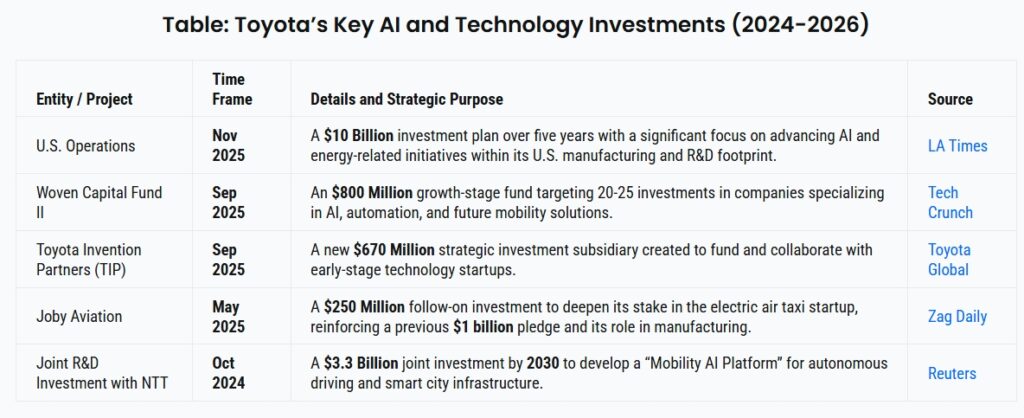
The expanded partnership aligns with Toyota’s growing investment in AI. In September 2025, the company launched two funds totaling $1.5 billion.
- The first, Toyota Invention Partners (TIP), set aside about $670 million for early-stage tech startups.
- The second, Woven Capital Fund II, committed roughly $800 million to later-stage companies focused on AI and advanced mobility.
Two months later, Toyota announced plans to invest another $10 billion over five years in its U.S. operations, focusing on AI and energy tech. These actions build on Toyota’s broader investment strategy from 2024, which allocated around $11.2 billion for future technologies, including AI and electric vehicles.
Together, these initiatives show Toyota’s belief in AI as a core technology for long-term competitiveness.
Japan Is Betting on AI
Toyota’s strategy reflects Japan’s national goal to lead in AI. It is the key to Japan’s economic plans as the country faces labor shortages from an aging population.
In 2024, the Japan Business Federation urged Japan to become an AI and robotics superpower. They called AI a major growth driver to tackle workforce challenges and boost competitiveness.
The Japanese government has also made AI central to its “Society 5.0” vision, which links digital technologies with everyday life.
This national strategy has sparked rapid innovation in both public and private sectors. AI-related patent applications in Japan have surged over the last decade, reflecting increased research and development during Japan’s third AI boom.
Industry forecasts predict strong market growth. Japan’s AI market, valued at about $1.34 billion in 2026, is expected to reach nearly $6.77 billion by 2031, with a compound annual growth rate (CAGR) of 26.1%. Government support, rising enterprise adoption, and ongoing tech innovation will drive this growth.
What It Means for Nvidia Investors
For Nvidia, the partnership with Toyota is more than just another automotive deal. The company is a leader in AI infrastructure for cloud computing and data centers. However, its future growth depends on entering physical industries like manufacturing, robotics, and transportation.
This strategy supports Nvidia’s premium market value.
Investors believe global AI spending will remain strong this decade. Nvidia’s valuation shows it will stay a top AI infrastructure supplier. Businesses are investing in data centers, autonomous systems, robotics, and smart manufacturing.
At the same time, analysts strongly opine that NVDA stock must protect its market share against custom AI chips and competing platforms.
For Toyota, the partnership offers advanced AI tools to accelerate software development, optimize manufacturing, and enhance future mobility solutions.
Their collaboration highlights AI’s role in the physical economy. As industries digitize factories and transportation networks, partnerships like Toyota and Nvidia’s may shape intelligent infrastructure. This alliance strengthens both companies in the expanding AI market.