

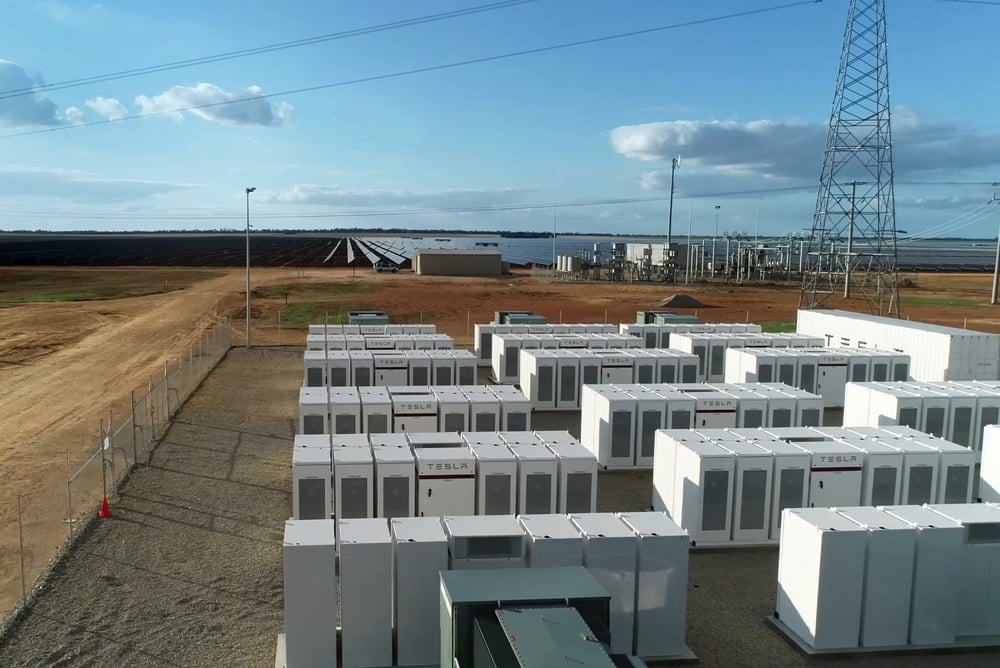
Australia is enhancing its renewable energy framework with a major project. Ark Energy has approved the final investment decision (FID) for its AUD$1.3 billion Richmond Valley Solar Farm and Battery Energy Storage System (BESS) in New South Wales (NSW). This marks a key step in the shift to a cleaner, more reliable electricity grid.
The hybrid project combines large-scale solar power with long-duration battery storage. It aims to provide renewable electricity, improve grid stability, create hundreds of jobs, and support Australia’s growing energy storage market.
Ark Energy Receives Final Investment Approval
Ark Energy, a renewable energy developer in Australia, announced that its parent company, Korea Zinc Co. Ltd., approved the financial investment decision at an Extraordinary Board Meeting in Seoul on July 21, 2026.
This approval unlocks a financing package of AUD$1.3 billion, which includes:
- AUD$586 million in equity funding
- AUD$716 million in debt financing
This is Ark Energy’s first build-to-own renewable energy project to secure a final investment decision, marking a major milestone for the company.
Ark Energy focuses on utility-scale solar farms, wind projects, battery storage systems, and renewable hydrogen facilities across Australia. It is a subsidiary of Korea Zinc, a leading non-ferrous metals producer with over 25 years of operation in Australia through Sun Metals Corporation.
Large Hybrid Solar and Battery Project
The Richmond Valley Solar Farm & BESS will be built about 25 kilometers south of Casino in northern New South Wales.
Once completed, the project will feature:
- Up to 500 MW of solar generation (435 MWac)
- Up to 475 MW of lithium iron phosphate (LFP) battery capacity
Moving on, construction will occur in multiple phases. The first stage, starting in 2026, will include: a 200 MWac solar farm and a 275 MW battery with 2,200 MWh of energy storage
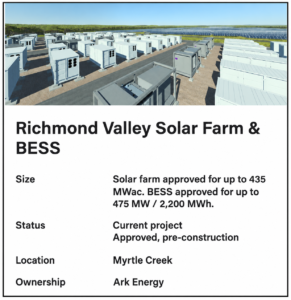
This long-duration battery will store excess solar energy during the day and release it during peak demand. This improves grid reliability and allows more renewable energy to replace fossil fuels.
Four Years of Development Leads to FID
Achieving the investment decision required years of planning and regulatory efforts.
Over the past four years, Ark Energy secured planning approvals, environmental clearances, grid connection rights, and government support through New South Wales’ Long-Term Energy Service Agreement (LTESA) program.
The company received:
- NSW Government planning approval in October 2025
- Federal environmental approval in December 2025
- Grid connection approval in June 2026
The project also gained support through the NSW Electricity Infrastructure Roadmap by securing an LTESA. This provides long-term revenue certainty, reducing investment risk. It is also included on the Australian Government’s National Renewable Energy Priority List.
Ark Energy’s CEO, Michael Choi, stated that the investment decision shows Korea Zinc’s confidence in both the project and the company’s long-term growth strategy. He added that this approval is strong support from the parent company, moving Richmond Valley into its next financing and construction phase.
- Financial close is expected in September 2026, with construction starting in October. Commercial operations are targeted for January 2029.
Beyond Clean Power: Economic and Environmental Benefits
The Richmond Valley project is set to deliver substantial economic benefits to the region.
During peak construction, it can support over 850 direct and indirect jobs. Local spending may reach around AUD$180 million, benefiting regional businesses, contractors, and suppliers.
The project also includes long-term community investment. Ark Energy will provide annual community funding of AUD$850 for every installed megawatt of solar capacity throughout the project’s life.
Environmental commitments are also essential. Plans include a new 30-meter-wide biodiversity corridor and planting native vegetation to enhance wildlife connectivity between the nearby Ellangowan and Bungawalbin State Forests.
Global LFP Battery Market Continues Rapid Growth
The Richmond Valley project highlights the growing role of battery storage in modern electricity systems. Solar and wind generation is rising, but their output can vary with weather. Battery systems help balance supply and demand by storing renewable energy when production is high and releasing it during peak demand.
Lithium iron phosphate (LFP) batteries are the preferred choice for many utility-scale storage projects due to their long life, safety, and competitive costs.
- According to Fortune Business Insights, the global lithium iron phosphate (LFP) battery market was valued at $23.97 billion in 2025.
- The firm expects the market to grow to $30.36 billion in 2026 and reach $77.07 billion by 2034, expanding at a compound annual growth rate (CAGR) of 12.35%.
Asia-Pacific accounted for over half of the global market in 2025, driven by strong manufacturing capacity and rising regional demand.

Australia Emerges as a Battery Storage Leader
Australia is quickly becoming a leading market for battery storage outside China and the United States.
The International Energy Agency (IEA) reported that China made up around 60% of global battery deployments in 2025, followed by the United States and Europe. However, battery installations are rapidly increasing in Australia and parts of the Middle East. These regions need storage to enhance electricity security and integrate more renewable energy.
Australia’s battery market reflects this trend.
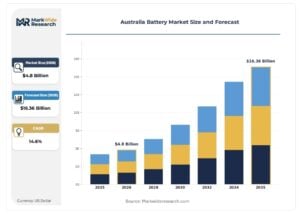
- Industry forecasts predict the Australian battery market will grow from $4.8 billion in 2026 to $16.36 billion by 2035, with a CAGR of 14.6%.
Government support has accelerated investment. Programs from the Clean Energy Finance Corporation (CEFC) and the Australian Renewable Energy Agency (ARENA) are lowering financing costs for large battery projects, making them more appealing.
States like New South Wales and Victoria are expanding grid-scale battery procurement. Also, Queensland is seeing strong demand for co-located solar and storage projects that capture higher electricity prices during evening peak demand.
Strengthening Australia’s Energy Transition
Projects like Richmond Valley show how Australia’s renewable energy strategy is evolving beyond just adding solar and wind capacity.
Large-scale batteries are becoming vital because they enhance flexibility, reduce renewable power curtailment, and help maintain reliable electricity supplies during peak demand.
Richmond Valley will combine a 500 MW solar farm with a large long-duration battery system. This will provide clean electricity and support the grid. The project will create local jobs, enhance the environment, and invest in the community long-term.
As battery costs go down and renewable energy increases, hybrid projects that mix solar power with energy storage will be key. They will help Australia create a lower-carbon and more resilient electricity system.