


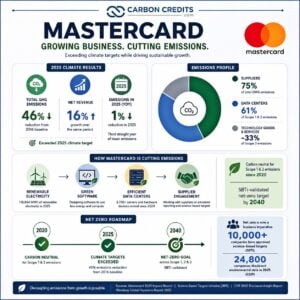
Many companies have set net-zero goals, but fewer have shown that they can grow while cutting emissions. Mastercard is one of them. The company says it exceeded its 2025 climate targets by reducing absolute total GHG emissions by 46% from 2016 levels.
Over the same period, net revenue grew 16%. In 2025 alone, Mastercard cut total emissions by another 1%, marking its third straight year of lower emissions while the business continued to expand.
Mastercard says these results show that companies do not have to choose between growth and climate action.
“Decoupling emissions from growth is possible,” wrote Ellen Jackowski, the company’s Chief Sustainability Officer, and Adam Tenzer, Senior Vice President of Data and Governance. Jackowski also said:
“We certainly recognize that the pathway to net zero is not linear, and — especially as we look at some of the increasing compute power, data centers and AI capabilities that we need to continue to build — we’re watching very carefully and managing how to add the compute capability that we need, while managing to stay very actively on track towards our net-zero goal.”
Net Zero Is Now a Business Issue
Climate targets have become part of mainstream business strategy. The achievement matters because investors are asking tougher questions. They no longer want companies to announce climate goals. They want proof that those goals are producing real results.
The Science Based Targets initiative (SBTi) says more than 10,000 companies now have approved science-based emissions reduction targets or commitments. At the same time, CDP reported that a record 24,800 companies disclosed environmental data in 2025.
Both numbers show that businesses face growing pressure to measure and reduce their climate impact. Mastercard has gone a step further.
Its net-zero target for 2040 has been validated by the SBTi and covers Scope 1, Scope 2, and Scope 3 emissions across its entire value chain. That is important because, for many companies, most emissions come from suppliers rather than their own offices or facilities.
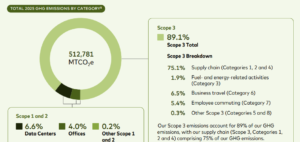
Mastercard’s own emissions profile shows this challenge clearly. According to its latest reporting:
- Suppliers account for 75% of total greenhouse gas emissions.
- Data centers produce about 61% of Scope 1 and 2 emissions.
- Technology goods and services make up about one-third of Scope 3 emissions.
Those numbers show why the company emphasizes technology and supply chains. It’s not just about office buildings or business travel.
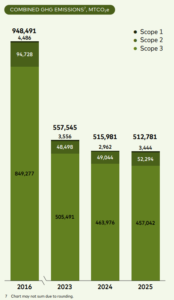
Mastercard also continued to make steady progress in 2025. According to its 2025 Report, the company’s total greenhouse gas emissions fell to 512,781 metric tons of CO₂ equivalent (tCO₂e) from 515,981 tCO₂e in 2024, a decline of about 0.6% year over year.
Smarter Technology Is Driving Bigger Emissions Cuts
Mastercard says better technology has become one of its biggest climate tools. The financier developed a patent-pending Sustainability Score that measures the environmental impact of every technology product and infrastructure asset.
The system tracks electricity use, regional carbon intensity, server utilization, and hardware life-cycle data. Engineers use the information to improve efficiency before new systems go live.
-
The company has also changed how it builds software.
Its Software Engineering Guild, which includes thousands of engineers, now follows guidance from the Green Software Foundation.
The goal is simple: design applications that use less computing power and less electricity. These practices are now part of Mastercard’s internal engineering standards.
-
The company is also reducing energy use inside its data centers.
Since 2024, it has decommissioned more than 3,700 servers and other hardware devices that were underused.
Hardware retirements in the first quarter of 2026 nearly doubled compared with a year earlier. The company is expanding dynamic power management. This lets servers adjust their electricity use automatically as workloads change.
-
Renewable electricity remains another key part of the strategy.
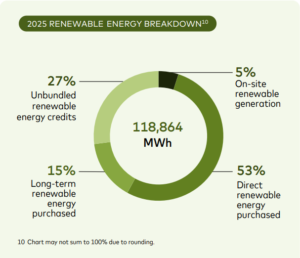
Mastercard has maintained carbon neutrality for Scope 1 and 2 emissions since 2020 through emissions reductions and renewable electricity. In 2025, the company bought or made almost 118,864 megawatt-hours of renewable electricity. This amount was enough to power its global operations and cut back on fossil fuels.
Together, these efforts show how the company is trying to reduce emissions across its operations while keeping its business growing. The next challenge will be cutting the much larger emissions that come from suppliers and the wider technology value chain.
The Hardest Emissions Are Still Ahead
Mastercard has made strong progress, but the company knows its biggest challenge is not inside its own buildings. It is across its supply chain.
According to the company’s latest Impact Report, suppliers produce 75% of Mastercard’s total greenhouse gas emissions. That makes supplier engagement one of the company’s biggest priorities on its path to net zero.
Mastercard now works with suppliers to improve emissions reporting, increase renewable energy use, and set science-based climate targets. The global payments company also partnered with Greenpixie, a specialist in cloud sustainability, to improve carbon reporting across cloud and co-location providers.
The partnership helps Mastercard measure electricity use and emissions more consistently across different vendors. This is becoming increasingly important as businesses move more computing workloads to the cloud.
Why Energy Efficiency Is Becoming the New Climate Advantage
Buying renewable electricity is no longer enough. Companies are now looking for ways to reduce the amount of energy they use in the first place.
Mastercard’s strategy reflects that shift. Instead of focusing only on renewable power, the company is redesigning software, improving server performance, and retiring underused hardware. These steps reduce electricity demand before renewable energy is added.
This approach is gaining support across the technology sector. The Green Software Foundation includes members like Microsoft, Intel, Accenture, and Mastercard. It promotes software design to reduce energy use and carbon emissions.
As AI, cloud computing, and digital payments expand, efficient software is becoming an important part of corporate climate strategies.
Can More Companies Follow Mastercard’s Playbook?
Mastercard’s latest results show that emissions reductions and business growth can happen at the same time.
The company has already exceeded its 2025 climate targets. It has been carbon neutral for Scope 1 and 2 emissions since 2020. It is also on track to meet its Science Based Targets initiative (SBTi) goal of net-zero emissions by 2040.
The outlook for digital payments also remains strong. The Worldpay Global Payments Report 2025 says global spending via digital payments will hit around $33.5 trillion by 2030. This is a rise from $18.7 trillion in 2024.
Digital wallets are expected to account for nearly half of all e-commerce payments and about 40% of in-store transactions by the end of the decade. As cash use drops and online shopping rises, payment networks like Mastercard can grow. It’s crucial to keep cutting emissions while managing more digital transactions.
While the hardest work in cutting emissions still lies ahead, Mastercard offers an important example for other companies.
Its experience shows that climate action is no longer limited to switching to renewable electricity. Better software, smarter engineering, cleaner supply chains, and more efficient data centers are becoming just as important.
As more businesses invest in AI, cloud computing, and digital services, the companies that reduce both emissions and energy use may be best positioned to grow in a low-carbon economy.