


Meta Platforms (NASDAQ: META) reported strong revenue growth, showcasing how artificial intelligence (AI) boosts its advertising business. However, profits dipped in Q2 2026 due to legal charges and restructuring costs.
Meta continues to invest in AI infrastructure, renewable energy, battery storage, nuclear power, and carbon reduction. These efforts align with its strategy to build energy-intensive AI data centers and achieve net-zero emissions.
Meta’s Q2 2026 earnings: Revenue up 28%
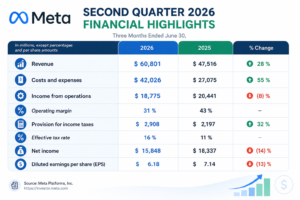
Meta’s revenue for the second quarter hit $60.8 billion, a 28% increase from $47.52 billion last year. This surpassed Wall Street’s estimate of $60.22 billion, driven by strong digital advertising and user engagement.
Despite the revenue growth, net income fell to $15.85 billion, or $6.18 per share, down from $18.34 billion, or $7.14 per share, a year prior. Analysts had expected earnings of $7.19 per share, so Meta missed profit estimates despite higher sales.
Mark Zuckerberg, the CEO, stated that AI is now the company’s major growth driver.
“AI is accelerating our core business today. It powers our next generation of products and opens new enterprise opportunities. We already see positive results and are optimistic about the future.”
AI enhances Meta’s advertising business
AI is increasingly crucial across Meta’s apps, improving ad performance and user engagement. In June 2026, the company’s Family Daily Active People (DAP) reached 3.60 billion, a 3% rise from last year.
Meta also reported:
- Ad impressions grew 14% year over year.
- Average ad prices increased 12%.
- Instagram now has over 2 billion daily active users.
- Threads reached 500 million monthly active users.
These numbers indicate strong advertiser spending on Meta’s platforms, with AI helping users engage more on Facebook, Instagram, Messenger, WhatsApp, and Threads.
Meta is rapidly integrating generative AI into its advertising platform. This allows businesses to create marketing campaigns more quickly and improve targeting.
Legal costs and layoffs reduce profits
Although revenue remained strong, Meta’s expenses rose sharply during the quarter. Total costs and expenses climbed 55% to $42.03 billion.
The increase was largely driven by:
- $2.40 billion in legal-related charges.
- $1.18 billion in severance costs following workforce reductions announced in May 2026.
These one-time expenses significantly reduced quarterly earnings. The company noted that ongoing legal and regulatory cases, including several youth-related lawsuits in the United States, could continue affecting future financial results
Aggressive AI investments continue
Meanwhile, Meta continued investing aggressively in AI infrastructure. Capital expenditures reached $31.08 billion during the quarter, highlighting the enormous cost of building next-generation AI data centers.
- The company generated $31.86 billion in operating cash flow, while free cash flow totaled $784 million after accounting for its large capital investments.
Higher Spending, Strong Outlook
Looking ahead, Meta expects third-quarter revenue of $61 billion to $64 billion, with foreign exchange expected to reduce year-over-year growth by about 1%.
The company also raised the lower end of its full-year expense forecast to $165 billion-$169 billion, mainly reflecting the legal charges recorded in the second quarter.
Meta narrowed its 2026 capital expenditure outlook to $130 billion-$145 billion, compared with its previous guidance of $125 billion-$145 billion, as it continues investing heavily in AI infrastructure. Despite the higher spending, management expects 2026 operating income to remain above 2025 levels.
Meta Stock Drops Despite Revenue Rise
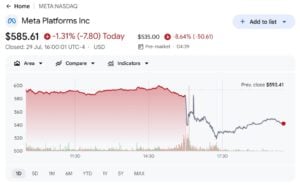
Meta’s stock fell about 6–10% as investors reacted to weaker-than-expected earnings per share (EPS), a 91% drop in free cash flow, and higher spending plans for AI infrastructure.
Although revenue rose 28%, many analysts remain positive about Meta’s long-term growth. However, investors now want clearer proof that the company’s heavy AI investments will generate stronger profits and improve cash flow.
Renewable Energy and Low-Carbon Power Portfolio
Meta has become one of the largest corporate buyers of renewable electricity. In 2025, it was the largest corporate clean energy buyer, securing contracts for about 10.24 gigawatts (GW) of renewable capacity.
The company aims for 100% renewable energy for its offices and data centers while pursuing net-zero emissions by 2030.
To support AI operations, it is diversifying its clean energy sources.
- Nuclear power: The company collaborates with developers for 1 GW to 4 GW of new nuclear capacity in the U.S., ensuring reliable, carbon-free power for AI data centers.
- Geothermal energy: Meta is partnering with Sage Geosystems for up to 150 megawatts (MW) of geothermal power, providing consistent clean electricity.
- Solar and wind: Meta expanded its partnership with Invenergy, covering 791 MW of projects in Ohio, Arkansas, and Texas. This boosts their renewable energy collaboration to about 1.8 GW.
- Long-duration battery storage: Partnering with Noon Energy, Meta plans to develop 1 GW / 100 gigawatt-hours (GWh) of long-duration battery storage, including a 25 MW / 2.5 GWh pilot project for improved electricity reliability.
- Space-based solar power: Meta is exploring technologies with Overview Energy, potentially providing 1 GW of power from space-based solar systems.
Climate Strategy for Carbon Emissions
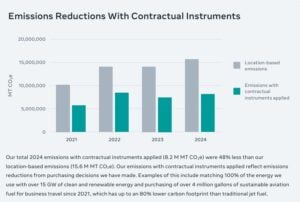
Alongside renewable energy efforts, Meta is cutting emissions in its operations and supply chain. The company reduced operational greenhouse gas emissions by about 6 million metric tons of CO₂ equivalent (CO₂e) in 2024.
- Meta also utilized Energy Attribute Certificates (EACs) to lower Scope 3 emissions linked to fuel use, devices, and remote work, cutting another 1.4 million metric tons of CO₂e.
Overall, its renewable energy strategy has helped avoid or reduce around 23.8 million metric tons of CO₂e since 2021.
As AI computing grows, Meta’s financial health increasingly hinges on balancing infrastructure investments with reliable low-carbon electricity supplies. Rising legal costs affected Q2 profits. Still, strong revenue growth, expanding AI capabilities, and bold clean energy investments position Meta for future growth and climate goals.