

The rapid growth of artificial intelligence (AI) is reshaping the energy sector. Data centers now require massive amounts of electricity, pushing technology companies to secure long-term clean power supplies at an unprecedented scale.
One of the latest examples is a new partnership between Enbridge and Meta Platforms. The companies plan to build a $1.2 billion solar and battery storage project in Wyoming. This will support Meta’s expanding data center operations.
Amanda Yang, Meta’s Head of Clean and Renewable Energy, remarked:
“We’re committed to supporting projects that add new energy to the grid while strengthening reliability in our data center communities. In partnership with Enbridge and Cheyenne Light, Fuel and Power, the Cowboy Project’s 1600 MWh battery system paired with 365 MW of solar, will deliver flexible, reliable power that benefits the broader grid, including our data center operations.”
The project highlights a larger global trend. AI infrastructure is driving a new wave of renewable energy investment, grid upgrades, and battery storage deployment across North America.
Wyoming’s Cowboy Project Blends Solar Power With Massive Battery Storage
The new development, called the Cowboy Project, will be built near Cheyenne, Wyoming. It combines:
- 365 MW of solar generation
- 200 MW / 1,600 MWh battery energy storage
- Total investment of about US$1.2 billion
The first phase is expected to enter service by the end of 2027.
According to Enbridge, the project will provide “dispatchable” renewable power. This means battery storage will help supply electricity even when solar generation is not available. Tesla will supply and service the battery systems under a long-term agreement.
The electricity will be delivered through Wyoming’s Large Power Contract Service (LPCS) tariff. This framework helps utilities support high-demand customers, such as data centers. It does this without directly impacting retail electricity rates.
The project further boosts the clean energy partnership between Enbridge and Meta. It now includes about 1.6 GW of contracted renewable capacity across North America, with the existing projects including:
- Clear Fork Solar – 600 MW
- Easter Wind – 152 MW
- Cone Wind – 300 MW
All three are located in Texas.
AI’s Explosive Growth Is Rewiring Global Electricity Markets
The project comes during a period of explosive growth in AI infrastructure spending. Recently, Bank of America predicted the global AI data center systems market may hit US$1.7 trillion by 2030.
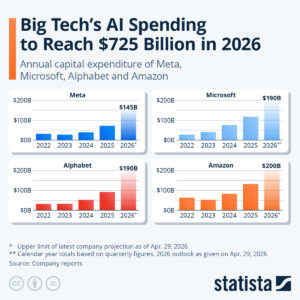
Strong investments in chips, networking systems, cloud infrastructure, and power systems fuel this growth. Major tech firms will likely spend hundreds of billions each year on AI infrastructure for the next ten years. Estimates show that their total AI spending this year will hit $725 billion.
This expansion is already affecting electricity markets.
The International Energy Agency (IEA) estimates that global electricity demand from data centers could more than double by 2030. In the United States, data centers may account for nearly 11% of total electricity demand by 2030, compared with roughly 4–5% today.
Meta is among the companies leading this buildout. The company is building several large AI data centers in the U.S. This includes projects in Louisiana, Wyoming, and other areas.
Utilities and regulators are under pressure. They need to expand transmission systems, increase generation capacity, and improve grid reliability quickly to meet demand.

SEE MORE: Meta, Amazon, Google, and Microsoft Dominate Clean Energy Deals as Global Buying Slips in 2025
Meta Expands Renewable Energy and Net-Zero Commitments
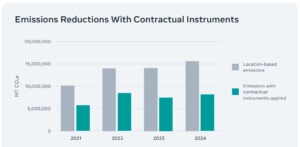
Meta has become one of the world’s largest corporate buyers of renewable energy. The tech giant was the largest corporate clean energy buyer in the world in 2025, according to BloombergNEF. They contracted around 10.24 GW of clean power that year.
The company says it aims to reach net-zero emissions across its value chain by 2030. It also seeks to match 100% of electricity use in its data centers and offices with renewable energy.
Meta has also expanded into newer forms of energy procurement. Recently, the company signed several agreements for:
- Nuclear energy: with nuclear developers to support 1–4 GW of new U.S. nuclear capacity for long-term clean power supply.
- Geothermal: with Sage Geosystems to deliver up to 150 MW of new geothermal baseload
power. - Large-scale solar: new agreements with Invenergy for 791 MW of solar and wind projects across Ohio, Arkansas, and Texas, bringing their total partnership to about 1.8 GW.
- Battery storage: with Noon Energy on up to 1 GW / 100 GWh of long-duration energy storage capacity, including a planned 25 MW / 2.5 GWh pilot project.
- Experimental space-based solar systems: with Overview Energy to potentially source up to 1 GW of space-based solar power through orbit-to-grid technology.
The company says AI infrastructure growth requires both clean energy expansion and stronger grid reliability. That is one reason battery storage is becoming central to many new data center energy projects.
In Wyoming, Meta states that the Cowboy Project’s 1,600 MWh battery system will boost flexibility. It will also help stabilize the grid while powering its operations.
Enbridge Pushes Deeper Into the AI Energy Infrastructure Boom
The project also reflects a broader shift at Enbridge. The company is traditionally known as one of North America’s largest oil and natural gas pipeline operators.
Enbridge handles roughly 30% of U.S. oil production and about 20% of U.S. natural gas consumption through its infrastructure network. However, the company has increasingly expanded into renewable energy and power infrastructure.
The energy company has a project backlog of about C$39 billion. This includes various renewable projects and data center-linked developments. CEO Greg Ebel recently said the company is pursuing more than 50 data center-related projects across North America.
The company also says it has invested in renewable power assets since the early 2000s, including wind, solar, and geothermal facilities.
This shift reflects changing market conditions. The growing demand for AI electricity is opening doors for infrastructure companies. They can now combine energy generation, storage, and grid services.
AI’s Energy Appetite Raises New Grid and Emissions Concerns
Renewable power procurement is growing fast, but data center expansion is still controversial in some areas. Environmental groups and consumer advocates have raised concerns about rising electricity demand, fossil fuel backup generation, and higher infrastructure costs tied to AI facilities.
For example, critics recently questioned financing structures linked to Meta’s Louisiana data center expansion, where new gas-fired power plants are expected to support electricity demand.
Data centers also face broader sustainability challenges, including:
- High electricity consumption,
- Water use for cooling systems,
- Pressure on transmission networks, and
- Rising regional emissions if grids rely on fossil fuels.
Why AI and Renewable Energy Are Now Growing Together
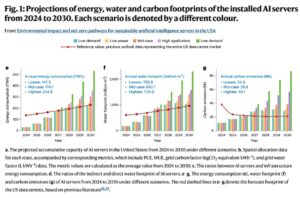
Industry analysts predict that AI-driven data center growth might add millions of tons of carbon dioxide each year in the U.S. by 2030. This could happen unless renewable energy use and grid decarbonization speed up.
This is why companies increasingly pair solar and wind projects with battery storage. Storage systems help smooth renewable output and reduce dependence on gas-fired backup generation during peak demand periods.
The Enbridge-Meta Cowboy Project reflects this convergence. It combines utility-scale solar, large battery systems, and long-term corporate power demand in a single project structure. The challenge will be ensuring that energy systems can grow fast enough while still supporting climate goals, grid stability, and affordable electricity access.