

Two of Europe’s biggest energy companies are taking different paths in the clean energy transition. TotalEnergies will buy Shell’s entire onshore renewable power portfolio in Europe. This deal adds hundreds of megawatts of operating capacity and a big pipeline of future projects. The financial terms were not disclosed.
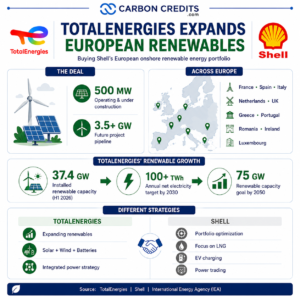
The agreement includes about 500 megawatts (MW) of solar and wind projects that are already operating or under construction. It also includes a pipeline of more than 3.5 gigawatts (GW) of future renewable projects across several European countries.
The assets are located mainly in France, Spain, Greece, Italy, Ireland, Luxembourg, Portugal, the Netherlands, Romania, and the United Kingdom.
Once completed, the acquisition will strengthen TotalEnergies‘ position as one of Europe’s largest renewable power producers. The company stated that the portfolio supports its strategy, which aims to create an integrated electricity business. It combines renewable generation, battery storage, and power trading.
Stéphane Michel, President, Gas, Renewables & Power at TotalEnergies, said:
“In line with our strategy, these two transactions enable us to optimize our capital allocation in renewables while continuing to deploy our Integrated Power strategy. The acquisition of Shell’s onshore renewables assets in Europe strengthens our power generation positions in selected key deregulated markets across Europe and supports the implementation of our integrated strategy across the electricity value chain, complementing the flexible generation capacity of the gas-fired power plants of TTEP, our joint venture with EPH, particularly in Italy, the Netherlands and the United Kingdom.”
Shell and TotalEnergies Are Taking Different Paths
The deal also highlights how Europe’s largest oil and gas companies are reshaping their clean energy strategies.
TotalEnergies continues to expand. The company has made renewable electricity one of its fastest-growing businesses. It is investing heavily in solar, wind, batteries, and flexible power generation while steadily reducing the share of oil in its energy mix.
Shell is taking a different approach. Rather than expanding its renewable generation portfolio, the company is focusing on businesses where it expects higher financial returns. These include liquefied natural gas (LNG), biofuels, electric vehicle charging, and power trading.
The oil major says the sale is part of its plan to simplify its renewable power business and improve capital discipline. The move follows several portfolio changes over the past two years.
In 2024, Shell sold its 1.2 GW onshore renewable business in India. Earlier this year, it also agreed to sell parts of its renewable portfolio in South Africa. Both companies remain committed to reaching net-zero emissions by 2050, but they are choosing different routes to get there.
- SEE MORE: Shell’s $1 Billion Wind Exit: Why the Oil Giant Is Rewriting Its Energy Transition Playbook
TotalEnergies Keeps Growing Its Clean Energy Portfolio
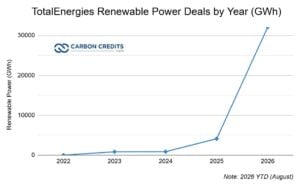
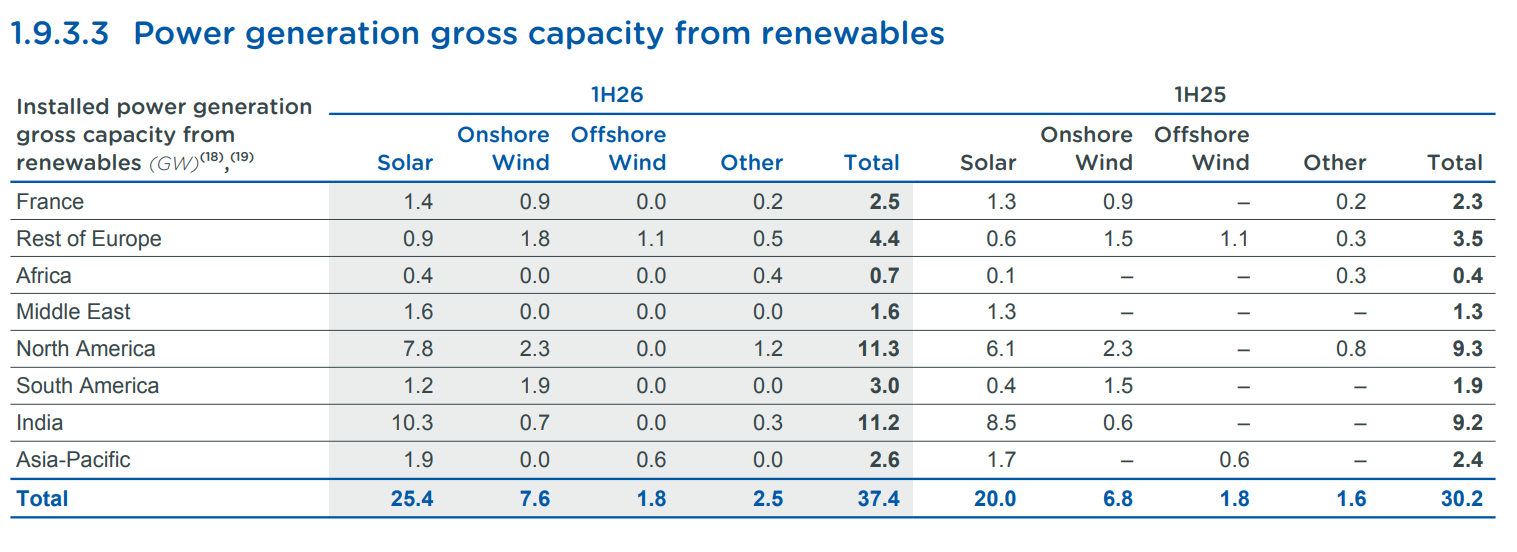
The acquisition builds on TotalEnergies’ rapid expansion in renewable electricity. The energy giant reported over 37.4 GW of installed renewable electricity capacity worldwide by the end of the first half of 2026. The massive deals within this period bring 681% growth in its renewable power agreements.
Then, it will expand to over 100 terawatt-hours (TWh) of annual net electricity production by 2030. And it aims to reach 75 GW by 2050.
The company also operates one of Europe’s largest renewable development pipelines. Before the Shell deal, TotalEnergies had nearly 10 GW of renewable capacity installed or being built in Europe. They also had another 27 GW in development.
Renewable electricity is becoming a bigger part of its business. During the first half of 2026, TotalEnergies generated 15% more electricity than a year earlier, driven by new solar and wind projects. Power production reached over 26 TWh, helping offset weaker oil and gas prices.
The company says that combining renewable energy with battery storage and electricity trading helps provide more reliable power. This approach also boosts returns.
- RELATED: TotalEnergies and Masdar’s $2.2 Billion Deal Signals a Big Push into Asia’s Renewable Energy Boom
Europe’s Renewable Market Continues to Grow
The timing of the acquisition reflects broader market trends. Europe is rapidly expanding renewable electricity to improve energy security and meet climate goals.
The International Energy Agency (IEA) expects renewable energy to supply almost all global electricity demand growth through 2028. Solar remains the fastest-growing source, while wind continues to expand across Europe.
The European Commission’s REPowerEU plan aims to speed up renewable deployment and reduce dependence on imported fossil fuels. The EU has set a binding target. It aims for at least 42.5% of its final energy to come from renewable sources by 2030. The goal is to eventually reach 45%.
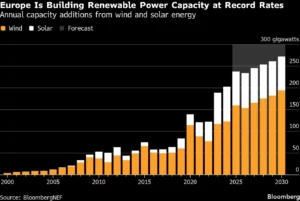
For companies such as TotalEnergies, these policies create long-term demand for renewable electricity. For Shell, priorities have changed. Now, it focuses on businesses that can yield better returns. It also aims to support its overall energy transition strategy.
The different approaches show that Europe’s energy transition is no longer about whether companies invest in low-carbon energy. It is increasingly about how they choose to compete in a rapidly changing power market.
Why Renewable Power Is the New Energy Battleground
The deal comes as Europe’s renewable energy market keeps growing.
According to the IEA, renewable energy will provide almost all of the world’s growth in electricity demand through 2028. Solar is leading the expansion, while wind power continues to grow across Europe.
The European Union is also raising its ambitions. The updated Renewable Energy Directive sets a goal for the EU.
As more renewable power enters the grid, companies need more than just wind and solar farms. They also need battery storage, electricity trading, and flexible power systems that can balance supply and demand. That is why large energy companies are increasingly building integrated electricity businesses instead of owning only renewable assets.
Scale Is Becoming a Competitive Advantage
TotalEnergies believes bigger renewable portfolios will create long-term value. The company is combining renewable power generation with battery storage, gas-fired flexibility, and electricity trading. This allows it to sell electricity when demand and prices are highest while improving returns from its renewable assets.
Shell is following a different strategy.
The company is not investing in more renewable energy. Instead, it focuses on areas with better profits, like LNG, power trading, electric vehicle charging, and low-carbon fuels. The company says these businesses can deliver better returns while still supporting its net-zero ambition.
Both companies want to grow in the energy transition. They simply disagree on where future value will come from.
A New Chapter in Europe’s Energy Transition
The sale of Shell’s European renewable portfolio is more than a business transaction, as it highlights how the energy transition is entering a new phase. Companies are no longer asking whether to invest in clean energy. They are deciding which low-carbon businesses will generate the strongest returns over the next decade.
For TotalEnergies, buying Shell’s renewable assets strengthens its position as one of Europe’s largest clean electricity producers. The acquisition also supports its strategy of becoming a major integrated power company while advancing its goal of net-zero emissions by 2050.
For Shell, the sale reflects a more selective investment strategy focused on higher-return energy businesses.
Together, the two companies show that there is no single path to net zero. Some companies are expanding renewable generation as quickly as possible. Others are concentrating on areas where they believe they have the greatest competitive advantage.
As Europe accelerates its shift to clean electricity, both strategies will help shape the next stage of the global energy transition.