

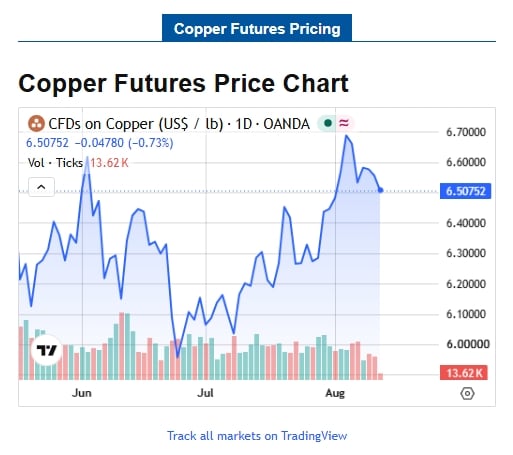
Copper prices reached a new high on the Comex as softer US inflation eased fears of interest rate hikes. Shrinking inventories in London also indicate that supply is tightening.
On August 12, Comex copper prices hit $6.7140 a pound, or about $14,802 a tonne, surpassing the previous record of $6.7045 set on August 5. It later eased to $6.6335 a pound.
This surge followed the US July Consumer Price Index, which showed inflation at 3.4% year over year, down from 3.5% in June. Core inflation was 2.5%. This data lessened the Federal Reserve’s urgency to raise rates in September, supporting commodities and risk assets.
But copper’s rise isn’t just about interest rates. The physical market is sending a stronger signal.
LME Copper Premium Widens as Inventories Fall
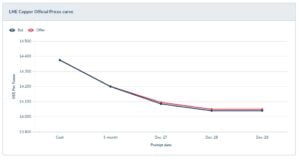
London copper has moved into deeper backwardation, meaning buyers pay more for immediate metal than for future delivery.
Cash copper on the London Metal Exchange settled at $14,424.50 a tonne, compared to $14,217 for the three-month contract. The resulting $207.50 premium was the widest of 2026, up from $138 a day earlier and just $34 at the end of July.
This spread indicates that consumers and traders are competing for available metal.
- LME warehouse stocks have also fallen sharply. Inventories stood at 214,550 tonnes, down over 35,000 tonnes, or about 14%, since the end of July.
- Reuters noted that LME stocks have dropped from about 401,000 tonnes in early May, with 58% of the remaining inventory tied up in cancelled warrants awaiting removal.
Copper Supply Problems Are Multiplying
Copper producers are struggling to boost output quickly enough to meet market needs.
Chile, the world’s largest copper producer, has cut its production outlook for the second straight quarter due to weaker output at major mines. Codelco, the state-owned producer, faces aging operations, high debt, and a need for major investment.
- The company expects 2026 copper production between 1.331 million and 1.357 million tonnes.
Chile’s supply issues are significant because the global copper market has little room for disruption.
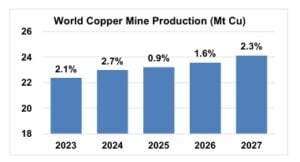
- The International Copper Study Group expects global mine production to grow just 1.6% in 2026, down from an earlier forecast of 2.3%. Growth is expected to improve to 2.3% in 2027.
Indonesia adds another risk. The Gresik smelter, processing ore from Freeport’s Grasberg mine, remains offline due to a boiler leak reported on August 8. Any prolonged outage could limit the availability of refined copper in Asia.
The Democratic Republic of Congo has also tightened its grip on supply. Kinshasa recently banned exports of copper and cobalt concentrates, allowing limited exceptions. Reuters stated this may not significantly impact the global balance but could tighten an already stressed concentrate market.
Copper Demand Is Moving Beyond Construction
Copper demand is increasingly linked to electrification.
Power grids, electric vehicles, renewable energy projects, energy storage, industrial equipment, and data centers all require significant copper.
The rapid growth of artificial intelligence is creating an additional demand driver. AI data centers need electricity-intensive computing equipment, transmission infrastructure, transformers, cables, and backup power systems. Rising data center investment could boost copper consumption across the power network.
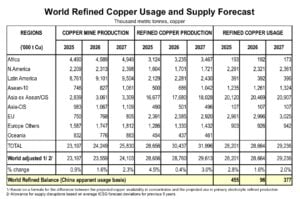
- The ICSG expects global refined copper usage to rise 1.6% in 2026 and 2% in 2027. Chinese demand is expected to rise about 1.9% this year, while consumption outside China is forecast to grow 1.3%.
The group noted that energy transition, urbanization, digitalization, and data center development will continue to support copper demand.
There is a key difference between the short-term and long-term outlook.
The institute still sees a refined copper surplus of about 96,000 tonnes in 2026 and 377,000 tonnes in 2027. This could limit prices if production improves and demand weakens, but forecasts are sensitive to mine disruptions, inventory changes, and Chinese stock levels.
The longer-term picture looks much tighter.
- The International Energy Agency estimates that the copper market could face a 30% supply deficit by 2035 under the current project pipeline.
Copper ore grades have dropped by about 40% since 1991, while average capital intensity for brownfield expansions has risen 65% since 2020. New copper projects can take around 17 years from discovery to production.
This makes today’s high prices less important than the industry’s ability to create new supply.
Copper Miners Are Benefiting
Higher copper prices are improving the outlook for major producers.
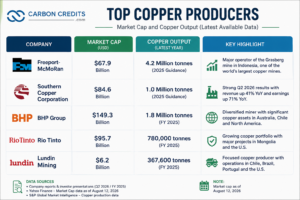
Southern Copper Corporation has emerged as one of the strongest large-cap names. The company reported $4.289 billion in second-quarter 2026 revenue, up 41% year over year, with earnings rising 71% to $2.01 a share. The stock is seen as a potential breakout candidate, driven by strong copper demand from AI infrastructure and grid investment.
Freeport-McMoRan remains another major player. BHP, Rio Tinto, First Quantum Minerals, Ivanhoe Mines, and Lundin Mining also offer investors direct exposure to copper production.
Recent market pricing shows First Quantum, BHP, and Rio Tinto among the stronger copper-related large-cap names, while the broader Global X Copper Miners ETF continues to benefit from the copper rally.
Investors should note that mining stocks do not simply track copper prices. Costs, production guidance, political risk, debt, and project execution can lead to large differences in returns.
Refer to the infographic below for their latest copper output and market cap data:
Fresh Deals Show Miners Are Racing for Copper
The industry’s deal activity reflects the growing value of copper assets.
Hudbay Minerals
In June, Hudbay Minerals completed its acquisition of Arizona Sonoran Copper, creating what the company calls the third-largest copper district in North America. Arizona Sonoran is now wholly owned by Hudbay.
Anglo American
Anglo American and Codelco finalized their agreement to combine the Los Bronces and Andina mine plans in Chile. This project is expected to unlock 2.7 million tonnes of additional copper over 21 years, or about 120,000 tonnes a year, pending environmental permits.
Meanwhile, Anglo American and Teck Resources are moving forward with their merger to create Anglo Teck, a major copper-focused mining group expecting over 70% exposure to copper.
Hindustan Copper
India is also deepening its involvement in the global copper supply chain. The country currently produces about 573,000 tonnes of refined copper annually, against a demand of around 1.8 million tonnes, according to Reuters.
Hindustan Copper is discussing potential cooperation with Chile’s Codelco to secure copper supply and explore mining opportunities.
Long-Delayed Copper Projects Could Unlock New Supply
Two delayed projects are gaining attention.
Papua New Guinea, Bougainville
In Papua New Guinea, Bougainville has chosen India’s Lloyds Metals & Energy for preparatory and feasibility work at the Panguna copper-gold mine. The project has estimated remaining resources of about 5.3 million tonnes of copper and 19.3 million ounces of gold. Lloyds previously set up a dedicated vehicle to pursue cooperation on the project.
Panguna has been closed since 1989 due to conflict over environmental damage, revenue sharing, and local control. Reopening the mine will need more than just capital. Community support, regulatory approvals, and political agreements are critical.
Tampakan Copper-Gold Project
In the Philippines, the Tampakan copper-gold project aims for production by 2028. The mine expects to produce about 375,000 tonnes of copper and 360,000 ounces of gold annually for 17 years.
These projects highlight a central issue for the copper market: the world has large deposits, but turning them into producing mines takes years.
Copper Outlook: Bullish, but Volatile
Strong fundamentals support copper’s record run.
Near-term prices benefit from falling LME inventories, tight physical premiums, supply disruptions, and the US premium. A softer inflation reading has also eased fears of higher US interest rates.
Longer term, demand is even stronger. AI data centers, grid expansion, electric vehicles, renewable energy, and industrial electrification are increasing copper needs at a time when new mines are more challenging and costly to develop.
The biggest risk is that high prices may weaken demand or spur enough new supply to create a temporary surplus. The ICSG’s projected surpluses for 2026 and 2027 show this is still possible.
Still, the structural landscape is shifting. The market increasingly rewards companies that own producing copper assets, while major miners are paying up for future supply.
For investors, the copper story is not just about the next price target. It’s evolving into a race for secure, long-term resources.