

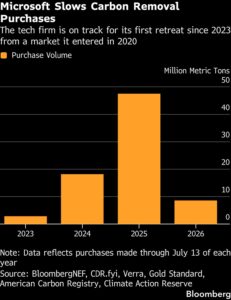
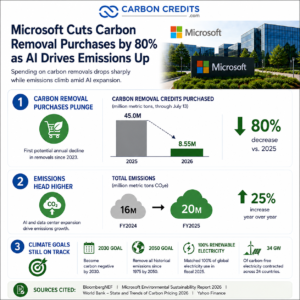
Microsoft is sharply reducing its carbon removal purchases this year as the company spends heavily to expand its artificial intelligence (AI) business. The tech giant purchased 8.55 million metric tons of carbon removal credits through mid-July 2026, about 80% less than it bought during the same period in 2025, according to BloombergNEF calculations. The drop could mark Microsoft’s first annual decline in carbon removal purchases since 2023.
The change comes as Microsoft’s emissions are moving in the opposite direction. The company’s latest sustainability report shows that total emissions rose 25% in fiscal 2025, driven mainly by the expansion of its data center network and growing electricity demand linked to AI.
The contrast highlights a growing challenge for technology companies: AI is driving rapid business growth, but it is also increasing the energy and emissions burden of building the infrastructure needed to support it.
Microsoft Pulls Back From Its Carbon Removal Buying Spree
Microsoft has been one of the world’s largest corporate buyers of carbon removal. In fiscal 2025, the company signed agreements covering a record 45 million metric tons of carbon dioxide removal with 21 companies. That was twice the volume contracted in fiscal 2024 and nine times the amount contracted in fiscal 2023.
The company has used these purchases to support a wide range of removal technologies. They include nature-based projects, biochar, carbon mineralization, and engineered carbon removal.
Microsoft says its carbon removal program is intended to help build a market for technologies that can remove carbon at scale. The latest reduction does not mean the company has abandoned carbon removal.
The tech firm continued to make purchases in 2026. In May, it agreed to buy 650,000 metric tons of carbon removal credits from BioCirc, even after reports that it had paused some new deals. That suggests a more selective approach rather than a complete exit.
Still, the decrease in its removal purchases this year ( as of July 13) compared to last year is massive, as shown in the chart below.
AI Growth Is Sending Microsoft’s Emissions Higher
The change comes as Microsoft’s environmental footprint is growing. The company reported that its total Scope 1, 2 and 3 emissions increased 25% year over year in fiscal 2025. The company said the increase was driven mainly by the expansion of its data center infrastructure and its decision to stop using some non-additional, unbundled renewable energy certificates.
Microsoft’s total emissions reached about 20 million metric tons of CO2e in fiscal 2025, compared with about 16 million metric tons a year earlier.
The company also reported a major change in its emissions mix. Scope 2 emissions accounted for 13% of Microsoft’s total footprint in fiscal 2025, up from nearly 2% the previous year. The Windows developer said this reflects the growing role of electricity systems across its operations and supply chain.
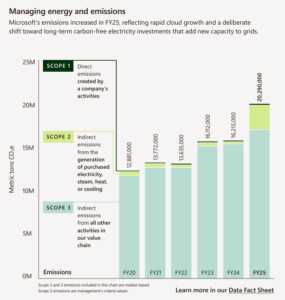
Scope 3 remains the largest part of Microsoft’s overall footprint. This matters because AI services require large amounts of computing power. Expanding data centers means more servers, construction materials, electricity, and equipment across Microsoft’s supply chain.
Microsoft’s Carbon Goal Remains in Place
Despite increased emissions and reduced purchases so far this year, Microsoft has not abandoned its main climate target. The company aims to become carbon negative by 2030. It also aims to remove from the atmosphere by 2050 an amount of carbon equal to all the company’s direct and electricity-related emissions since its founding in 1975.
A spokesperson for the tech firm stated in response to Bloomberg News:
“Any adjustments we make are part of our disciplined approach, not a change in ambition.”
Microsoft’s 2026 sustainability report says the company matched 100% of its annual global electricity consumption with renewable energy in fiscal 2025. It also said it is expanding its focus on adding new carbon-free electricity to the grids where it operates.
The company has contracted 34 GW of carbon-free electricity across 24 countries, according to its sustainability reporting. These actions show that carbon removal is only one part of Microsoft’s climate strategy.
The company is also trying to reduce emissions from its operations, increase clean electricity supply, and cut emissions throughout its supply chain.
Microsoft (MSFT) Stock Edges Higher
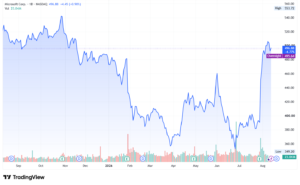
Microsoft (NASDAQ: MSFT) shares were up about 0.5% on August 13, after rising nearly 2% earlier in the session, according to a Yahoo Finance report. The modest gain came despite news of the sharp reduction in carbon removal purchases. This suggests that investors were paying more attention to Microsoft’s broader AI growth and spending plans than the carbon market development.
AI’s Emissions Problem Keeps Carbon Removal in the Mix
The reduction in purchases raises an important question: how will Microsoft deal with the emissions that it cannot eliminate quickly?
Carbon removal is designed for that part of the problem.
Microsoft’s original climate strategy called for cutting emissions by more than half by 2030 and using carbon removal to address the remainder. The company has said that its removal portfolio will include both nature-based and technology-based solutions.
But Microsoft’s own emissions data shows why the task is becoming harder. In fiscal 2024, the company said total emissions were already 23.4% above its 2020 baseline. At the same time, its energy use had increased 168%, while revenue had grown 71%.
The latest 25% year-over-year increase adds another challenge. If AI infrastructure continues to expand rapidly, Microsoft may need larger reductions elsewhere to stay on its 2030 path.
Carbon Removal Enters a More Selective Market
Microsoft’s pullback comes as the wider carbon market is becoming more selective. The World Bank’s State and Trends of Carbon Pricing 2026 found that global carbon credit issuance increased 8% between 2024 and 2025. However, carbon credit prices declined slightly overall. Credits with strong ratings or high-integrity labels continued to receive premiums.
Future demand remains strong. Companies signed about $12 billion in offtake agreements for future carbon credits in 2025, three times the level recorded in 2024.
However, the market remains heavily dependent on a small number of large buyers. Microsoft has been the biggest driver of demand for carbon removal. Its purchasing decisions can therefore affect project developers, technology companies and investors across the sector.
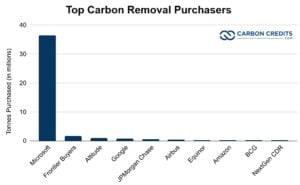
A sustained reduction in Microsoft’s purchases could make it harder for early-stage carbon removal companies to secure long-term financing. At the same time, it could push the market toward projects that offer stronger evidence of permanent and measurable carbon removal.
AI Growth Is Raising the Stakes for Microsoft’s Climate Plan
Microsoft’s carbon removal pullback highlights a wider problem for the technology industry. AI is creating enormous demand for data centers and electricity. Companies are responding by building infrastructure at record speed. That growth can make it harder to reduce absolute emissions even when efficiency improves.
Microsoft has made major investments in clean electricity and carbon removal. It has also maintained its goal of becoming carbon negative by 2030. But its latest numbers show the scale of the challenge.
Emissions rose 25% in fiscal 2025, while carbon removal purchases through mid-July 2026 were down about 80% from the same period last year.
For Microsoft, the next phase will require more than buying carbon credits. It will depend on reducing emissions from data centers and suppliers while adding new clean electricity to the grids that power AI.
For the carbon removal industry, the shift is equally important. Microsoft remains a major buyer, but its latest move shows that future demand may depend less on volume and more on cost, quality, permanence, and measurable climate impact.