


OpenAI’s rapid expansion of ChatGPT is creating a growing energy challenge for the company and the communities hosting its data centers. That challenge is now playing out in Georgia, where OpenAI plans to build a $20 billion data center campus in Effingham County.
The project, called Project Camellia, is planned for 3.2 gigawatts (GW) of power. OpenAI says Georgia Power would deliver the electricity in phases from 2028 through 2032.
The project has drawn objections from environmental and consumer groups. They want more details about the power contract and stronger protections for Georgia electricity customers. The debate also raises a wider question for ChatGPT: how much energy and other resources will be needed as AI use keeps growing?
OpenAI Faces Questions Over Georgia Power Deal
OpenAI says it will pay the full cost of the electricity and infrastructure needed for Project Camellia. Georgia Power has also said the project will include financial protections for its customers. The ChatGPT developer stated:
“Building this infrastructure in the United States strengthens domestic industry, creates good jobs, and helps ensure American communities participate in the economic opportunity created by AI. Project Camellia can help build that foundation while creating lasting opportunity in Effingham County and Southeast Georgia, and would be entirely privately funded.”
However, environmental groups want more transparency.
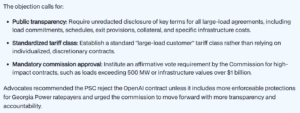
The Southern Alliance for Clean Energy, Sierra Club and Natural Resources Defense Council have objected to the proposed agreement. They say in the letter that important details remain unclear and are calling for stronger safeguards before the contract moves forward.
Their concerns include the size of the electricity load, infrastructure costs, and the possible effect on other power customers. Their letter reads:
“The magnitude of the load from the announced OpenAI project heightens the consequences of any shortcomings in the fully redacted contract’s cost-recovery provisions. A contract that does not adequately ensure recovery of all costs incurred to serve the load could leave Georgia Power customers responsible for those costs.”
The issue matters because 3.2 GW is an extremely large power demand. The International Energy Agency (IEA) notes that traditional data centers often use 10 to 25 megawatts, while large AI data centers can require more than 100 MW. Project Camellia would therefore operate on a much larger scale than a typical data center.
OpenAI says the project will also be designed to reduce its impact on the local power system. It plans to lower its electricity use during periods of high demand so that residential customers are less affected.
How Much Energy Does ChatGPT Really Use?
The Georgia project also highlights a problem with measuring ChatGPT’s environmental footprint. OpenAI does not publish one total figure for the electricity used by ChatGPT worldwide.
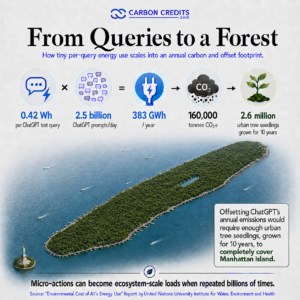
The energy needed for each query also varies. It depends on the model, the task, the length of the response, and the hardware used. OpenAI cites an Epoch AI estimate that a typical GPT-4o query uses about 0.3 watt-hours of electricity.
That number may sound small, but ChatGPT operates at huge scale. The United Nations University estimates that ChatGPT handles about 2.5 billion prompts each day. Its analysis estimates that global AI systems could have a much larger resource footprint as usage expands.
This creates an important distinction. Lower energy use per query does not necessarily mean lower total energy use. If the number of AI users and tasks grows faster than efficiency improves, overall electricity demand can still increase.
That is one reason the environmental debate is shifting from individual prompts to the much larger data center system that supports them.
AI Is Driving Data Center Power Demand Higher
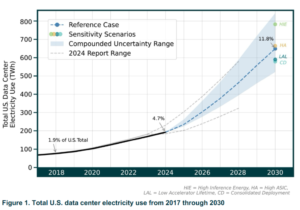
Data centers are becoming a major source of electricity demand. The IEA estimates they consumed about 415 TWh in 2024, with demand expected to more than double to 945 TWh by 2030, nearly 3% of global electricity use.
AI is a key driver. Electricity use from accelerated servers, which mainly support AI workloads, is expected to grow about 30% annually through 2030 in the IEA’s base case.
The U.S. faces an especially sharp increase. Data centers could account for nearly half of U.S. electricity demand growth through 2030, with consumption rising about 240 TWh from 2024 levels.
Project Camellia is part of this broader trend. As OpenAI and other AI companies expand computing capacity, utilities will need more power generation and grid infrastructure.
Water Is Another Environmental Concern
AI data centers also require water for cooling, although usage varies by facility and cooling system.
OpenAI says Project Camellia will use a closed-loop cooling system that recirculates water rather than continuously withdrawing and discharging large volumes. The company says this design will keep ongoing water use low.
The issue remains important as AI data centers expand. A 2026 United Nations University study estimates that global data centers could have a water footprint of about 9.3 trillion liters by 2030, alongside a land footprint exceeding 14,500 square kilometers.
These figures cover the global data center system, not OpenAI or ChatGPT alone. However, they show that AI’s environmental impact extends beyond electricity use.
OpenAI Is Expanding Its AI Infrastructure
Project Camellia is also only one part of OpenAI’s wider infrastructure expansion. The company says it needs substantially more computing power as AI systems become more capable and handle longer and more complex tasks.
OpenAI is developing other large data-center projects in the United States and abroad.
- In Michigan, its Stargate project is planned around a 1-GW data center campus. OpenAI says the site will use closed-loop cooling.
- OpenAI is also developing infrastructure in Norway. The company initially announced a project with 230 MW of capacity, with plans that could allow for added capacity later. The company says the Norway project will use renewable power and closed-loop direct-to-chip cooling.
These projects show that OpenAI is trying to address some of the environmental effects of its growth through cleaner electricity and more efficient cooling. However, the scale of the expansion remains significant.
Transparency Will Shape AI’s Climate Debate
The Georgia dispute points to a larger issue for OpenAI and ChatGPT. AI companies are improving model efficiency, but they are also expanding their computing infrastructure at a rapid pace. The project shows how the ChatGPT boom is becoming an energy and environmental issue as much as a technology story.
OpenAI has already made commitments for Project Camellia that include paying its own energy costs, keeping water use low, and providing public reporting through an annual independent audit. The company will now need to show that these commitments work in practice.
For ChatGPT, the key issue is not simply how much electricity one prompt uses. It is the combined effect of billions of prompts, increasingly powerful models, and the data centers needed to run them.
Lower energy use per AI task will help, but the long-term impact will depend on how quickly OpenAI can improve efficiency, expand clean power, reduce water use, and provide clear data on the resources behind its growing AI systems.