

Walmart delivered another quarter of sales growth on August 20, 2026, while its latest sustainability data shows a sharp drop in operational emissions. The world’s largest retailer is now balancing business growth with its goal of reaching zero Scope 1 and 2 emissions across global operations by 2040.
Walmart reported $187.9 billion in second-quarter fiscal 2027 revenue, up 5.9% from a year earlier. Global e-commerce sales jumped 23%, while Walmart U.S. comparable sales increased 2.6%. The company also raised its full-year sales outlook to 4% to 5% growth.
The results came as Walmart’s FY2026 ESG data showed Scope 1 and 2 emissions fell 7.5% year-over-year. Renewable sources supplied 53.3% of its global electricity needs, while its wider supply chain emissions remain far larger than its direct operational footprint.
Walmart Delivers Strong Revenue Growth, But U.S. Sales Lose Some Momentum
Walmart’s latest earnings show that the retailer continues to expand even as consumers face higher fuel costs and other economic pressures. Revenue reached $187.9 billion in the three months ended July 31, 2026. Global e-commerce sales rose 23%, with growth across Walmart’s major markets.
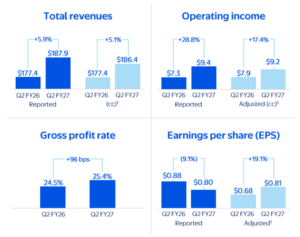
However, Walmart U.S. comparable sales grew just 2.6%. Reuters reported that this was the company’s slowest quarterly comparable-sales growth in six years and below the 3.8% analyst expectation.
Despite the slower U.S. sales growth, Walmart raised its full-year outlook. The company now expects fiscal 2027 net sales to grow 4% to 5%.
Walmart (WMT Stock) Shares Slide After Earnings
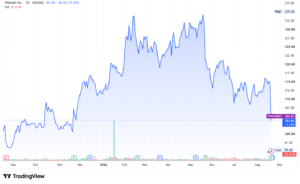
Walmart shares fell about 9.1% on August 20, despite the retailer beating earnings and revenue expectations. Investors focused on slower U.S. comparable-sales growth and weaker-than-expected third-quarter guidance, sending Walmart’s stock to its lowest level of 2026.
The results show the scale of Walmart’s business. That scale also makes its climate strategy important. Changes in energy use, transport, refrigeration, packaging and products can affect emissions across a very large global supply chain.
Direct Emissions Drop 7.5% as Walmart Pushes Toward 2040
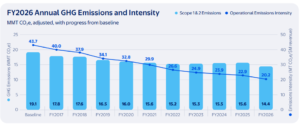
Walmart’s latest ESG report gives a more positive picture on direct emissions. In FY2026, Walmart cut its absolute Scope 1 and 2 emissions by 7.5% year-over-year.
The company said this brought its reduction to 24.6% from its FY2016 baseline. Operational emissions intensity also fell 11.6% year-over-year and 53.7% from FY2016.
Scope 1 covers emissions from sources Walmart owns or controls, such as fuel use. Scope 2 covers emissions linked to the electricity it buys.
The retailer’s progress comes as it works toward zero Scope 1 and 2 emissions across its global operations by 2040. The company says it plans to reach that goal without relying on carbon offsets. Its plan includes more:
- Renewable energy,
- Cleaner vehicles,
- Lower-impact refrigerants, and
- Electrified equipment.
Renewables Now Power More Than Half of Walmart’s Electricity
Clean electricity is one of Walmart’s main tools for cutting emissions. Renewable sources supplied 53.3% of the company’s global electricity needs in FY2026, according to its ESG report. This puts Walmart above its earlier goal of powering 50% of its global operations with renewable energy by 2025.
- The retail giant’s longer-term goal is to reach 100% renewable energy for its operations by 2035.
The retailer operates stores, clubs, distribution centers and other facilities across 19 countries. That means moving a large share of its electricity use to renewable sources can have a significant effect on its operational emissions.
Walmart is also expanding customer-facing clean energy services. Its U.S. stores and clubs had more than 1,300 electric vehicle charging stations in FY2025, per its ESG reporting.
Supply Chain Remains Walmart’s Bigger Carbon Challenge
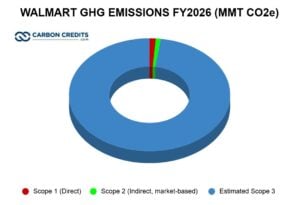
Walmart’s estimated Scope 3 emissions reached 635 million metric tons of CO2e in FY2026, far above its direct operational emissions. Although Scope 3 emissions intensity improved 8.29% from FY2022, total emissions increased as Walmart grew and its product mix changed.
The retailer is addressing this through Project Gigaton, which works with suppliers on energy, packaging, waste, products and nature. More than 4,300 suppliers reported progress in FY2026, with 187 million metric tons of CO2e in expected emissions avoided, reduced or sequestered.
Since 2017, cumulative reported results have topped 1.37 billion metric tons, exceeding Walmart’s original 1 billion-tonne goal for 2030. However, these figures are supplier-reported results and should not be treated as direct reductions in Walmart’s own Scope 3 inventory.
Looking Beyond Emissions to Protect Nature
Walmart’s sustainability work extends beyond emissions. In FY2026, Walmart said its suppliers and grantees reported sustainably managing, protecting or restoring 76.2 million acres of land and 3.68 million square miles of ocean.
The Walmart Foundation has invested more than $120 million since FY2021 in projects, research and other efforts linked to natural-resource protection. That included $30.5 million in FY2026. These programs matter to Walmart because forests, grasslands and oceans support the supply chains behind many products it sells.
The company says healthy natural systems can help protect water supplies, support climate resilience and reduce risks to long-term product availability.
Net-Zero Goal Has No Offset Shortcut
Walmart’s climate target stands out because the company does not plan to use carbon credit offsets to meet its operational zero-emissions goal. Its stated target is to achieve zero Scope 1 and 2 emissions across global operations by 2040 without relying on carbon offsets.
That means Walmart must continue cutting emissions from its own operations rather than simply balancing them with purchased credits.
The bigger challenge remains Scope 3. Walmart’s estimated 635 million tonnes of CO2e in FY2026 shows how much of its climate footprint sits outside its direct operations.
Can Walmart Grow Without Growing Its Footprint?
Walmart’s Q2 FY2027 earnings show a company that continues to grow at enormous scale. Its latest ESG data also shows that it is making progress in cutting direct emissions.
The 7.5% year-over-year drop in Scope 1 and 2 emissions and 53.3% renewable electricity share are important steps toward its 2040 goal. Yet, the bigger test is the supply chain.
Project Gigaton has helped suppliers report more than 1.37 billion tonnes of cumulative expected emissions reductions, removals and avoided emissions, but Walmart’s growing business will continue to affect its overall value chain footprint.
As Walmart raises its sales outlook and expands e-commerce, the company will need to keep reducing emissions while growing. For one of the world’s largest retailers, that balance could have a major effect on the carbon footprint of global consumer goods.