

The world is on track to cross the critical 1.5°C warming threshold within the next few years. A new United Nations Environment Programme (UNEP) report says the threshold is increasingly difficult to avoid, but it does not mean the climate fight is over.
UNEP’s Limiting Overshoot report outlines a difficult but still possible path: allow temperatures to rise above 1.5°C for a limited period, push warming to its lowest possible peak, and then bring global temperatures back down.
The strategy depends on much faster emissions cuts, stronger climate adaptation and a major expansion of carbon dioxide removal (CDR). It also highlights a growing reality for governments and businesses: reaching net-zero emissions may no longer be the final destination. The world may eventually need to move into net-negative emissions to reverse some of the warming.
1.5°C Is Becoming a Temporary Threshold
The Paris Agreement established 1.5°C as a key long-term limit for global warming compared with pre-industrial levels. UNEP press release revealed that current climate action, however, is not moving quickly enough to keep warming below it indefinitely.
So even if governments fully implement existing national climate plans and meet additional net-zero commitments, the most optimistic scenario considered by UNEP still sees warming peak at around 1.8°C.
In this context, UN Secretary-General Antőnio Guterres said,
“This summer’s scorching heat, raging wildfires and deadly floods are a warning of what lies ahead. We must make the overshoot above 1.5 degrees as small and short as possible. That demands an overshoot of ambition.”
Other pathways result in even higher temperatures.
The difference between 1.5°C and 1.8°C may look small on paper, but the climate consequences can be significant. Every additional fraction of a degree increases pressure on ecosystems, food systems, water supplies, infrastructure and human health.
For vulnerable countries and communities, the consequences could be especially severe.
Small island nations and low-lying coastal cities face growing risks from rising seas. Extreme heat and flooding could become more disruptive, while changing ocean conditions would place additional pressure on marine ecosystems and the communities that depend on them.
The Longer Temperatures Stay High, the Greater the Risk
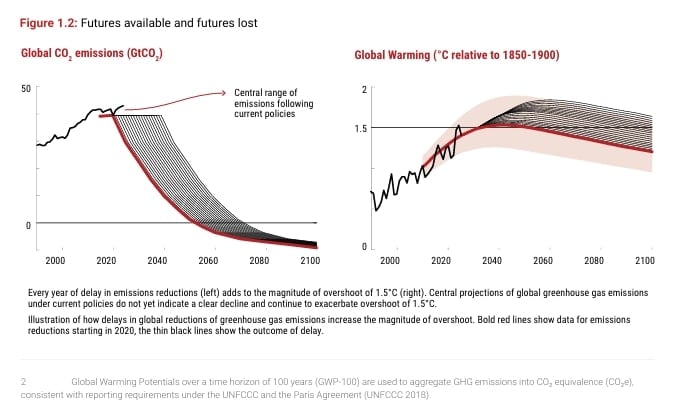
The problem is not only how high temperatures rise. How long they remain elevated also matters.
Higher and prolonged warming increases the risk of major climate systems reaching tipping points. UNEP highlights threats involving the Greenland and West Antarctic ice sheets, the Amazon rainforest and the Atlantic Meridional Overturning Circulation, or AMOC.
Some climate changes could build gradually. Others could happen much faster than expected.
The effects would also spread through economies. Rising temperatures can increase energy demand, damage infrastructure, raise insurance costs and put additional pressure on financial systems.
Food and water security are another major concern. Without effective adaptation, global food production could decline by as much as 14% by 2050, according to the report.
These risks make limiting the peak temperature increasingly important, even if the 1.5°C target is temporarily exceeded.
Additionally, Inger Andersen, Executive Director of UNEP, said:
“There are no good outcomes if we remain above 1.5°C. Across the globe, extreme heatwaves are already proving that climate impacts will strike faster, hit harder, and last longer – costing more lives and causing deeper disruption. Now is the time we must double down on climate action. We can – and must – get on the right path. By cutting greenhouse gas emissions, strengthening resilience and adaptation, and ensuring exceedance of 1.5°C is as small and short as possible.”
The World’s Best Remaining Option: Overshoot, Peak and Decline
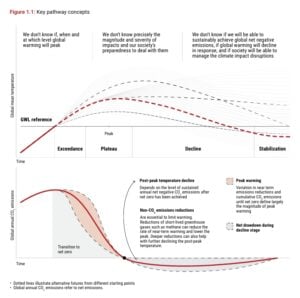
UNEP describes an “overshoot, peak and decline” pathway as the best remaining option for reducing the damage from a temporary breach of 1.5°C.
The approach has three broad stages.
- First, countries need to slow warming as quickly as possible. Deep cuts in greenhouse gas emissions, particularly methane and other short-lived climate pollutants, would slow the rate of temperature rise.
- Next comes the peak. During this period, economies would need to continue cutting emissions and reach at least net-zero while adapting to increasingly severe climate impacts.
- The final stage involves bringing temperatures down through sustained net-negative carbon dioxide emissions. This is where carbon removal becomes critical.
Carbon Removal Moves From Backup Plan to Climate Tool
Carbon dioxide removal involves taking CO₂ out of the atmosphere and storing it for the long term. Approaches can include restoring forests and other nature-based systems, alongside engineered carbon removal technologies.
UNEP makes an important distinction: carbon removal cannot replace emissions reductions.
Companies and governments cannot continue emitting at current levels and rely on CDR to solve the problem later. Emissions must fall sharply first, with carbon removal addressing residual emissions and eventually helping the world move toward net-negative emissions.
The report also stresses the importance of keeping peak warming well below 2°C. Carbon removal can contribute to a return below 1.5°C only if remaining emissions are brought down substantially, and removal is deployed responsibly.
Strong governance will therefore become increasingly important. Carbon removal projects need credible measurement, environmental safeguards and rules that address questions of scale, fairness and long-term storage.
Adaptation Will Be Just as Important
Even a successful return below 1.5°C would not erase the damage caused during the period of higher temperatures.
Some communities could face permanent changes to their environments, livelihoods and economies. In certain locations, relocation may become necessary.
Adaptation must therefore progress alongside emissions reductions and carbon removal.
The most effective strategies can deliver both benefits at the same time. Nature-based cooling, for example, can help reduce heat exposure while supporting ecosystems and improving resilience.
Adaptation will also need to become more flexible. Climate risks can change rapidly, and infrastructure designed for past conditions may not be suitable for a warmer world.
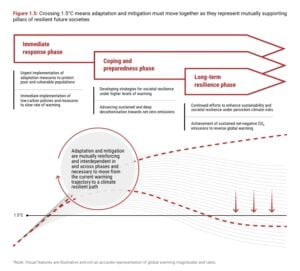
Three Phases of the Climate Response
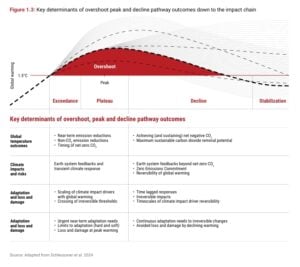
UNEP divides the response into three interconnected phases.
Immediate action focuses on slowing warming through rapid emissions reductions, especially methane cuts, while protecting vulnerable communities and ecosystems.
Coping and containment begins as temperatures approach their peak. Governments and businesses would need to accelerate decarbonization, reach at least net-zero, and strengthen resilience against increasingly severe impacts.
Long-term resilience comes as temperatures begin to decline. Sustained net-negative CO₂ emissions would be needed alongside long-term adaptation and stronger climate resilience.
The timeline for moving through these stages will depend heavily on how quickly governments act.
Climate Action Is Now a Race Against the Peak
Crossing 1.5°C should not be treated as a new acceptable climate target. The central challenge is to make any overshoot as small and short as possible.
Every fraction of a degree avoided can reduce damage. Every year spent at higher temperatures can increase the risk of irreversible changes.
Reaching the best possible outcome will require more than carbon removal. Governments need stronger climate policies, faster renewable energy deployment, deeper emissions cuts, methane reductions and major investment in adaptation.
Finance and international cooperation will also be essential. Countries with greater historical responsibility for emissions face greater pressure to move faster and provide support to more vulnerable nations.
The climate challenge has therefore entered a new phase. Net-zero remains essential, but it may be only the midpoint. The longer-term goal could require removing more carbon from the atmosphere than humanity emits.
The window for keeping that pathway open is narrowing. The decisions made now will determine not only whether temperatures cross 1.5°C, but also how high they climb, how long they stay there, and whether the world can eventually bring them back down.