

Sustainable funds have become a growing part of the global asset-management market. These funds combine financial investments with environmental, social, and governance (ESG) factors. Their performance can vary widely based on the assets they hold, where they invest, and how fund managers define sustainability.
On September 10, Morgan Stanley said sustainable investment funds delivered higher median returns than traditional funds in the first half of 2026. Their assets under management also reached a record $4.24 trillion.
Sustainable Funds Outperformed Traditional Peers in H1 2026, But Investor Flows Remain Weak
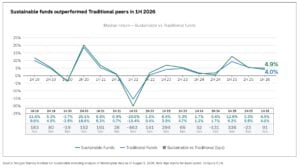
Morgan Stanley Institute for Sustainable Investing’s latest “Sustainable Reality” report, based on Morningstar data covering about 99,000 global funds, found that sustainable funds returned a median of 4.9% in the first six months of 2026. Traditional funds returned 4.0% over the same period.
Sustainable fund assets also grew during the period, reaching a new record. However, the data show that the market still faces challenges. Investor inflows recovered after a difficult 2025, but traditional funds attracted new money at a faster pace.
This means sustainable funds are growing in dollar terms, but their share of the overall fund market has continued to decline.
AUM Hits Record $4.24 Trillion
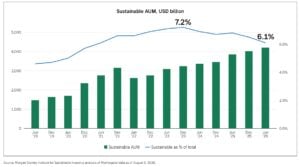
Global sustainable fund AUM increased 4.8% from the end of 2025 to $4.24 trillion at June 30, 2026. Most of that increase came from investment performance rather than new money flowing into the funds.
Sustainable funds now represent 6.1% of total fund assets, down from a peak of 7.2% in December 2023. Morgan Stanley said sustainable AUM has continued to grow steadily since 2022, but traditional funds have consistently recorded stronger net inflows in recent periods.
Some of the key figures from the report include:
- $4.24 trillion: Sustainable fund AUM at the end of June 2026.
- 4.8%: Increase in sustainable AUM from December 2025.
- 6.1%: Sustainable funds’ share of total fund AUM.
- 4.9%: Median sustainable fund return in H1 2026.
- 4.0%: Median return for traditional funds.
- $37.7 billion: Net inflows into sustainable funds during H1.
- 2.5% vs. 0.9%: Traditional and sustainable fund inflows, respectively, as a percentage of prior year-end AUM.
Equity Exposure Drove the Performance Gap
The performance advantage was closely linked to asset allocation.
Sustainable funds have a significantly higher allocation to equities, which were the strongest-performing major asset class during the first half. Equities accounted for 56% of sustainable funds, compared with 41% of traditional funds.
- Sustainable equity funds generated a median return of 9.0%, slightly ahead of the 8.6% return for traditional equity funds. But the picture was very different in fixed income.
- Sustainable fixed-income funds posted a median return of -1.3%, compared with +1.3% for traditional fixed-income funds.
Morgan Stanley said geography also played a role. About 80% of sustainable fixed-income funds invest globally or in Europe, where both sustainable and traditional fixed-income funds posted negative median returns.
Other asset classes also lagged traditional funds, with sustainable funds delivering a median return of 2.5% compared with 3.0%.
So, the overall outperformance does not necessarily mean that sustainability factors alone drove the higher returns. Morgan Stanley pointed to the mix of assets in sustainable funds, especially their higher exposure to equities, as an important factor.
Americas and APAC Lead Sustainable Fund Outperformance
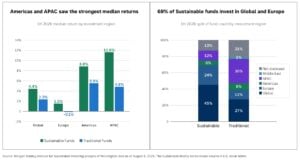
Sustainable funds also recorded higher median returns than traditional peers across all four major investment regions in H1 2026.
The strongest relative performance came from the Americas and Asia-Pacific, helping offset weaker results from funds focused on Europe and global markets. They nevertheless outperformed their traditional counterparts in those areas as well.
Geographic exposure remains important because sustainable funds are more concentrated in global and European investment mandates. About 69% of sustainable funds invest in global or European markets, compared with roughly 39% of traditional funds.
Europe-domiciled sustainable funds were particularly notable. They generated a median return of 3.9% in H1 2026, compared with 1.8% for traditional funds domiciled in Europe.
Inflows Rebounded, But Momentum Faded in Q2
Investor demand improved substantially from 2025, when sustainable funds experienced $75 billion of net outflows.
Sustainable funds attracted $37.7 billion in net inflows during H1 2026. But almost all of the recovery came during the first quarter.
Inflows reached $33.5 billion in Q1, before slowing sharply to only $4.2 billion in Q2. Traditional funds, meanwhile, attracted inflows equal to 2.5% of their prior year-end AUM, compared with 0.9% for sustainable funds.
The regional data show an uneven recovery:
- Europe-domiciled sustainable funds attracted $43.9 billion in H1 inflows, equal to 1.2% of prior year-end AUM.
- North American sustainable funds attracted $3.1 billion in Q2, ending more than three years of outflows.
- Asia-domiciled sustainable funds recorded $7.5 billion of outflows, equivalent to 5.5% of prior year-end AUM.
Article 9 Funds Stabilize After Years of Outflows
The report also provides a look at Europe’s SFDR fund classifications.
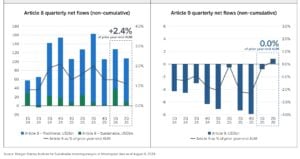
Article 8 funds recorded $242.2 billion in inflows during H1 2026. However, funds classified as sustainable by Morningstar accounted for only $45.8 billion, or 19%, of those flows.
- Article 9 funds, meanwhile, recorded a small $0.8 billion inflow in Q2. That followed 10 quarters of outflows dating back to Q4 2023, leaving Article 9 flows roughly flat for the first half of 2026.
The data suggests that sustainable investing is not disappearing from global markets, but the growth story is becoming more nuanced. Assets continue to rise, performance has been competitive, and flows have returned to positive territory. At the same time, traditional funds are attracting capital at a faster rate, reducing sustainable funds’ share of the overall market.
The first half of 2026 therefore points to a sustainable investment market that is growing in dollar terms while facing a tougher test on investor demand and relative market share.