


ADM is moving deeper into the carbon removal market, planning to sell carbon removal credits generated by its large-scale carbon capture operation at its corn processing complex in Columbus, Nebraska.
The project could bring more than 800,000 metric tons of annual carbon removal capacity into the voluntary carbon market (VCM), making ADM’s planned offering one of the largest engineered carbon removal credit issuances to date.
The credits are being certified under Puro.earth’s Geologically Stored Carbon methodology, with the first issuance expected by the end of 2026 if the ongoing audit and verification process is completed.
For ADM, the move creates a new commercial pathway for its carbon capture infrastructure. For the carbon market, it adds a large source of biogenic carbon removal credits backed by permanent geological storage.
ADM Turns Ethanol CO2 Into Carbon Removal Credits
ADM is a major agricultural supply chain and processing company that turns crops such as corn and soybeans into food ingredients, animal feed, fuels, and other products.
Its Columbus complex includes wet and dry mills and is one of the company’s major corn-processing operations. The facility now also sits at the center of ADM’s carbon removal strategy.
ADM and energy infrastructure company Tallgrass began carbon capture and storage operations at Columbus in 2025. The system captures biogenic CO2 produced during ethanol fermentation.
The Carbon Removal Chain Behind the Columbus Project
Tallgrass then purifies and compresses the captured gas before transporting it through its infrastructure to the Eastern Wyoming Sequestration Hub. It is then permanently stored underground through carbon storage wells operating under a Wyoming Department of Environmental Quality Class VI permit.
The project therefore connects three parts of the value chain: agricultural production, ethanol processing, and permanent carbon storage.
The combination is important because the CO2 comes from recently grown biomass. Corn absorbs CO2 as it grows, and that biogenic carbon is captured during ethanol production and permanently stored underground.
This further creates the basis for carbon removal credits, provided the project meets the methodology’s accounting, monitoring, and verification requirements.
Tallgrass Infrastructure Adds Scale
The carbon removal project also depends on transportation infrastructure that can move captured CO2 from Nebraska toward permanent storage.
Tallgrass converted its existing Trailblazer pipeline, which previously transported natural gas, for CO2 transportation. The system runs through Nebraska, Colorado, and Wyoming and has capacity to transport more than 10 million tons of CO2 annually.
ADM’s Columbus facility connects to the system through a dedicated lateral pipeline. According to ADM, the connection was built using voluntary easements from landowners.
This infrastructure gives the Columbus project a route from the point of capture to a dedicated geological storage site, which is essential for turning captured CO2 into a long-duration removal credit.
Puro.earth Certification Could Open a New Revenue Stream
Puro.earth is certifying the project under its Geologically Stored Carbon methodology, Edition 2024. The initial credits are expected to be issued by year-end, subject to completion of the audit. Once verified, ADM expects the project to have a 15-year crediting period.
Kris Lutt, ADM’s vice president of Innovation & Growth, said the company’s experience with carbon capture and geological storage, including its Decatur, Illinois operations, gives it a foundation for expanding into carbon removal markets.
He further explained that ADM sees the Columbus project as a way to connect its agricultural operations with a growing customer market for durable carbon removal. He also said the company expects demand to come from industries including technology, finance, aviation and pharmaceuticals.
Puro.earth President Jan-Willem Bode similarly pointed to the importance of measurement, data collection and third-party auditing. He said the certification process is intended to give buyers greater confidence that the removals can be independently verified and treated as investable carbon assets.
ADM’s Emissions Still Run Far Larger Than Its Carbon Removal Capacity
The Columbus project is significant, but its planned removal volume needs to be viewed against ADM’s overall emissions footprint.
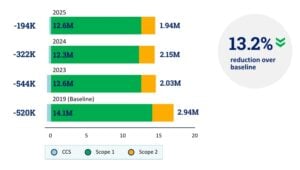
- ADM reported 128.4 million metric tons of CO2e in total emissions in 2025. The company said it achieved a 13.2% absolute reduction in Scope 1 and 2 emissions from its 2019 baseline.
Scope 1 and Scope 2 Emissions Chart
Its decarbonization strategy includes:
- fuel switching
- energy efficiency
- lower-carbon electricity
- carbon capture and storage.
Last year, the company also completed more than 60 energy-efficiency and emissions-reduction projects expected to cut more than 368,000 metric tons of CO2e annually.
Significantly, it also purchased zero-emissions credits linked to nuclear power for electricity used at 45 locations across Illinois, New York and Pennsylvania.
Scope 3 remains a much larger challenge. ADM said upstream agricultural emissions account for more than 73% of its combined Scope 1, 2 and 3 inventory. Its response includes regenerative agriculture programs and efforts to prevent deforestation.
In 2025, ADM estimated that its regenerative agriculture programs reduced emissions by about 946,000 metric tons of CO2e compared with regional benchmarks.
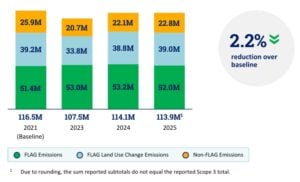
The distinction matters. Carbon capture at Columbus can create a new removal product, but ADM’s broader climate strategy still depends heavily on reducing emissions throughout its agricultural supply chain.
VCM Is Moving Toward Higher-Quality Carbon Removal
ADM’s entry comes as the voluntary carbon market is shifting away from a simple volume-growth story and toward quality, durability, and verification.
The latest Ecosystem Marketplace data show that reported VCM transaction value fell to $535 million in 2024, down 29% from 2023, while 182 million tons of credits were retired. The market has been under pressure from concerns about credit quality, but buyers have continued to show interest in more credible projects.
Other market estimates are considerably larger because they use different definitions and methodologies. Mordor Intelligence estimates the VCM at $2.83 billion in 2026, up from $2.36 billion in 2025, and projects it could reach $7.06 billion by 2031.
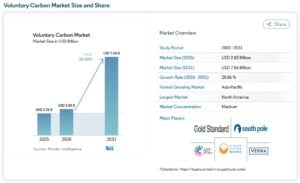
The difference between these estimates highlights how difficult it is to put one number on the VCM. Transaction databases measure actual reported deals, while commercial market forecasts often model a broader set of market activity.
For carbon removal specifically, the growth opportunity is much larger. McKinsey has estimated that the carbon removal market could reach $40 billion to $80 billion annually by 2030, based on currently announced projects and expected deliveries.
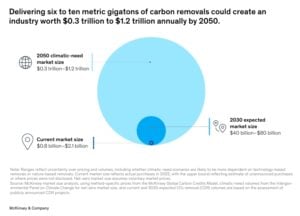
That creates an opening for large projects such as ADM’s Columbus facility.
Why ADM’s Entry Matters for Carbon Removal
The biggest takeaway from ADM’s move is not simply the number of credits it could generate.
It is the combination of large-scale biogenic CO2 capture, existing transportation infrastructure, geological storage, and third-party certification.
The project also shows how carbon removal could increasingly be integrated into existing industrial and agricultural systems rather than developed as an entirely separate industry.
The Columbus project also highlights where the carbon removal market may be heading: toward larger projects with measurable physical infrastructure, longer crediting periods and stronger verification requirements.
For a VCM that has spent several years rebuilding confidence in credit quality, that shift could be just as important as the additional 800,000-plus tons of annual removal capacity coming online