


Amazon is expanding its renewable energy footprint in the UK as demand for low-carbon electricity grows across the economy. The company has now signed a new Power Purchase Agreement (PPA) with Statkraft for the 36-megawatt (MW) Mossy Hill wind farm near Lerwick in Scotland’s Shetland Islands. The project is expected to become operational in November 2030.
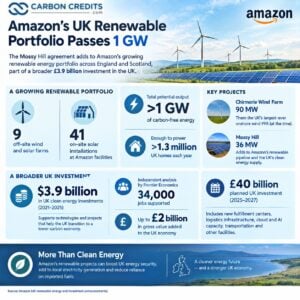
The deal adds to more than £3 billion (about US$3.9 billion) that Amazon says it invested in low-carbon technologies across the UK between 2021 and 2025. Its UK portfolio now spans more than 50 carbon-free energy projects with combined capacity of over 1 gigawatt (GW) once fully operational.
The investment comes as clean energy spending accelerates globally. The International Energy Agency (IEA) predicts global energy investment will hit $3.4 trillion by 2026. Of this, around $2.2 trillion will focus on clean energy technologies, grids, storage, nuclear, efficiency, and electrification.
Amazon’s UK Renewable Portfolio Passes 1 GW
The Mossy Hill agreement is Amazon’s latest addition to a rapidly growing UK portfolio.
The company has signed PPAs and developed renewable energy projects across England and Scotland. Its portfolio includes nine off-site wind and solar farms and 41 on-site solar installations at Amazon facilities. Once they start, the projects will produce over 1 GW of carbon-free energy. This is enough to power more than 1.3 million UK homes each year.
The earlier Chirmorie Wind Farm agreement in South Ayrshire was particularly significant. Its 90 MW project represented what Amazon described as the UK’s largest-ever onshore wind PPA at the time.
Mossy Hill adds another 36 MW to the pipeline. Together, these projects give Amazon a large, long-term position in Britain’s renewable power market while supporting new generation capacity for the wider grid.
John Boumphrey, Amazon UK and Ireland Country Manager, said:
“Our latest project in the Shetland Islands builds on years of investment in renewable energy across the UK… Last year we announced our plan to invest £40bn (US$53bn) in the UK by 2027 and the transition to a lower-carbon economy is a part of how we’re putting that commitment to work.”
The $3.9 Billion Figure Covers More Than Wind Power
Amazon’s roughly $3.9 billion UK clean energy investment is broader than its renewable electricity portfolio. The company reports over £3 billion in low-carbon investments from 2021 to 2025. This funding supports technologies and projects that help the UK shift to a lower-carbon economy.
Frontier Economics conducted an independent analysis for Amazon. They estimate that the investment supported 34,000 jobs and added up to £2 billion in gross value to the UK economy.
Amazon has also committed to invest £40 billion in the UK between 2025 and 2027. That broader investment includes new fulfillment centers, logistics infrastructure, cloud and AI capacity, transportation and other facilities.
Clean energy is therefore one part of a much larger expansion. The company claims its renewable projects can boost UK energy security. They add to local electricity generation and cut reliance on imported fuels.
Why Amazon Is Locking In Long-Term Renewable Power
Amazon’s renewable strategy relies heavily on PPAs. Under these agreements, the e-commerce giant commits to buying electricity from a renewable project for a specified period.
Such contracts can provide developers with predictable revenue and help them secure financing for new projects. This model has allowed large corporations to become major sources of demand for new renewable capacity.
Amazon says it has helped projects reach deployment by acting as an anchor offtaker. Its UK portfolio therefore does more than match electricity consumption. It can also support the construction of new generation capacity.
The strategy is becoming more relevant as electricity demand rises. The IEA expects global electricity investment to hit nearly $1.6 trillion by 2026. With end-use electrification added, it could rise to around $2 trillion. Grid investment alone could approach $550 billion, up nearly 20% year over year.
Renewable projects backed by long-term corporate demand can therefore play a growing role in meeting future electricity needs.
Amazon Has Already Matched 100% of Its Electricity
The renewable projects also support Amazon’s global climate strategy. Amazon reached its goal of using 100% renewable energy for its global operations in 2025. This is five years sooner than the original target of 2030. It achieved the same level for the third consecutive year.
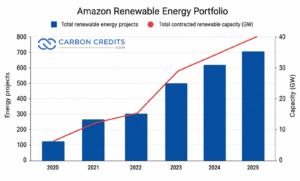
Its carbon-free energy portfolio includes over 700 projects worldwide. This totals more than 42 GW of capacity in 30 countries, based on its 2025 sustainability report.
The company co-founded The Climate Pledge in 2019 and remains committed to achieving net-zero carbon emissions across its global operations by 2040. However, matching electricity consumption with renewable energy does not mean Amazon’s overall emissions have already fallen.
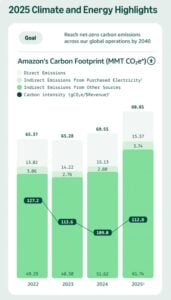
Amazon’s 2025 sustainability report reveals that its absolute carbon emissions rose 16% from 2024. However, carbon intensity dropped 38% from the 2019 baseline. Revenue increased 156% over the same period. That distinction is important as Amazon continues to expand.
AWS and AI Are Driving Amazon’s Power Needs
Amazon’s renewable energy strategy is also tied to the rapid expansion of AWS. It claims that AWS infrastructure added more data center capacity in 2025 than any other company worldwide. Data centers need a lot of reliable electricity to operate effectively.
At the same time, Amazon is working to improve energy efficiency. Its data centers recorded an average Power Usage Effectiveness (PUE) of 1.14 in 2025, compared with an industry average of 1.25 cited by the company. Amazon also says its data centers are seven times more water-efficient than the industry average.
Globally, data center electricity demand is becoming a major driver of power investment. This makes securing additional low-carbon electricity increasingly important for technology companies.
Amazon is also investing beyond wind and solar. Its broader energy strategy includes advanced nuclear, geothermal, and long-duration energy storage. The goal is to provide cleaner electricity while also improving the reliability of power supplies.
Renewable Power Has Not Yet Stopped Emissions Growth
Amazon’s renewable investments are significant, but the company’s overall decarbonization challenge remains large. Its business continues to expand across e-commerce, transportation, and cloud computing.
The company’s 2025 sustainability report says it delivered 2.4 billion packages using electric vehicles during the year and operated more than 52,700 electric delivery vans globally. It is targeting 100,000 electric delivery vehicles by 2030.
- Amazon also reduced carbon emissions per shipped unit by 7% in 2025.
However, its absolute emissions increased as its operations grew. The company needs ongoing investment in electricity, transportation, buildings, packaging, and its supply chain to hit its 2040 target. This is where renewable energy can have a larger role.

Amazon Is Turning Renewable Power Into Infrastructure Strategy
Amazon’s latest UK wind agreement shows how corporate renewable energy buying is moving beyond a simple sustainability initiative. The 36 MW Mossy Hill project adds to more than 50 UK carbon-free energy projects and takes Amazon’s planned UK portfolio beyond 1 GW of capacity.
At the same time, the global energy market is moving in the same direction. The IEA expects $2.2 trillion to flow into clean energy areas in 2026, nearly twice the investment expected for fossil fuels.
For Amazon, the UK strategy provides long-term access to carbon-free electricity while supporting new renewable capacity. The challenge now is to keep that growth aligned with emissions reductions. Amazon has already matched 100% of its global electricity consumption with renewable energy, but its absolute carbon footprint increased in 2025.
The company’s ongoing investment in wind, solar, electric transport, efficient data centers, and new clean energy technologies will be key. This will determine if it can achieve net-zero emissions by 2040.