

Thorizon and Urenco have signed a memorandum of understanding (MoU) to explore cooperation on nuclear fuel for advanced molten salt reactors. The companies will assess how Urenco could supply enriched uranium and whether Thorizon’s future reactors could use depleted uranium, a by-product of the enrichment process.
The agreement could help Thorizon secure fuel for its planned reactors while allowing Urenco to expand its role in the advanced nuclear market.
The partnership comes as countries look to nuclear power for reliable, low-carbon electricity. However, the industry must address a key challenge: securing enough uranium and expanding the facilities needed to process it into reactor fuel.
What Thorizon and Urenco Bring to the Partnership
Thorizon is a European nuclear technology company developing molten salt reactors. The company is working on the Thorizon One, a reactor designed to produce electricity and industrial heat.
Unlike conventional reactors, which use solid fuel assemblies, molten salt reactors dissolve nuclear fuel in a liquid salt mixture. The salt also carries heat away from the reactor core.
Thorizon aims to develop a low-pressure reactor that could make better use of nuclear materials. However, the technology remains under development, and its commercial potential will depend on testing, licensing and successful deployment.
Urenco brings experience in uranium enrichment, a critical stage in the nuclear fuel cycle. The company operates enrichment facilities in Germany, the Netherlands, the United Kingdom and the United States.
Enrichment increases the concentration of uranium-235, the isotope used to sustain a nuclear chain reaction in most commercial reactors. Without the right fuel specifications, nuclear plants cannot operate as designed.
Under the MoU, the companies will explore several areas of cooperation:
- Uranium enrichment: Urenco could support the supply of enriched uranium for Thorizon’s reactor programme.
- HALEU supply: The companies will examine options for high-assay low-enriched uranium, or HALEU, used by certain advanced reactor designs.
- Depleted uranium: They will investigate whether Thorizon’s technology could use this material as part of its fuel cycle.
The agreement is exploratory. It does not confirm a binding fuel supply contract or guarantee that Thorizon will use depleted uranium commercially.
HALEU and Depleted Uranium Could Play a Role
HALEU contains between 5% and 20% uranium-235. Conventional commercial reactors typically use uranium enriched to less than 5%.
Some advanced reactor designs need higher enrichment levels to meet their fuel and operating requirements. Thorizon plans to use HALEU in its molten salt reactor design, with the first reactors targeted for the mid-2030s.
Urenco is developing an Advanced Fuels Facility at Capenhurst in the UK, with HALEU production expected to begin in 2031. The proposed cooperation could help Thorizon explore a potential fuel supply route ahead of its planned deployment.
The companies will also study the possible use of depleted uranium.
Enrichment removes a portion of uranium-235 from natural uranium, leaving behind material with a lower concentration of that isotope. This leftover material, known as depleted uranium, consists mainly of uranium-238.
Some advanced reactor designs can use uranium-238 to produce fissile material through nuclear reactions. If Thorizon can establish a technically and commercially viable way to use depleted uranium, it could extract more value from existing nuclear materials and potentially reduce its reliance on newly mined uranium.
However, the outcome will depend on the reactor design, fuel chemistry, and technical validation.
Uranium Supply Struggles to Keep Pace With Demand
The proposed partnership comes as the nuclear industry prepares for higher fuel demand.
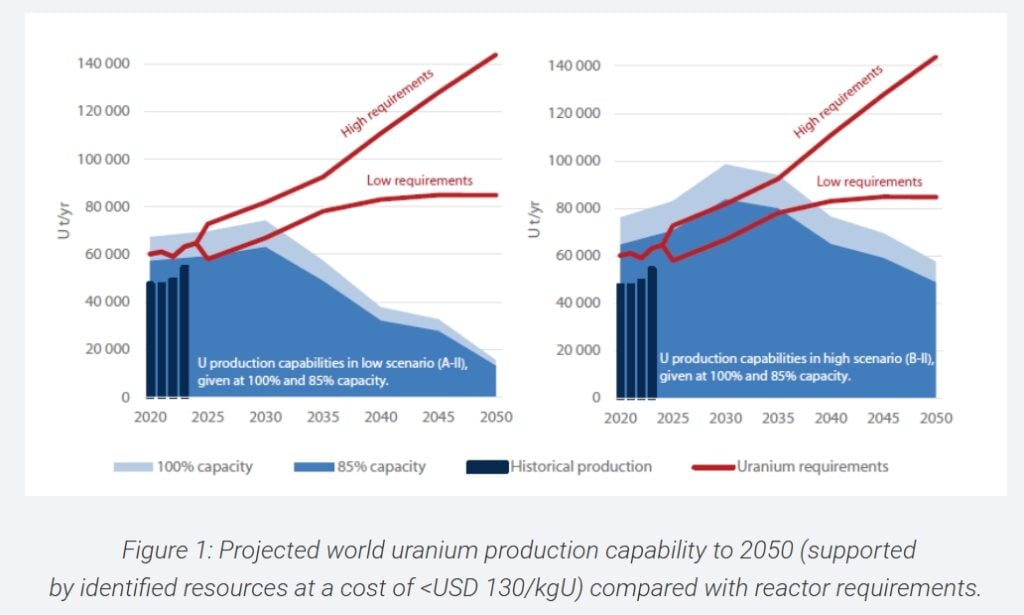
According to the World Nuclear Association (WNA), global nuclear reactors required an estimated 68,920 tonnes of uranium in 2025, while mines produced around 60,000 tonnes.
The difference highlights the industry’s reliance on inventories and secondary sources, including previously mined uranium, to meet reactor requirements.
Demand could rise further as countries extend existing reactor operations and build new nuclear plants. The WNA’s reference scenario projects annual uranium requirements could exceed 150,000 tonnes by 2040.
Several factors could put pressure on future supply:
- Growing nuclear capacity: New reactors and lifetime extensions will increase demand for nuclear fuel.
- Long mining timelines: Uranium projects can take years to develop, permit, and bring into production.
- Supply concentration: A relatively small number of countries account for much of global uranium production, making diversification important.
- Processing constraints: Miners must supply uranium, but conversion, enrichment and fuel fabrication facilities must also keep pace with demand.
These challenges create opportunities for companies across the nuclear fuel cycle, from uranium miners to enrichment providers and advanced fuel developers.
Urenco Expands Its Enrichment Capacity
Urenco is investing in additional capacity to meet anticipated demand for enriched uranium.
On October 8, 2026, Urenco USA reported that it had started production in the sixth of eight planned new centrifuge cascades at its New Mexico facility. The expansion will add 700,000 separative work units (SWU) of annual enrichment capacity, with the final cascade expected in spring 2027.
Urenco also plans a further 2.1 million SWU expansion at the site, with initial production targeted for 2032.
These investments could help strengthen the fuel supply chain as conventional and advanced nuclear technologies compete for enrichment services.
For Thorizon, cooperation with an established supplier could help address one of the major hurdles facing new reactor designs: securing suitable fuel at the right time. For Urenco, the agreement provides a way to explore a potential role in the next generation of nuclear power.
The immediate outcome remains uncertain. The companies must still determine whether their proposed fuel arrangements are technically and commercially viable. But as uranium demand rises, partnerships that connect fuel suppliers with advanced reactor developers could become increasingly important.