

TeraWulf Inc. (NASDAQ: WULF) is moving beyond Bitcoin mining to become a major provider of data center infrastructure for artificial intelligence (AI). A growing deal pipeline, including a long-term agreement with AI company Anthropic, has put the company in the spotlight as demand for computing power rises.
However, TeraWulf’s growth story is about more than AI. It also depends on access to electricity, the cost of running data centers, and the environmental impact of powering thousands of computer servers.
The company says its access to low- and zero-carbon power gives it an advantage as demand for AI infrastructure grows. Its reported energy mix supports that claim, but questions remain about future power needs, emissions, and the impact of new data centers on local communities.
For investors, the key question is whether TeraWulf can turn its energy strategy into a lasting business advantage while meeting its growth targets.
Anthropic Deal Puts TeraWulf’s AI Growth in Focus
TeraWulf’s move into AI infrastructure gained momentum in July 2026, when it announced a 20-year data center lease with Anthropic. The agreement covers about 401 megawatts (MW) of computing capacity at TeraWulf’s Justified Data Campus in Kentucky.
The company expects the first lease term to generate around $19 billion in contracted revenue. It could go up to about $33 billion if Anthropic chooses to extend for two five-year options.
- Initial delivery is expected in the second half of 2027, with full delivery planned for early 2028.
The deal is a big step for TeraWulf. It shows their move from Bitcoin mining to high-performance computing (HPC). This shift includes systems used for AI and other tough tasks.
CEO Paul Prager has described the Anthropic agreement as only the beginning of a much larger market. In comments reported by Stocktwits, he pointed to rising demand for AI computing and limited access to ready-to-use power infrastructure.
This matters because building an AI data center requires more than computer chips. Operators also need reliable electricity, cooling systems, grid connections, and suitable sites.
TeraWulf is betting that its existing energy infrastructure and development experience will help it meet this demand. However, the $19 billion figure represents expected revenue over the lease term, not profit or cash already received. The company must still build and deliver the planned capacity.
Low-Carbon Power Could Support Its Competitive Position
Power is one of the highest costs and challenges for large data centers. As AI systems grow, operators need more electricity to run servers and cooling equipment. TeraWulf’s 2025 corporate sustainability report provides a useful look at its energy strategy.
- The company reported that about 89% of its power came from low- or zero-carbon resources in 2025. It also reported an average power usage effectiveness (PUE) of about 1.06 across its operations.
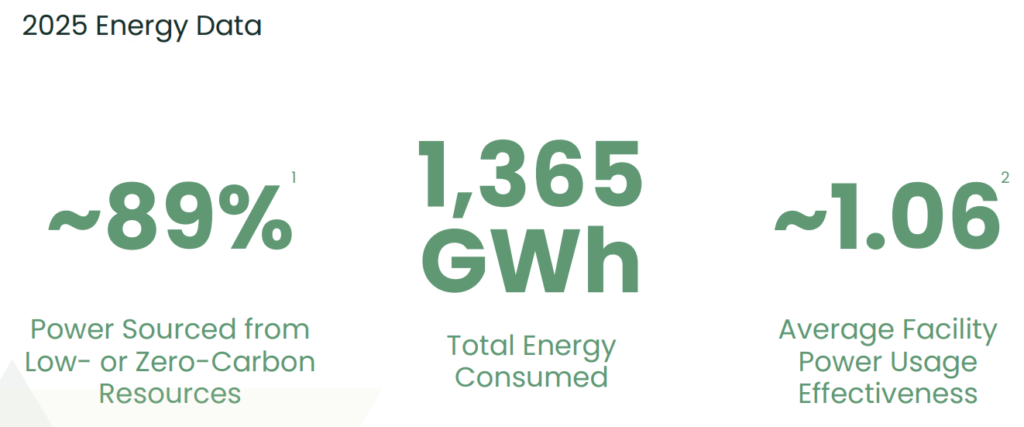
PUE measures how much total energy a data center uses compared with the energy delivered to its computing equipment. A score closer to 1.0 generally means less energy is spent on supporting systems, such as cooling and power distribution. These figures suggest that TeraWulf has access to relatively low-carbon electricity and operates its facilities with a focus on energy efficiency.
Its Lake Mariner campus in New York benefits from a grid with a large share of nuclear, hydropower, and wind generation. The site is on a former coal-fired power plant. This lets the company use existing industrial land and electrical systems.
This approach could help TeraWulf limit the need for new land development and reduce some of the challenges involved in connecting large facilities to the grid. Still, access to low-carbon electricity does not mean that data centers have no environmental impact.
Construction, equipment, backup power, and rising electricity demand all matter. The company’s reported power mix also does not, by itself, show its total greenhouse gas emissions.
- SEE MORE: WULF Stock Climbs on $31 Target as TeraWulf Bets Big on Low-Carbon, Nuclear-Powered Bitcoin Mining
AI Growth Brings New Energy and Emissions Questions
AI can help businesses improve efficiency, but running AI systems also requires large amounts of electricity. As more companies use advanced AI models, the demand for data center capacity is expected to grow.
- This creates an important challenge for the industry: how to expand computing power without placing too much pressure on electricity supplies or increasing emissions.
The climate impact of an AI data center depends partly on where its electricity comes from. A facility powered mainly by low-carbon sources can have a lower electricity-related emissions footprint than one relying heavily on coal or natural gas.
However, even a relatively low-carbon data center can add pressure to the grid if it uses large amounts of electricity. More demand may require new generation, transmission lines, and other infrastructure.
TeraWulf’s energy strategy may ease some concerns. However, its future impact depends on the power sources available as its facilities grow.
Investors should also look at how the company reports energy use and emissions as it shifts from Bitcoin mining to AI computing. More detailed, comparable data would help show whether its environmental performance improves as the business grows.
WULF Stock Shows Signs of a Rebound, But What Should Investors Watch?
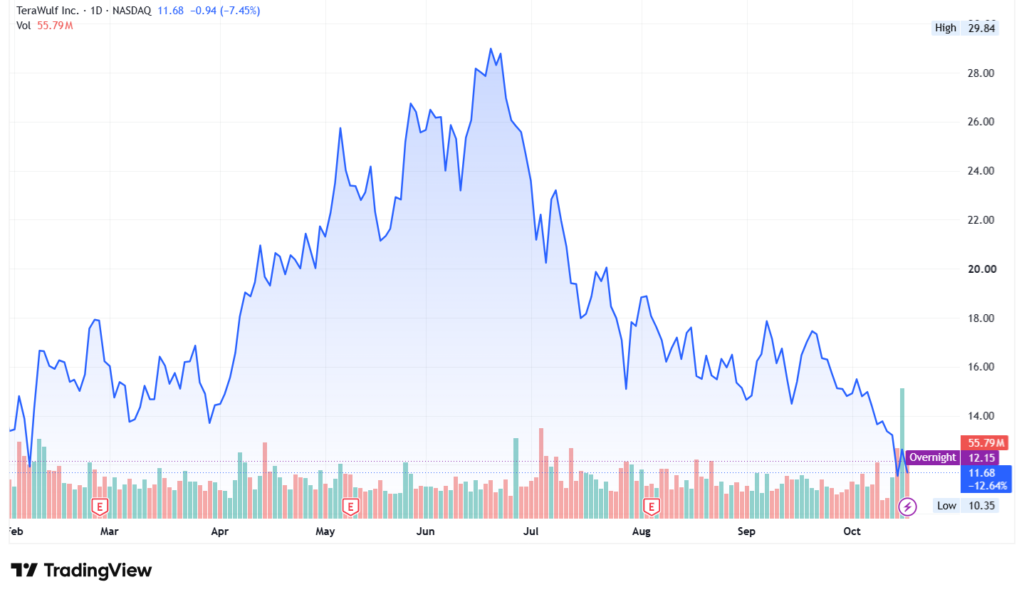
TeraWulf (WULF) stock closed down 7.45% at $11.68 on October 16, but rose 3.25% to $12.06 in overnight trading on October 18. The move offers a potential rebound after recent losses, though investors remain focused on the costs and execution risks of the company’s AI data center expansion.
The company’s AI strategy offers significant growth potential, but investors need to look beyond large contract values. TeraWulf reported second-quarter 2026 revenue of $44.8 million, including $31.9 million from HPC leases. That means HPC leasing accounted for about 71% of total revenue during the quarter.
As the business grows, investors will want to monitor:
- How much new capacity is operational.
- Whether projects stay on budget.
- How quickly contracted revenue turns into cash flow.
Other important factors include financing costs, construction spending, customer commitments, and the risk of raising additional capital. Long-term leases can provide revenue visibility, but they do not remove the costs and execution risks involved in building large data centers.
The company’s energy strategy also deserves close attention. Low-carbon electricity and efficient cooling may help control operating costs and support customer demand. Investors should see if these benefits last as the company grows into new areas. Different power sources and grid conditions may affect this.
TeraWulf’s sustainability disclosures help investors see progress. Still, it’s important to look at the energy mix and efficiency figures along with total energy use, emissions, water use, and community impacts.
Can TeraWulf Combine AI Growth With Lower-Carbon Infrastructure?
TeraWulf is positioning itself to benefit from rising demand for AI computing. The Anthropic lease provides the company with a strong long-term commitment. Also, access to low-carbon power may help it compete in the energy-intensive industry.
But the opportunity comes with challenges. Building new capacity requires significant investment, and data centers face growing scrutiny over electricity demand, environmental impacts, and local costs.
For WULF shareholders, the key question is whether TeraWulf can achieve its expansion plans. They also want to know if the company can control costs and keep its energy advantages.
Low-carbon power could be a competitive strength, but long-term success will depend on execution, reliable energy supplies, and clear evidence that the company’s growth can be managed responsibly.