


The 7RCC Global launched the 7RCC Spot Bitcoin and Carbon Credit Futures ETF (BTCK) on NYSE Arca. The fund links Bitcoin to regulated carbon credit futures. This makes it one of the first exchange-traded products that connects digital assets with carbon markets.
The launch happens when both markets are evolving quickly. Bitcoin is becoming more integrated into traditional finance through ETFs. Meanwhile, carbon markets are expanding as governments and companies pursue net-zero targets.
The result is a product that reflects two major investment themes: digital assets and decarbonization.
A New ETF Combining Bitcoin and Carbon Credits: The 80/20 Split
The BTCK ETF allocates approximately 80% of assets to Bitcoin and 20% to regulated carbon credit futures. The fund strategy avoids voluntary offsets entirely. Instead, it targets established, government-regulated compliance frameworks:
- European Union Emissions Trading System (EU ETS): The world’s largest cap-and-trade system.
- California Cap-and-Trade (CCA): North America’s premier carbon compliance market.
- Regional Greenhouse Gas Initiative (RGGI): The Northeast U.S. power-sector cap complex.
These are among the most established carbon pricing systems in the world.
According to 7RCC, this hybrid structure captures two distinct macroeconomic forces. Bitcoin reacts to liquidity, adoption, and monetary policy. Carbon markets react to tightening emissions caps, industrial compliance, and regulatory enforcement.
The BTCK fund does not offer a literal carbon offset portfolio. Instead, it blends two of the most powerful structural themes of the decade: digitalization and decarbonization.
This structure could attract investors wanting cryptocurrency exposure. It also offers access to environmental markets in one listed product.

The launch also highlights how ESG considerations continue to influence financial innovation, even as sustainable investing strategies evolve.
From Speculative Asset to Wall Street Mainstay
The timing of the launch is notable because Bitcoin has become increasingly accepted by institutional investors.
The approval of U.S. spot Bitcoin ETFs in 2024 transformed access to the asset class. In their first year, spot Bitcoin ETFs pulled in over $36 billion. This makes them some of the most successful ETF launches ever.
Today, the largest Bitcoin ETFs manage tens of billions of dollars in assets. BlackRock’s iShares Bitcoin Trust (IBIT) alone has accumulated more than $46 billion in assets under management, demonstrating the scale of institutional demand.
This growth has helped move Bitcoin further into mainstream financial markets. Yet, Bitcoin’s environmental footprint remains a primary concern for institutional allocators.
However, the underlying energy mix is changing rapidly. A pivotal study by the Cambridge Centre for Alternative Finance (CCAF) highlights this dramatic shift:
- Sustainable energy use: Reached 52.4% across the global network.
- Renewable energy share: Accounts for 42.6% of total electricity.
- Coal power collapse: Dropped significantly to just 8.9% of mining energy.
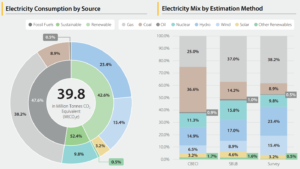
The use of renewable energy in Bitcoin mining has grown recently. Major miners like Marathon Digital Holdings and Riot Platforms are anchoring operations near solar installations. They increasingly use grid-balancing programs to capture stranded and wasted energy.
Still, worries about electricity use and emissions from proof-of-work mining continue. This backdrop shows why an ETF combining Bitcoin with carbon market exposure might interest investors. They are looking for a bigger sustainability story.
- RELATED: WULF Stock Climbs on $31 Target as TeraWulf Bets Big on Low-Carbon, Nuclear-Powered Bitcoin Mining
The Quiet Rise of Carbon as an Investable Asset
While Bitcoin has captured headlines, carbon markets have quietly become one of the most important tools in global climate policy.
According to the World Bank, carbon pricing instruments now cover roughly 28% of global greenhouse gas emissions. Many governments are using carbon taxes and emissions trading systems more and more to promote decarbonization.
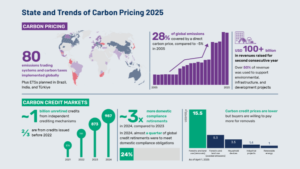
The EU ETS remains the world’s largest carbon market. It covers power generation, heavy industry, aviation, and maritime sectors across Europe. Similar compliance programs continue to expand in North America and Asia.
At the corporate level, demand for carbon-related products is also growing. Thousands of companies have established net-zero commitments, creating long-term interest in carbon credits, removals, and emissions reduction strategies.
Market forecasts suggest significant expansion ahead. McKinsey & Company estimates that global carbon credit demand could rise significantly by 2030. Companies are now seeking more ways to meet their climate goals.
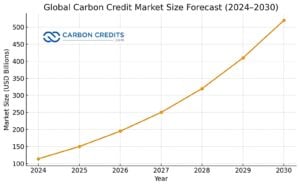
Carbon markets are smaller than traditional commodity markets. However, they are seen as a key asset linked to the energy transition.
Where Blockchain Meets the Energy Transition
The BTCK launch reflects a broader trend in financial markets: the convergence of digital assets and climate-related investments. Historically, these sectors developed separately.
Cryptocurrency investors focused on technological adoption and decentralized finance. Climate investors focused on emissions reductions, renewable energy, and sustainability-linked assets.
Today, those lines are beginning to blur. Institutional investors increasingly want diversified exposure to emerging themes. They also want investment products that fit within evolving ESG and sustainability frameworks.
By combining Bitcoin and carbon futures, BTCK attempts to bridge those worlds.
The fund operates at a highly competitive 44 basis points. It utilizes Gemini Trust Company as its primary digital asset custodian.
The concept is not necessarily about offsetting Bitcoin’s environmental footprint directly. Instead, it gives investors exposure to two markets that may benefit from long-term structural trends.
Both are expected to play larger roles in the global economy over the next decade and are both growing, but for different reasons. Bitcoin is benefiting from greater institutional adoption. Meanwhile, carbon markets are expanding as governments and companies pursue net-zero goals.
A Small Launch With Bigger Implications
The BTCK ETF is unlikely to reshape either the Bitcoin market or the carbon market on its own. However, it represents an interesting development in the evolution of both sectors.
For cryptocurrency investors, it introduces exposure to one of the world’s fastest-growing environmental markets. For climate-focused investors, it provides a new way to access digital assets within a regulated framework.
More broadly, the fund reflects how financial markets are adapting to two powerful global trends: digitalization and decarbonization.
Bitcoin and carbon credits may seem like an unlikely pairing. Yet, both markets are increasingly becoming part of larger conversations about the future of finance, energy systems, and net-zero transitions.
The success of BTCK will ultimately depend on investor demand. But its launch suggests that the gap between digital assets and climate finance may be narrowing, creating new opportunities where technology and sustainability intersect.