

Global investment in nuclear energy could reach approximately $6 trillion by 2050 as governments expand nuclear power to meet rising electricity demand and reduce carbon emissions. The World Nuclear Association (WNA) estimates that annual investment must rise to more than $250 billion to support government ambitions to more than triple global nuclear capacity.
Its July 2026 report, A $6 Trillion Investment Opportunity: Nuclear Value Chain Investment Through 2050, identifies opportunities across reactor construction, small modular reactors (SMRs), uranium mining, nuclear fuel processing and waste management.
The WNA’s October 2026 outlook estimates that global nuclear capacity could reach 1,467 gigawatts electric (GWe) by 2050 if existing reactors continue operating, planned projects advance and national capacity targets are achieved. However, meeting these ambitions will require much faster construction, stronger supply chains and greater access to private financing.
Nuclear Power Reaches Record Generation as Investment Needs Grow
Nuclear energy is attracting renewed interest as countries seek reliable, low-carbon electricity for industrial facilities, data centers and power grids. The latest WNA outlook reports that global nuclear electricity generation reached a record 2,701 terawatt-hours (TWh) in 2025, supplying around 9% of global electricity.
The existing reactor fleet also continues to perform strongly. The average nuclear reactor capacity factor reached 83.7% in 2025, reflecting the ability of operating plants to generate electricity consistently.
However, construction activity remains below the level needed to achieve global expansion targets. Eleven reactors started construction in 2025, including nine in China and two in Russia. The WNA estimates that construction rates must eventually rise to around six times current levels to triple nuclear capacity by 2050.
The investment opportunity extends beyond building new power plants. Existing reactors may require upgrades and lifetime extensions, while expanding nuclear capacity will increase demand for uranium, fuel processing, specialized equipment, and waste management.
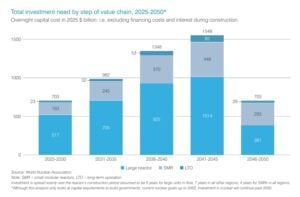
Where Could the $6 Trillion Nuclear Investment Go?
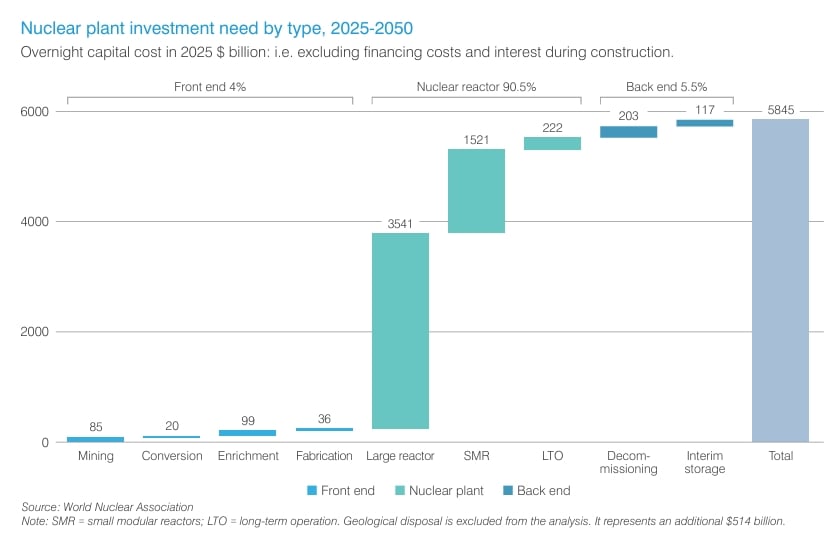
The WNA estimates that nuclear reactors will account for approximately $5.3 trillion, or 90.5%, of total investment across the nuclear value chain through 2050.
The main opportunities include:
- Large nuclear reactors: Approximately $3.5 trillion in projected investment.
- Small modular reactors: Around $1.5 trillion to support approximately 260 GW of capacity.
- Existing nuclear plants: About $222 billion for lifetime extensions.
- Nuclear fuel supply: Approximately $240 billion for uranium mining, conversion, enrichment and fuel fabrication.
- Decommissioning and interim storage: Around $320 billion for managing the back end of the nuclear industry.
Geological disposal of nuclear waste could require another $514 billion, according to the report, although this amount is excluded from the headline $6 trillion estimate.
SMRs could become an important part of the expansion. These smaller reactors are designed to support standardized manufacturing and potentially shorter construction schedules. However, investors still need evidence that commercial projects can achieve competitive costs and reliable delivery.
The wider nuclear supply chain could also benefit. Uranium producers, enrichment companies, fuel fabricators, engineering firms and specialized equipment manufacturers may see stronger demand if reactor construction accelerates.
Can Nuclear Capacity More Than Triple by 2060?
The International Atomic Energy Agency (IAEA) has extended its nuclear power projections to 2060 for the first time in its 2026 Energy, Electricity and Nuclear Power Estimates report.
The agency’s projections show a wide range of possible outcomes:
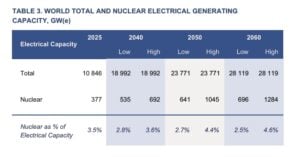
- Low case: Global nuclear capacity reaches 696 GWe by 2060.
- High case: Capacity rises to 1,284 GWe, more than three times the level at the end of 2025.
- New capacity: The high case assumes approximately 1,017 GWe of additions by 2060, offset by around 128 GWe of retirements.
- SMR contribution: Small modular reactors account for about 28% of new capacity in the high case.
The IAEA also reported that 72 reactors, with a combined capacity of 77.2 GWe, were under construction at the end of 2025.
These projections are scenarios rather than guaranteed outcomes. Achieving the higher growth case will depend on national policies, financing, construction capacity, and the ability to complete projects on time.
Uranium Supply Could Create Another Investment Opportunity
Expanding nuclear power will require a larger and more reliable uranium supply. A September 2026 report from the OECD Nuclear Energy Agency (NEA) and the IAEA found that identified uranium resources are sufficient to meet even the highest projected demand through 2050. However, turning those resources into mine production will require sustained investment.
- The agencies estimate that annual uranium requirements could rise from approximately 64,500 tonnes of uranium in 2025 to between 84,800 and 143,900 tonnes by 2050, depending on nuclear capacity growth.
- Investment in exploration and mine development is already increasing. Global uranium exploration and development spending exceeded $1.78 billion during 2023 and 2024, approximately 46% higher than in 2021 and 2022.
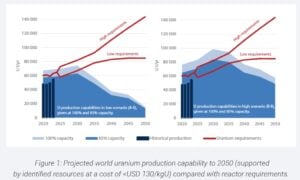
Yet new supply takes time to develop. The NEA says uranium mining projects typically require 15 to 20 years of development. Long-term contracts and adequate uranium prices will therefore be important to encourage new mines and reduce future supply risks.
This creates a potential opportunity for uranium miners and fuel suppliers, but rising demand alone does not guarantee higher profits. Project costs, uranium prices, permitting and the timing of new supply will influence returns.
What Could Hold Back Nuclear Investment?
Despite the scale of the opportunity, nuclear projects require substantial upfront capital and can take years to complete. Construction delays, cost overruns, licensing requirements, and supply-chain constraints can weaken project economics.
The WNA’s July 2026 financing roadmap identifies several conditions needed to attract more institutional capital:
- Standardized reactor designs and repeatable project structures.
- Clear rules for allocating construction and operating risks.
- Predictable revenue models and long-term financing arrangements.
- Stronger manufacturing capacity and skilled workforces.
- Government support and credible plans for waste management and decommissioning.
Private investors may be more willing to finance nuclear projects when governments provide stable policies and developers demonstrate a track record of delivering plants on schedule.
Is Nuclear Energy a Long-Term Investment Opportunity?
The $6 trillion estimate highlights the potential scale of nuclear investment through 2050. Large reactors are expected to attract most of the spending, while SMRs, uranium mining, enrichment and fuel fabrication could offer additional opportunities across the supply chain.
For investors, the central question is whether governments can convert ambitious capacity targets into funded, operating projects. Nuclear power could become more important as electricity demand rises, but the industry must overcome financing challenges and improve construction performance.
The projected investment represents potential market demand, not guaranteed revenue or investment returns. Companies that can deliver projects efficiently and supply critical nuclear materials may be better positioned to benefit if the industry enters a sustained growth cycle.