

A major Turkish business group sponsoring the upcoming UN climate summit has weakened its emissions targets while its oil-refining business benefits from a global supply crunch and rising profits.
Koç Holding, one of Türkiye’s largest industrial groups, is the Global Business Partner of COP31, which will take place in Antalya from November 9 to 20, 2026. Its energy subsidiary, Tüpraş, operates the country’s largest oil-refining business.
An investigation by Climate Home News found that Koç Holding and Tüpraş lowered their 2030 emissions reduction targets in 2025. The change came as Tüpraş planned to keep its refineries running at high capacity and prepare for higher production in 2026.
The findings raise questions about the role of major fossil fuel-linked companies at climate summits. They also highlight the challenge of judging corporate climate plans when companies continue to depend on oil while investing in lower-carbon energy.
Koç Holding and Tüpraş did not respond to multiple requests for comment from Climate Home News. The UN climate secretariat and the COP31 presidency also declined to answer questions about the sponsorship agreement.
COP31 Sponsorship Raises Questions About Climate Integrity
Koç Holding was named COP31’s Global Business Partner in August 2026. The COP31 presidency said the group would share its experience in turning climate commitments into practical business action.
The partnership gives Koç a prominent role at a summit designed to advance global climate action. But the company’s oil business has brought its climate record under fresh scrutiny.
The hosting agreement between Türkiye and the UN Framework Convention on Climate Change (UNFCCC) says the government should seek advice from the UN climate secretariat when assessing potential partners. The agreement also says that a partner’s “climate integrity” should be considered.
However, the process for applying this test remains unclear. The Turkish presidency has not published its sponsor-selection criteria or the financial terms of its partnership agreements.
Campaigners say companies with major fossil fuel businesses should face stronger checks before receiving prominent roles at climate conferences. They argue that sponsorship can give companies visibility and access to policymakers, even when their business plans remain tied to oil and gas.
The issue is not limited to COP31. Previous climate summits have also accepted sponsorship from companies linked to fossil fuels, prompting calls for clearer rules on corporate participation.
Koç Holding and Tüpraş Lowered Their Emissions Targets
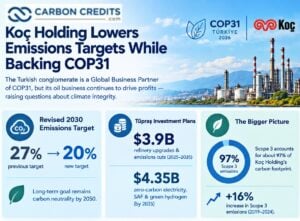
Koç Holding and Tüpraş both announced lower interim emissions reduction targets in 2025. The companies had previously aimed to cut emissions from their own operations by 27% by 2030, compared with 2017 levels. They reduced that target to 20%.
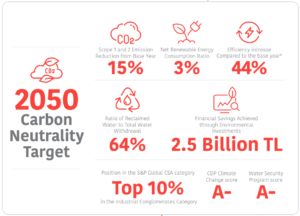
Tüpraş also lowered its 2035 target from a 35% reduction to 25%. Both companies have retained their long-term ambition to reach carbon neutrality by 2050.
The companies said changing market conditions, economic pressures and technology developments had affected their plans. Koç Holding also pointed to the slower-than-expected development of green hydrogen, which had been an important part of its earlier transition strategy.
The revised 2030 targets are closer to the progress the companies had already made. By 2025, Koç Holding had cut emissions from its own operations by about 16% from 2017 levels, while Tüpraş had reduced them by around 17%.
This means the companies have less ground to cover to meet their updated interim goals. However, lower targets do not automatically mean emissions will rise. Actual results will depend on future operations, investments, and emissions reporting.
Oil Refining Remains Central to the Business
Tüpraş is the main source of income for Koç Holding’s energy division. It operates four refineries that turn crude oil into petrol, diesel, jet fuel, and other products.
In 2025, Tüpraş processed 28.1 million tonnes of crude oil and other materials and produced 26.8 million tonnes of products. Its refineries operated at 93% of capacity.
The company planned to raise production to 29 million tonnes in 2026. It has said it intends to maintain existing refinery capacity and run its facilities at maximum potential.
Tüpraş has also benefited from strong refining margins. These margins—the difference between the cost of crude oil and the value of refined products—rose as the global oil-processing market faced supply pressures linked to the Middle East crisis.
The strong oil business sits alongside the group’s stated climate ambitions. Koç Holding and Tüpraş have pledged to reach carbon neutrality by 2050, but oil refining is expected to remain an important source of earnings for years to come.
The issue is not simply that Tüpraş continues to operate refineries. The key question is whether its investments and emissions plans will lead to a meaningful shift away from fossil fuels over time.
Most of the Group’s Emissions Come From Sold Fuels
A major gap in the revised targets is their limited coverage of the group’s overall climate impact. The targets focus on emissions from the companies’ own operations and purchased energy. These are known as Scope 1 and Scope 2 emissions.
But much of the climate impact comes from products sold to customers. When petrol, diesel and jet fuel are burned in cars, trucks and aircraft, they release greenhouse gases. These emissions are known as Scope 3.
Climate Home News reported that Scope 3 emissions accounted for about 97% of Koç Holding’s carbon footprint. These emissions rose by roughly one-sixth between 2019 and 2024, and neither Koç Holding nor Tüpraş has set a target to reduce them.
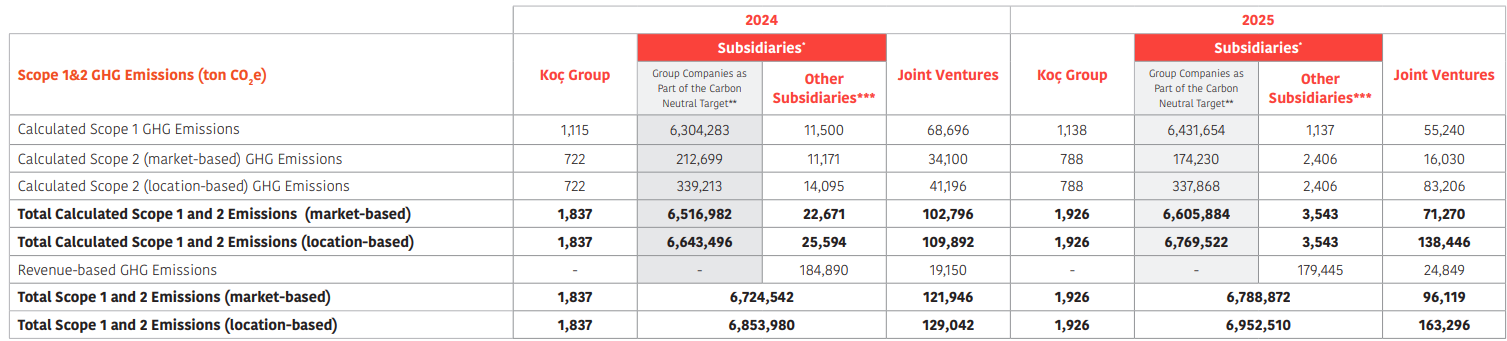
This distinction matters when assessing a company’s climate progress. A refinery can cut the energy it uses and improve its own efficiency while continuing to sell large volumes of fossil fuels. Without a clear plan to address emissions from sold products, cuts at factories and refineries may cover only a small part of the company’s total climate impact.
Green Investment Plans Face Delays and Cost Pressures
Koç Holding and Tüpraş are also investing in lower-carbon energy. Their plans include renewable electricity, sustainable aviation fuel (SAF) and green hydrogen.
Tüpraş plans to invest $3.9 billion between 2025 and 2035 in refinery improvements and measures to reduce emissions from its operations. Its wider plan calls for $4.35 billion in investment in zero-carbon electricity, sustainable aviation fuel and green hydrogen by 2035.
The company also aims to expand its installed zero-carbon electricity capacity to 1.6 gigawatts by 2030 and 2.5 GW by 2035. Its renewable energy portfolio includes solar and wind projects, while additional developments remain in the pipeline.
However, some projects have been delayed or scaled back.
Tüpraş originally planned to begin producing green hydrogen in 2025. It now expects to launch a pilot project by 2030, with large-scale commercial production not expected before 2035. The company has cited higher costs for electrolyzers, which use electricity to split water into hydrogen and oxygen.
Its SAF plans have also changed. Instead of converting an existing refinery unit by 2026, Tüpraş now plans to build a separate plant expected to begin operating toward the end of 2028. That change means the new fuel production would be added to existing refining capacity rather than replacing it.
The projects could support the transition to lower-carbon energy. But delays and high costs show how difficult it can be to turn long-term climate plans into operating businesses.
COP31 Puts Corporate Climate Claims Under the Spotlight
The Koç Holding case highlights a wider challenge for COP31: how to bring businesses into climate action while ensuring their claims match their investment decisions and emissions results.
Corporate partnerships can help fund new technology and expand clean energy projects. But a sponsor’s role at a climate summit also carries reputational value, making the selection process important.
For Koç Holding and Tüpraş, the main test will be whether their planned investments lead to substantial and lasting changes in their businesses. Progress will depend on more than emissions cuts at refineries. It will also depend on how the group addresses emissions from the fuels it sells and whether its low-carbon projects move forward.
COP31’s approach to sponsor screening may also shape future debates over the role of companies with large fossil fuel interests at UN climate conferences.
As world leaders prepare to meet in Antalya, the question is not only what companies promise to do. It is whether their targets, spending, and business plans show a credible path toward lower emissions.