


Verra has received the first ICVCM approval for a methodology covering early coal plant retirement. Its VM0052 Version 1.1 allows eligible transition credits to carry the Core Carbon Principles (CCP) label, marking a major step for carbon finance and the energy transition.
Furthermore, this development could attract more investors and carbon credit buyers to projects that speed up coal plant closures. These projects aim to replace coal-fired electricity with renewable energy while supporting workers and communities affected by plant shutdowns.
The CCP label also gives these transition credits a recognized quality benchmark in the voluntary carbon market. This recognition could build buyer confidence and encourage more companies to invest in projects that help phase out coal.
How Verra’s VM0052 Methodology Works
Coal-fired power plants remain a major source of global greenhouse gas emissions. However, shutting them down before the end of their operating lives can create financial and energy security challenges, particularly in emerging economies.
Many plants still have years of operation ahead. Owners may lose electricity revenue, while workers, contractors, local businesses, and communities may face significant economic disruption.
Verra developed VM0052 to address these challenges through carbon finance. The methodology allows eligible projects to generate Verified Carbon Units (VCUs) for emissions reductions achieved by retiring operating coal-fired power plants earlier than planned and replacing their electricity generation with renewable energy.
The methodology does not simply reward a plant for closing. Project developers must demonstrate that the retirement would not have happened at the same time without the project. They must also account for electricity generation that replaces the retired coal capacity.
- This distinction is important because shutting down one coal plant does not automatically reduce emissions if other fossil fuel facilities increase their electricity production to fill the gap.
Mandy Rambharos, CEO of Verra, says:
Key Eligibility Rules Under VM0052
Version 1.1, published on October 30, 2026, sets specific conditions for coal retirement projects seeking carbon credits.
For example, eligible coal-fired power plants must meet several requirements:
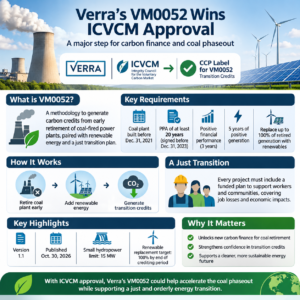
- Construction must have started before December 31, 2021. This prevents developers from building new coal plants with the expectation of receiving carbon finance for early retirement.
- The plant must have a long-term power purchase agreement (PPA) of at least 20 years, signed before December 31, 2023.
- The plant must have generated positive annual net income after tax during the previous three years and demonstrate positive fair value.
- It must also show positive electricity generation over the previous five years.
These conditions help ensure that the methodology supports the early closure of operating coal assets rather than plants that are already financially unviable or close to retirement.
The methodology also requires project developers to demonstrate that the retirement is additional. In simple terms, the plant must close earlier than it would have under normal technical, economic, or regulatory conditions.
Verra uses a separate module, VMD0060, to assess the baseline retirement date and additionality of each project.
Here’s the summary of Verra’s methodology:
Renewable Energy Must Replace Coal Power
Another important requirement is the replacement of lost coal-based electricity with new renewable generation.
Under VM0052, project developers must prepare a renewable electricity pairing plan. The new facilities must export electricity to the grid and collectively provide enough annual generation to replace 100% of the retired coal plant’s annual electricity output by the end of the crediting period, based on a P90 generation estimate, or meet the quantity required by the system operator.
Eligible replacement technologies include:
- Solar power, with or without battery energy storage systems (BESS)
- Onshore and offshore wind
- Small hydropower, limited to 15 MW of net output capacity for individual plants
- Geothermal energy
- Tidal and wave power
- Eligible biogas and waste-to-energy facilities
The methodology also allows four ways to connect renewable energy development with coal retirement: contractual, financial, on-site, and regulatory pairing.
For example, a utility could revise a coal plant’s power purchase agreement to include new renewable electricity capacity. Alternatively, refinancing arrangements could require investment in renewable generation as a condition for retiring the coal facility.
These requirements help ensure that coal retirement leads to a cleaner electricity supply rather than shifting emissions elsewhere in the grid.
Just Transition Plans Protect Workers and Communities
VM0052 also places social safeguards at the center of the carbon crediting process.
Every project must develop and implement a comprehensive just transition plan under Verra’s VMD0061 module. The plan must address potential job losses, household income disruptions, and the wider economic impact on communities that depend on coal-fired power plants.
Importantly, the plan must be fully funded from sources other than VCU sales revenue. This means project developers cannot rely solely on future carbon credit sales to finance worker and community support.
The methodology also requires ongoing monitoring of stakeholder engagement, livelihood protection, financial transactions, and the implementation of transition measures.
These safeguards could help address one of the biggest challenges in coal phaseouts: ensuring that climate action does not leave workers and local economies behind.
Stronger Monitoring and Carbon Accounting Under Version 1.1
The updated methodology introduces more detailed requirements for calculating emissions reductions and monitoring project performance.
Project developers must account for baseline emissions from the coal plant, emissions from replacement electricity, and potential leakage from other power plants that increase generation after the coal facility closes.
For instance, if gas-fired power plants supply electricity that the retired coal facility previously generated, the methodology requires developers to account for associated emissions, including upstream methane leakage where applicable.
- Version 1.1 also strengthens monitoring requirements. Developers must track renewable energy generation milestones and notify Verra and the system operator within 60 days if a milestone is at risk or missed.
Carbon credit issuance can be paused when renewable generation targets are not met. The methodology also requires proper decommissioning of major coal equipment and the start of site cleanup, including the safe disposal of coal ash and hazardous materials.
Projects must also prevent double counting of renewable electricity benefits under other carbon crediting or environmental attribute programs.
What the ICVCM Approval Means for Carbon Markets
The ICVCM approval gives eligible VM0052 credits access to the CCP label, potentially making them more attractive to corporate buyers and investors seeking higher-integrity climate finance opportunities.
The development could also expand the role of voluntary carbon markets beyond conventional emissions reduction and removal projects. Transition credits offer a financing mechanism for tackling emissions from existing fossil fuel infrastructure, where early retirement can be difficult without additional financial support.
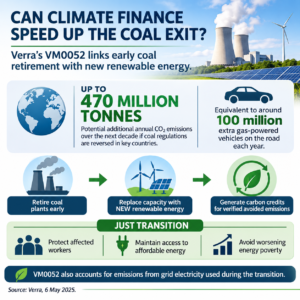
- However, the approval does not mean that every coal retirement project automatically qualifies for CCP-labelled credits. Individual projects must still meet VM0052 requirements, undergo validation and verification, and comply with Verra’s VCS Program rules.
The methodology also includes safeguards against carbon lock-in. Project proponents and relevant host countries must maintain commitments against building new coal plants or expanding existing coal capacity.
Ultimately, VM0052 creates a framework for connecting carbon finance with a more challenging part of the energy transition: retiring existing coal assets while maintaining reliable electricity supplies and protecting affected communities.
Overall, the ICVCM recognition could help Verra attract private investment for early coal retirement and renewable energy projects. However, the key challenge will be delivering real emissions cuts while protecting energy security and supporting affected communities.