

Audi is giving old cars a new purpose. The company is launching Audi Circular Solutions GmbH, a new business designed to recover valuable materials, reuse vehicle components, and bring more recycled resources back into car production.
The initiative aims to turn vehicle recycling into a profitable business rather than treating it as simply the final step in a car’s life cycle.
The new subsidiary will combine used-car purchases, vehicle dismantling, second-hand parts sales, and raw-material recovery. It plans to start operations in early 2027, initially focusing on a central sales channel for genuine used spare parts.
The move comes as the automotive industry faces growing pressure to reduce manufacturing emissions, use resources more efficiently, and cut its dependence on newly mined materials. By recovering materials from existing vehicles, Audi wants to keep valuable resources in circulation for longer.
From Old Vehicles to Valuable Materials
Audi is building on its earlier recycling projects to expand this business.
One example is its MaterialLoop project, which brought together 15 partners from the research, recycling, and automotive industries. The initiative examined how materials from 100 end-of-life vehicles could be recovered and reused in new production.
The results were promising. Audi recovered more than 60% of the aluminum and over 85% of the steel from the vehicles for potential reuse in manufacturing.
The company also worked with recycling partner TSR Resource to recover steel from old vehicles. A digital material account tracks the recovered material, helping suppliers bring recycled steel back into the production process.
With Audi Circular Solutions, the company wants to take these efforts further and build a more organized system for collecting, processing, and selling used components and recovered materials.
How the New Circular Business Will Work
The new subsidiary will focus on four main activities:
- Buying used vehicles and components: Acquiring vehicles and parts that still have economic value.
- Dismantling vehicles: Working with specialist partners to recover reusable components and materials.
- Selling genuine used parts: Creating a central sales channel for customers looking for original Audi components.
- Recovering raw materials: Returning recycled materials to the automotive supply chain.
The business will initially focus on company-owned vehicles, including its internal fleet. It plans to expand later by purchasing additional used vehicles for dismantling.
The used-parts business will first target private and commercial customers in Germany and other European markets. Audi may also include components from other vehicle brands in the future.
Rather than building the entire recycling network itself, the company will work with established dismantling and recycling partners. This could help it expand faster while creating new business opportunities across the recycling supply chain.
Cutting Emissions Through Better Energy and Resource Efficiency
The circular economy push also supports Audi’s wider sustainability strategy.
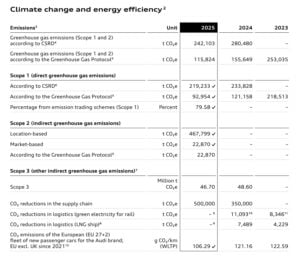
According to its 2025 Sustainability Report, the company’s Scope 1 and 2 greenhouse gas emissions across its reporting production sites fell to approximately 549,174 tonnes of CO₂ equivalent in 2025, compared with 630,887 tonnes in 2024. That’s a reduction of around 13%.
- Energy consumption also declined. Total energy use reached approximately 3.07 million MWh in 2025, down from 3.27 million MWh a year earlier.
- Renewable energy supplied around 1.95 million MWh, representing nearly 64% of total energy consumption.
Audi also improved its specific energy consumption from 1.96 MWh per vehicle in 2024 to 1.89 MWh in 2025. These improvements show how manufacturing efficiency and cleaner energy can help reduce the environmental impact of vehicle production.
However, the bigger challenge lies across the supply chain. Audi reported approximately 46.7 million tonnes of Scope 3 emissions in 2025, compared with 48.6 million tonnes in 2024.
Raw material extraction, component manufacturing, and logistics all contribute to these emissions. Increasing recycled material use could help address part of this footprint, particularly for energy-intensive materials such as steel and aluminum.
Recycling Steel, Aluminum, and EV Batteries
Audi is already putting circular manufacturing principles into practice.
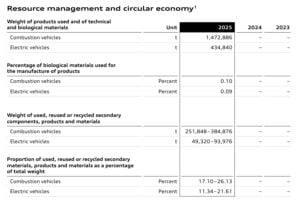
Its Aluminum Closed Loop system, launched in 2017, sends aluminum offcuts from production facilities back to suppliers. These materials are recycled into new aluminum sheets and returned to manufacturing. This reduces waste and the need for additional primary aluminum.
The company is also increasing recycled steel and aluminum use in selected vehicle components. For example, post-consumer recycled steel is used in parts of the Audi Q6 e-tron and A6 e-tron.
Battery recycling is another important focus. Through partnerships and research initiatives, Audi is exploring ways to recover valuable materials from used high-voltage batteries, including lithium, nickel, manganese, and cobalt.
These materials are essential for electric vehicle batteries and energy storage systems. Recovering them could reduce pressure on mining operations and create more resilient supply chains.
The company is also exploring ways to recycle plastics from old vehicles. Better sorting and processing technologies could help recover mixed plastic waste that would otherwise be difficult to reuse.
Can Vehicle Recycling Become a New Revenue Stream?
Audi’s latest move reflects a bigger change in the automotive industry. Car manufacturers are increasingly looking beyond vehicle sales and exploring how they can generate value throughout a vehicle’s entire life cycle.
For Audi, the opportunity goes beyond reducing waste. Selling used genuine parts could create additional revenue, while recovering valuable materials could lower procurement costs and reduce dependence on virgin resources.
The initiative also supports the Volkswagen Group’s regenerate+ sustainability strategy, which focuses on resource efficiency, recycling, and greater use of secondary materials.
Audi aims to achieve net carbon neutrality across its value chain by 2050 at the latest. Expanding vehicle reuse and material recovery could help move the company closer to that goal.
The real test will be how quickly Audi can scale the business, build reliable recycling partnerships, and bring recovered materials back into production.
If successful, Audi Circular Solutions could make old vehicles more valuable, reduce manufacturing waste, and turn circular manufacturing into a new growth opportunity.