

The nickel market remains highly uncertain. Stainless steel, electric vehicle (EV) batteries, and industrial uses support demand. However, expanding Indonesian production and high inventories continue to weigh on nickel prices.
Indonesia’s production policy could become the market’s biggest price driver. Meanwhile, mining companies are advancing projects outside Indonesia to diversify supply chains.
For investors, the key question is whether nickel demand can absorb growing supply. A recovery will depend on actual production cuts, industrial activity, and battery-market trends.
Nickel Prices: Can the Market Recover?
Nickel struggled to sustain a recovery in 2026. The LME three-month contract briefly moved above $16,000 per tonne in October after reports that Chinese producers were considering output reductions at Indonesian operations.
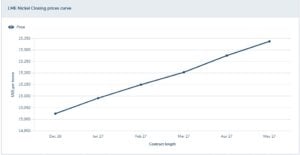
The contract closed at $15,479 per tonne on November 23. Its official cash price stood at $15,210 per tonne on November 24. LME warehouse stocks reached 275,184 tonnes, while prices remained about 7% lower year to date.
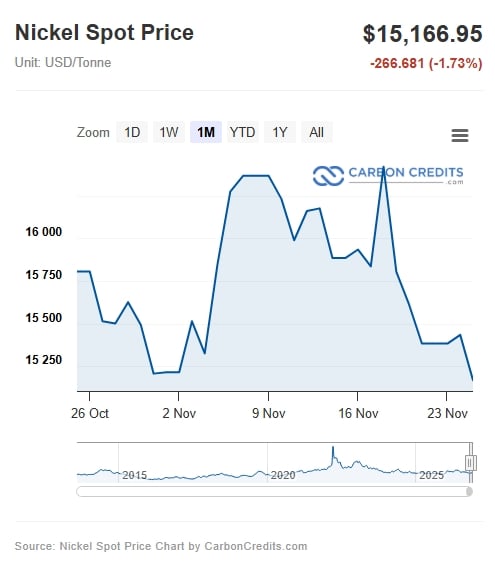
Large inventories can limit price gains even when producers announce cuts. Investors should watch exchange stocks, Indonesian quotas, and Chinese smelter output. Lower ore availability may support prices, but existing refined nickel stocks could delay the effect.
Global Supply Could Outpace Demand
The International Nickel Study Group (INSG) expects primary nickel production to reach 3.87 million tonnes in 2026, against consumption of 3.85 million tonnes. That implies a 19,000-tonne surplus.
For 2027, INSG projects production of 4.07 million tonnes and demand of 4 million tonnes, creating a 70,000-tonne surplus. S&P Global Energy’s CERA is more optimistic: it forecasts a 30,000-tonne surplus in 2027 and a possible market deficit in 2029.
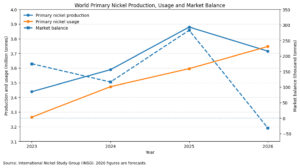
The gap between forecasts reflects different assumptions about Indonesian output, stainless steel, and battery demand. Investors should treat them as scenarios, not certainties.
Indonesia Holds the Supply Switch
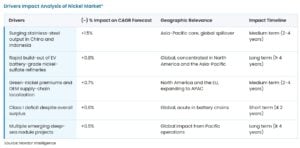
Indonesia has become the center of the nickel industry through its resource base and investment in processing facilities. But capacity has grown faster than consumption, putting pressure on prices and mining margins.
In November, officials indicated that Indonesia could tighten its 2027 ore quota under its annual mining work plan, known as RKAB. The country revised its 2026 quota to about 290-300 million wet metric tonnes, up from an initial allocation of 260-270 million tonnes.
Ore quotas and refined nickel output are different. Smelters may use inventories or imported ore, including material from the Philippines.
Stainless Steel and Batteries Shape Demand
Stainless steel remains nickel’s largest end-use market.
Batteries offer another growth market. Nickel is used in nickel-manganese-cobalt (NMC) and nickel-cobalt-aluminium (NCA) chemistries, which provide high energy density. However, lithium iron phosphate (LFP) batteries have gained market share, particularly in China. They avoid nickel and cobalt and can lower manufacturing costs.
Nickel may still benefit from battery production, energy storage, and industrial uses. Recycling could add supply as more EV batteries reach the end of their useful lives.
Top Nickel Mining Deals that Highlight Supply Diversification
Companies continue to advance projects outside Indonesia despite weak prices. Buyers want more diverse sources and long-term supply agreements.
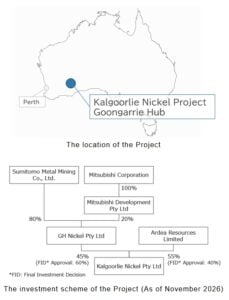
On November 24, Sumitomo Metal Mining announced an agreement with Mitsubishi Corporation and Ardea Resources to advance the Goongarrie Hub in Western Australia into pre-FEED. Sumitomo and Mitsubishi will provide A$58.8 million for the next study phase, due to finish in 2027.
The project could produce 30,000 tonnes of nickel and 2,000 tonnes of cobalt annually for more than 40 years.
- MMG is also seeking approval for its proposed $500 million acquisition of Anglo American’s Brazilian nickel business.
- European steelmakers want guarantees that Brazilian ferronickel will continue reaching their market. Reuters reported that MMG proposed increasing annual European supplies from 11,500 tonnes to 16,000 tonnes.
- In Canada, Canada Nickel extended its US$27.8 million loan facility with Auramet International to February 9, 2027.
What Investors Should Watch in 2027
According to Mordor Intelligence, the global nickel market size was estimated at 3.40 million tons in 2025 and is expected to grow from 3.55 million tons in 2026 to 4.39 million tons by 2031, at a CAGR of 4.36% during the forecast period.
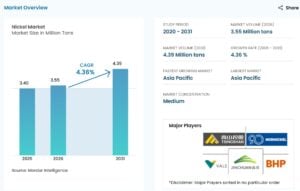
INSG’s projected surplus suggests prices may struggle unless supply growth slows or demand strengthens. CERA’s smaller surplus offers a more constructive scenario, but both forecasts depend heavily on Indonesia.
Investors should monitor the 2027 ore quota, actual mine and smelter output, exchange inventories, and stainless steel production.
Projects with competitive costs, infrastructure, financing, and credible offtake agreements may attract interest. Higher-cost developments without committed buyers could struggle to secure capital.
Nickel’s long-term demand story remains relevant, but EV growth alone will not determine its future. Stainless steel remains essential, while LFP batteries limit nickel use in some vehicles. Oversupply remains the market’s main challenge. A lasting recovery will require production discipline and stronger consumption.