

Meta is reviewing its 2030 net-zero emissions goal as the rapid growth of artificial intelligence (AI) puts pressure on its climate plans. The company says its long-term ambition remains unchanged. However, it is reconsidering the timeline and interim targets because energy systems and low-carbon supply chains have not kept pace with its expanding infrastructure.
The review is a major development for one of the world’s largest technology companies. Meta continues to invest in clean energy, more efficient data centers, and carbon removal. However, its latest sustainability report also shows that net emissions rose sharply in 2025 as the company expanded its AI operations.
The 2026 Meta Sustainability Report provides a closer look at this challenge. It covers the company’s environmental performance in 2025 and outlines its plans for climate action, energy, water, and its supply chain.
Meta Puts Its 2030 Net-Zero Timeline Under Review
Meta set a goal in 2020 to reach net-zero emissions across its value chain by 2030. The target covered emissions from its own operations as well as those linked to suppliers, construction, and other business activities. But the company now says the conditions behind that goal have changed.
In the report, Meta executives Rachel Peterson, vice president of data centers, and Blair Swedeen, global head of net zero and sustainability, said demand for AI infrastructure had grown faster than expected. At the same time, clean energy deployment and other low-carbon solutions had not advanced at the speed needed to support that growth. They noted:
“Transforming these systems will take time and collective effort, which is why we are doing two things at once: continuing to invest, innovate, and partner at pace, and evolving our pathway to net zero. We are re-evaluating our timelines, sequencing, and interim milestones — including the 2030 timeframe for our net zero emissions goal and our near-term intensity targets — so our approach reflects current operating realities while keeping progress transparent year over year.”
The company pointed to several challenges. Grid connection queues can take years. Permitting remains slow, while new transmission lines are not being built fast enough. Supply chains for low-carbon fuels, materials, and hardware also need more time to develop.
Meta is therefore reviewing its timelines, the order in which it plans to act, and its interim milestones. This includes the 2030 net-zero deadline and its near-term emissions intensity targets.
The company has not announced a replacement date. It also says its long-term ambition remains to reach net zero, restore more water than it consumes, and build infrastructure that supports local communities and power grids.
This means Meta has not formally canceled its net-zero goal. However, the review raises questions about how quickly the company can reduce emissions while continuing to expand its AI business.
AI Growth Pushes Meta’s Emissions Higher
The report shows the scale of the challenge. Meta recorded 11.8 million metric tonnes of net greenhouse gas emissions in 2025, a 45% increase from the previous year. Most of the increase came from Scope 3 emissions, which cover impacts across the company’s value chain.
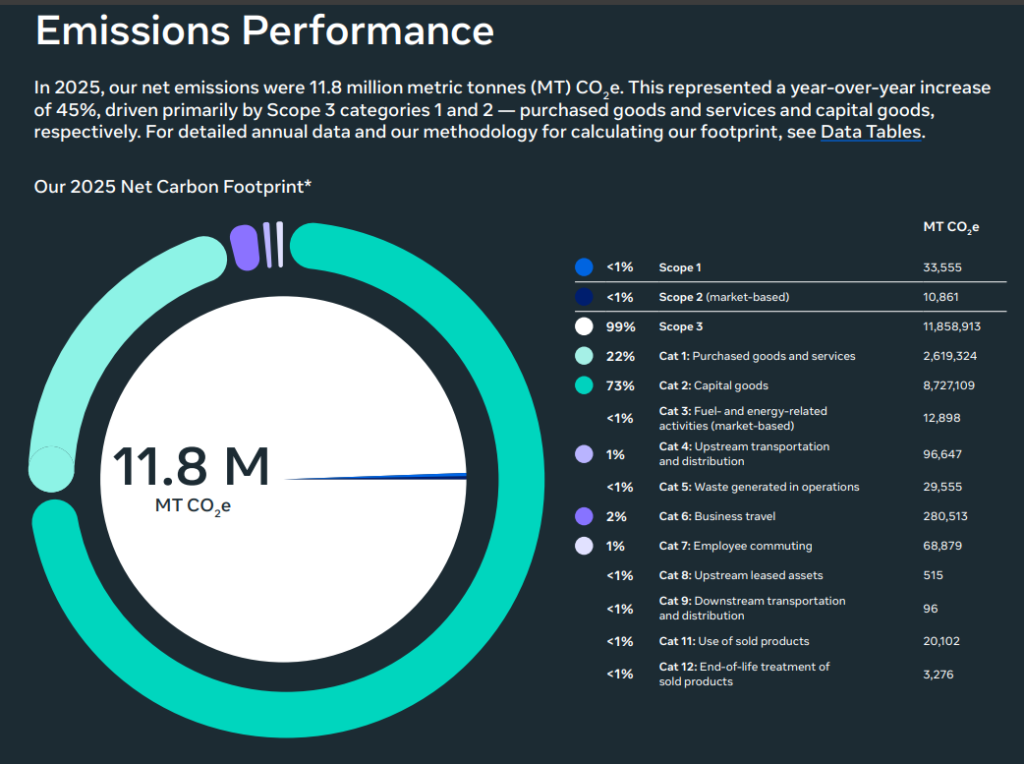
Scope 3 made up 99% of Meta’s reported net emissions. Within this category, capital goods accounted for about 8.73 million tonnes of CO2 equivalent (CO2e), or 73% of the total. This includes equipment and other materials used to build and expand data centers.
- Purchased goods and services added another 2.62 million tonnes, equal to 22% of the total.
These figures show that Meta’s climate challenge goes beyond the electricity used to run its data centers. Building new facilities and buying the hardware needed for AI also create a large carbon footprint.
Electricity demand is rising as well. Meta’s electricity consumption increased by 35% in 2025, according to reporting on the company’s latest results. The growth reflects the expansion of data centers and the computing power needed for AI services.
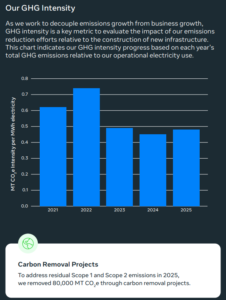
The report also shows that emissions intensity increased slightly in 2025 after falling in the previous two years. This suggests that efficiency gains have not yet offset the wider impact of infrastructure growth.
Meta Adds More Clean Energy as Power Demand Grows
Despite rising emissions, Meta remains one of the world’s largest corporate buyers of clean and renewable energy. The company says it matched 100% of its annual electricity use with clean and renewable energy for the sixth consecutive year in 2025.
The tech giant also signed contracts for more than 10 gigawatts (GW) of new clean energy capacity during the year. That brought its total contracted capacity to more than 30 GW across seven countries and 28 U.S. states. Nearly 12 GW was already producing electricity.
The difference matters. Contracted capacity does not mean that every project is already operating or supplying power to Meta’s data centers. The company still needs new projects to be built and connected to the grid.
Meta is also broadening its energy strategy beyond solar and wind. Its agreements with nuclear energy companies could help enable up to 7.7 GW of nuclear power in the United States by 2035. It is also supporting geothermal energy, battery storage, and longer-duration energy storage.
For example, Meta has backed a 150-megawatt advanced geothermal project in New Mexico. It has also contracted for more than 700 MW of traditional energy storage projects and reserved access to up to 1 GW of potential space-based solar capacity as that technology develops.
These investments could help provide more reliable, lower-carbon electricity as demand grows. However, many projects will take years to become operational.
Natural Gas Adds Another Climate Challenge
Meta may use on-site power generation, including natural gas, when local utilities cannot meet its electricity needs. It is also seeking low-methane gas certificates to address emissions from gas production and transport.
However, these certificates do not make gas-fired power carbon-free. This creates a challenge for Meta as it invests in clean energy while considering gas to meet rising AI power demand.
Data Center Design and Suppliers Offer Ways to Cut Emissions
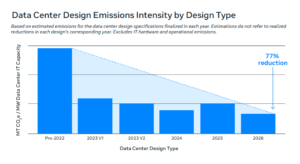
Meta says its latest data center designs have 77% less embodied carbon than its original specifications. It is also supporting low-carbon concrete, mass timber, and lower-carbon steel.
In 2025, suppliers responsible for 62% of its supply-chain emissions had science-aligned targets, up from 48% in 2024. Meta also engaged 343 suppliers, nearly twice the previous number.
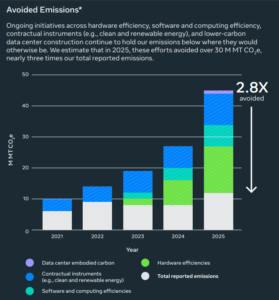
The company estimates that its efficiency, clean energy, and construction efforts avoided more than 30 million tonnes of CO2e in 2025. This is an estimate of emissions avoided, not a reduction in its reported emissions.
Carbon Removal Supports Meta’s Long-Term Climate Strategy
Meta uses carbon removal to address emissions it cannot eliminate. In 2025, it removed 80,000 tonnes of CO2e to address residual Scope 1 and Scope 2 emissions.
The company also agreed to buy 676,000 nature-based carbon removal credits from forest projects through 2035. The agreement supports climate-smart management of 68,000 acres on Washington’s Olympic Peninsula.
Meta is also working with Google and McKinsey on a Living Carbon reforestation project in Appalachia. It aims to restore degraded land while supporting biodiversity and local communities. These projects complement emissions cuts but cannot replace them.
AI Growth Tests Meta’s Net-Zero Ambition
Meta’s latest report presents two sides of its climate strategy. The company is expanding clean energy procurement, improving data center designs, and supporting carbon removal. Yet, its net emissions rose 45% in 2025 as AI infrastructure demand increased.
The review of its 2030 net-zero timeline reflects a wider challenge for the technology sector. Companies are building more data centers to support AI, but power grids, clean energy projects, and low-carbon supply chains are struggling to keep up.
Meta says it will continue investing in climate solutions and share updates as it reviews its targets. The next step will be to explain how its revised timeline and milestones can match the scale of its business expansion.
For now, the report makes one point clear: clean energy contracts and efficiency gains are important, but they have not yet stopped Meta’s emissions from rising. The company’s ability to bring down its full value-chain footprint will be a key test of whether its long-term net-zero ambition remains achievable.