


Global greenhouse gas emissions have reached another record, even as renewable energy, electric vehicles and other low-carbon technologies expand. The International Energy Agency’s (IEA) World Energy Outlook 2026 puts global economy-wide emissions at 54.1 gigatonnes (Gt) of CO₂ equivalent (CO₂e). The figure highlights a difficult reality: clean energy growth is not yet fast enough to drive a sustained decline in global emissions.
The energy sector has been responsible for around two-thirds of the increase in global greenhouse gas emissions over the past decade. The power sector accounts for the largest share of that growth, despite the rapid expansion of low-emissions electricity.
The challenge is not simply to add more renewable capacity. Countries must also reduce fossil fuel use, improve energy efficiency, electrify transport and industry, tackle methane emissions and scale carbon capture and removal. The IEA’s latest outlook shows how widely the results could differ depending on policy decisions and investment over the next two decades.
Global Emissions Remain on a Difficult Trajectory
The 54.1 Gt CO₂e figure covers greenhouse gases across the global economy. It is important to distinguish it from energy-related carbon dioxide emissions, which measure a narrower part of the climate problem.
- The IEA estimates that energy-related CO₂ emissions reached 38.7 Gt in 2025. Their growth has slowed compared with the previous decade, but they have yet to enter a structural decline.
The gap between slower growth and actual reductions matters. A slower increase in emissions does not mean the world is moving towards net zero. It means emissions are still adding to the concentration of greenhouse gases in the atmosphere, increasing pressure on countries to deliver deeper cuts.
The latest national climate commitments also leave a significant gap. According to the IEA, the new round of Nationally Determined Contributions (NDCs) implies that energy-related CO₂ emissions will fall by only around 0.5% annually through 2035, reaching approximately 31.2 Gt.
This pace is not enough to align global emissions with the Paris Agreement temperature goals. The IEA says the new pledges do not represent a meaningful improvement in overall energy-sector mitigation ambition compared with the previous submission cycle.
Three Energy Scenarios Show the Net-Zero Gap
The IEA’s outlook examines different energy futures through its Current Policies Scenario (CPS), Stated Policies Scenario (STEPS) and Net Zero Emissions by 2050 (NZE) Scenario. It also includes an Additional Response Case (ARC), which explores the impact of stronger measures that governments are considering.
The scenarios show how much policy implementation matters.
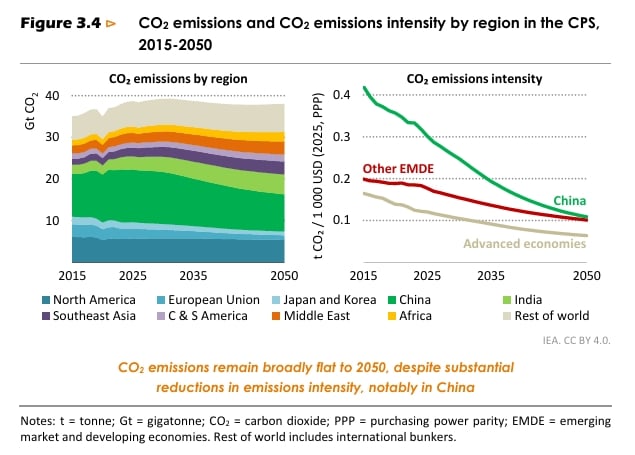
- Under the Current Policies Scenario, global energy-related CO₂ emissions remain broadly flat at around 38 Gt annually through 2050. Fossil fuels continue to account for a major share of energy supply, while global energy demand increases.
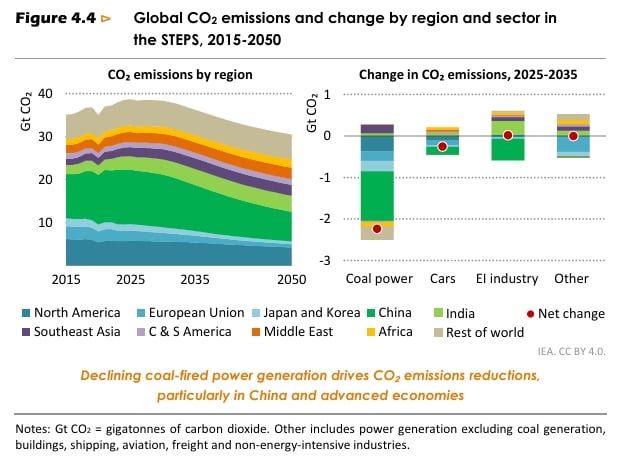
The Stated Policies Scenario offers a more dynamic outlook. It includes existing policies as well as measures governments have formally proposed. In this scenario, energy-related CO₂ emissions peak before 2030, fall to around 36 Gt by 2035 and reach approximately 30 Gt by 2050.
The Additional Response Case delivers somewhat faster reductions. However, the IEA estimates that global warming could still reach around 2.4°C by 2100 under this pathway. The Stated Policies Scenario points to approximately 2.5°C, while the Current Policies Scenario reaches around 2.9°C.
The NZE Scenario presents a much steeper transition. It requires energy-related emissions to fall by more than half by 2035, reaching below 19 Gt. Global warming peaks just below 1.7°C around mid-century before falling below 1.5°C by 2100.
This pathway also involves a period of temperature overshoot. The IEA estimates that warming exceeds 1.5°C for several decades, underlining how much earlier emissions reductions would have been needed to avoid crossing the threshold.
- READ MORE: UNEP Warns Global Warming May Overshoot 1.5°C, Calls for Faster Emissions Cuts and Carbon Removal
What a Credible Net-Zero Pathway Requires
The IEA identifies four major pillars for cutting energy-sector emissions: low-emissions electricity, efficiency and electrification, low-emissions fuels, and carbon capture and storage.
1. Expand low-emissions electricity
Renewables and nuclear power must replace a much larger share of fossil-fuel generation. Under the NZE Scenario, low-emissions sources account for almost 90% of global electricity generation by 2035, compared with 42% today.
The pathway requires installed renewable capacity to triple between 2025 and 2035. Nuclear capacity also grows significantly. However, adding generation alone will not be enough. The IEA projects that global transmission and distribution networks must expand by more than 30 million kilometres over the same period.
Grid investment, battery storage and system flexibility will therefore play a central role in integrating more renewable power.
2. Electrify transport, buildings and industry
Electricity must also replace fossil fuels in end-use sectors. The NZE Scenario sees electricity’s share of total final energy consumption rise from 23% in 2025 to 35% by 2035.
Electric vehicles, heat pumps and industrial electrification are important parts of this shift. By 2035, electric vehicles account for 36% of the global passenger car stock in the NZE pathway, compared with 6% in 2025.
Efficiency improvements are equally important. They can reduce energy demand while allowing economies to expand. The transition will also require stronger power grids and reliable access to electricity, particularly in emerging economies where energy demand is growing rapidly.
3. Cut methane and develop low-emissions fuels
Carbon dioxide is not the only priority. Methane has a strong near-term warming impact, making reductions in emissions from oil and gas operations particularly important.
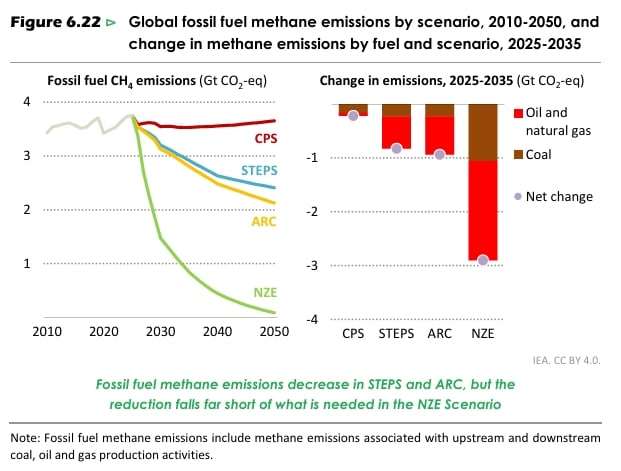
- In the NZE Scenario, fugitive methane emissions fall by around 80% by 2035. The IEA’s indicators also show fossil fuel methane emissions declining from 3.7 Gt CO₂e in 2025 to 0.8 Gt in 2035.
Low-emissions hydrogen, hydrogen-based fuels, bioenergy and other sustainable fuels can help reduce emissions in sectors that are difficult to electrify. Their deployment, however, must be supported by infrastructure, competitive production costs and credible emissions accounting.
4. Scale carbon capture and carbon removal
Carbon capture, utilisation and storage (CCUS) will have a larger role in industries where direct emissions reductions are difficult. The NZE Scenario projects annual CO₂ capture rising from 0.1 Gt in 2025 to 2.2 Gt by 2035 and 6.4 Gt by 2050.
Carbon removal also becomes increasingly important. The pathway includes 0.7 Gt of CO₂ removal by 2035, rising to 2.7 Gt by 2050.
These figures represent a major scale-up. They also highlight the need to distinguish between capturing emissions before they enter the atmosphere and removing CO₂ that is already in the atmosphere. Both may contribute to climate goals, but they are not interchangeable.
The Investment Challenge Behind Net Zero
The transition will require substantial capital. Under the NZE Scenario, average annual global clean energy investment triples to around $4.5 trillion during the decade to 2035.
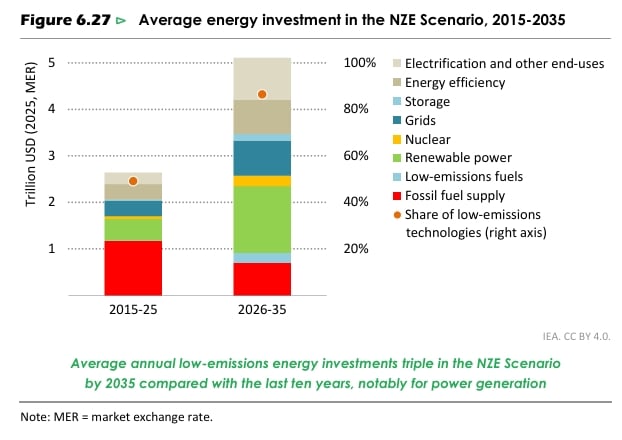
That investment must reach renewable generation, nuclear power, electricity networks, storage, electric transport, efficiency, low-emissions fuels, and carbon management infrastructure.
For carbon markets, the outlook points to a growing need for credible emissions reductions and durable carbon removal. However, carbon credits cannot replace direct cuts in fossil fuel use or delay investment in clean energy. Their role is strongest when they support additional climate action, address residual emissions, and meet robust standards for measurement, reporting, and verification.
Net Zero Depends on Execution, Not Just Targets
The IEA’s outlook makes one point clear: the world has several available technologies to reduce emissions, but deployment remains uneven, and policy ambition is not keeping pace with the scale of the challenge.
The difference between 2.9°C under current policies and the lower warming outcome in the NZE Scenario is not a minor adjustment. It reflects a fundamentally different energy system, requiring faster electrification, cleaner power, lower methane emissions and a much larger role for carbon capture and removal.
For investors, this creates opportunities across clean power, grids, batteries, nuclear energy, low-carbon fuels and carbon management. It also raises execution risks. Projects must secure financing, permits, infrastructure, reliable technology and long-term demand.
The 54.1 Gt CO₂e emissions figure is therefore more than a climate statistic. It is a measure of the distance between current economic activity and the emissions reductions needed to meet global climate goals. The next phase of the energy transition will be judged less by the number of net-zero pledges or renewable capacity announcements and more by whether actual emissions begin to fall consistently. Until that happens, the path to net zero remains a target rather than a demonstrated global trend.