


Google is giving access to its Earth Engine to all government and commercial entities. Google Earth Engine launched over a decade ago and access was only granted to researchers, academia, and non-profit organizations.
It is one of the world’s largest, publicly available collections of the Earth’s observation data, combining high-resolution photos and data that allow companies to know how their operations impact the environment.
Google is also launching a Carbon Footprint for Google Workspace will be ready in 2023. It will help users measure, report, and reduce emissions on Google services such as Gmail, Docs, and Meet.
Carbon Emissions Tech: Google Earth Engine
Digital technology always has a role to play in helping other sectors to decarbonize. Justin Keeble, managing director at Google Cloud, noted that,
“Even a small choice for an organization… [For example,] when to proactively water crops ahead of a drought, which green funds to invest in — requires understanding unique and often complex information.”
Earth Engine is a platform for scientific analysis and visual representation of geospatial data for various users. These include academic, non-profit, business, and government users.
Earth Engine hosts satellite imagery and stores it in a public data archive. This data storage includes historical earth images even going back over 40 years. The images are then available for global-scale data mining.
The technology allows one to analyze forest, water coverage, and land use changes. Users can also use it to assess the health of agricultural fields.
With it, users can detect changes, map trends, and quantify differences on the Earth’s surface.
According to users, the World Resources Institute, for instance:
“Google Earth Engine has made it possible for the first time in history to identify where and when tree cover change has occurred at high resolution… Global Forest Watch would not exist without it.”
Potential Carbon Emissions Reduction
The International Energy Agency has set net zero emissions by 2050. This particularly involves the energy, materials, and mobility sectors.
If scaled up across industries, Google Earth Engine can deliver up to 20% of the IEA’s emissions reduction.
A study by the World Economic Forum said that those industries can reduce emissions by 4% – 10% with the help of digital technology. Though not as significant as energy, the technology sector also contributes to carbon emissions in other industries.
A digital carbon footprint refers to the emissions from the production, use and data transfer of digital devices and infrastructure.
- In particular, global email usage produces as much CO2 as having 7 million more cars on the road. And so limiting email use can result in meaningful impact.
Take for example the case of email users in the UK alone. If each of them is sending one less email daily, about 16,433 tonnes of CO2 emissions can be reduced. This reduction is equal to 81,152 flights from London to Madrid.
The same use of Earth Engine is possible in many other applications. Thanks to it being one of the largest publicly available data catalogs.
-
Plus, its global data archive covers the past 50 years and is updated every 15 minutes.
The service can detect trends and understand correlations between human activities and their environmental impact. And that becomes “more precisely than ever before”. This makes Earth Engine a vital tool both for firms and organizations as they tackle climate change effects.
Companies can use Earth Engine in planning and achieving their carbon emissions reduction targets. At least a fifth of large public firms have set their net zero goals by 2050 at the most.
As Mr. Keeble also said, businesses and individuals alike are wondering how to turn sustainability ambition into action. This Google imagery service offers a potential tool for that purpose.
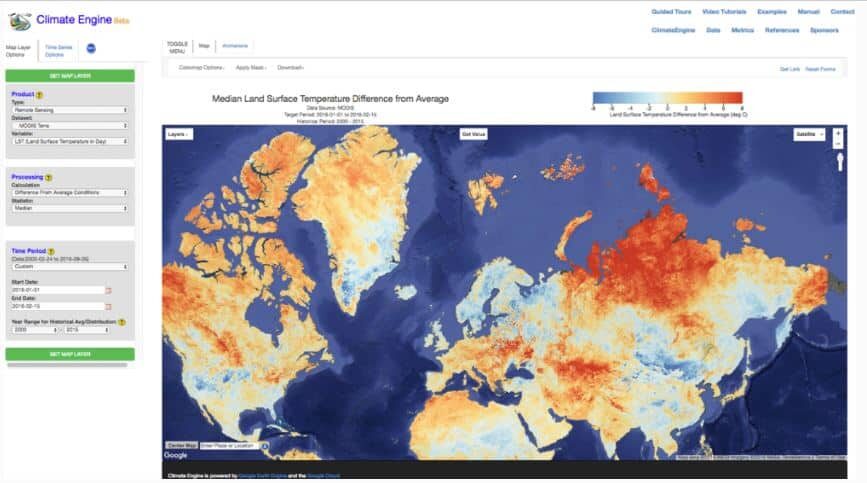
The image below shows a sample use of the technology by Climate Engine to create an interface that can display time-series mapping information. It enabled scientists to obtain surface climate-based data easier and faster.
Carbon Footprint Tracker
The upcoming Carbon Footprint for Google Workspace service will also have a tool designed to help users access emissions data. It will allow them to track their emissions or to report disclosures.
Same with Earth Engine, the carbon footprint tool will help users assess their environmental impact. It will help them measure and thus, reduce their carbon emissions using Google Cloud services.
In a sense, the tools will aid companies to come up with carbon emissions reduction solutions as the world transitions to net zero.