

The Ontario Teachers’ Pension Plan (OTPP) continues to look for positive environmental impacts of their investments.
The Fund’s recent climate report shows great progress on its net zero by 2050 plan. The Chief Investment Officer, Ziad Hindo said:
“We are increasingly evolving our thinking to consider how we can use our capital in a way that has clear and measurable real-world environmental and social benefits while creating value for our members.”
Indeed, one of the world’s biggest pension funds has been making huge strides on its net zero targets.
To date, OTPP delivers retirement security to 333,000 members and pensioners, invests in 50+ countries worldwide, and manages C$242.5 billion in net assets (as of June 30, 2022). 80% of those assets are managed in-house.
Ontario Teachers’ Net Zero Pathway Progress
Ontario Teachers’ has put 2025 and 2030 targets in place to cut its carbon emissions to reach net zero investment activity by 2050.
OTPP aims to reduce portfolio carbon emissions intensity by 45% by 2025 and 67% by 2030, compared to its 2019 baseline. These emission reduction targets cover all the Fund’s assets, resources, and holdings.
Also, OTPP has an ambitious plan to achieve $300B in net assets by 2030 and $50B in green investments by 2050.
Since their net zero 2050 announcement last year, Ontario Teachers’ saw a significant drop in their emissions due to its investment shift from passive to active exposure.
Currently, the Fund’s private assets that represent 72% of its PCF (portfolio carbon footprint) holdings continue to achieve lower emissions intensity than other asset classes. Its wholly owned subsidiary Cadillac Fairview, for instance, has been taking actions that further reduce carbon emissions.
2021 Key Highlights
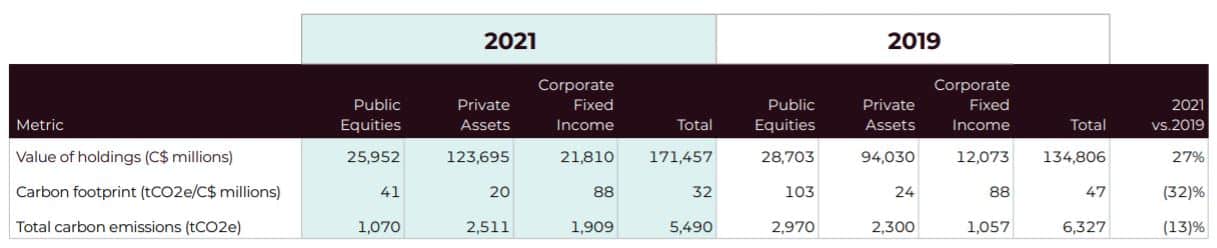
The following table shows Ontario Teachers’ progress in cutting its PCF as of 2021.
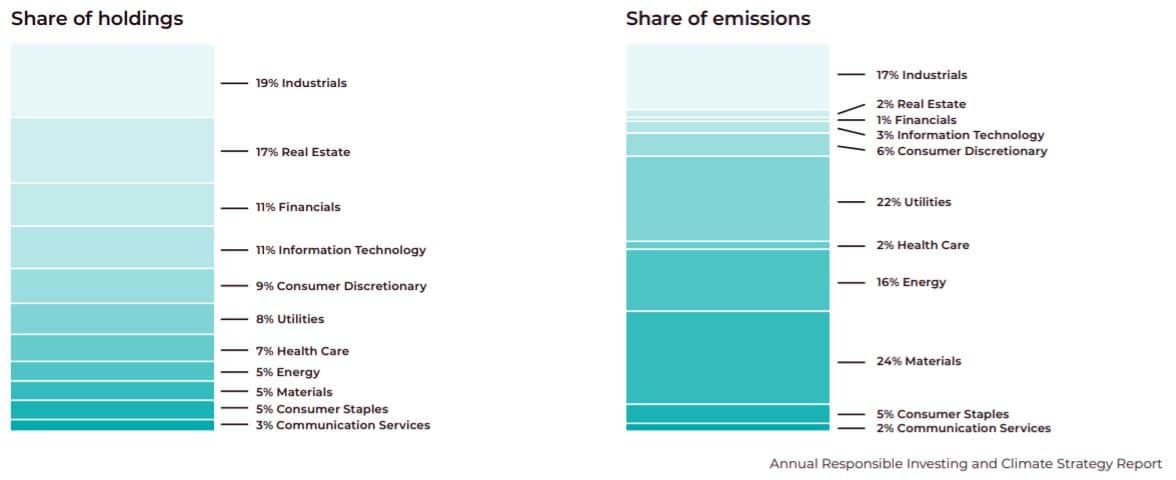
While here’s the sector-based carbon footprint contribution of the Fund.
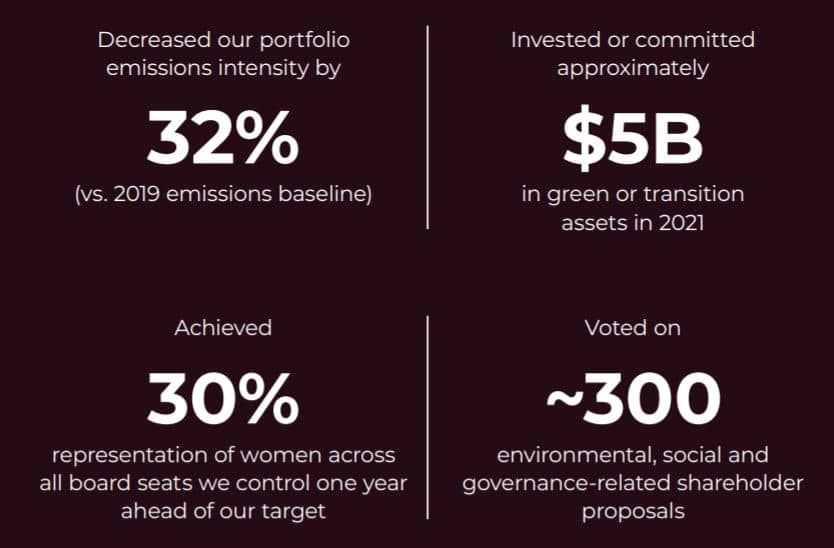
Regarding other performance metrics, Ontario Teachers’ achieved the following results.
The annual total fund net return has been 9.7% since the pension plan started in 1990.
The Fund’s Climate Strategy
Ontario Teachers’ climate strategy reflects its commitment to reducing the environmental impact of its portfolio. Its decarbonizing strategies also capitalize on opportunities supporting the transition to a net zero future.
Decarbonizing portfolio:
The Fund calls its net zero by 2050 plan “PART” short for Paris Aligned Reduction Target. One key element of the PART is decarbonizing OTPP portfolio companies. And so in 2021, Ontario Teachers’ set a target to align net zero goals of companies with significant stakes.
By providing resources to and working closely with its portfolio companies, they’ve made progress with PART by creating a “decarbonization playbook”. It’s a guidance for portfolio companies detailing:
- The case for change, including board and management education
- Carbon footprint baseline development
- Decarbonization levers identification and assessment
- Target setting, validation, and communication
- Guidance on what a credible net-zero plan entails
They’re now engaging the first wave of select portfolio companies to implement the decarbonization playbook. By prioritizing those firms, it helps OTPP to focus its efforts on the highest-emitting companies where they influence emissions.
Decarbonizing high-emitters:
Part of this strategy is to make an initial investment of about $5 billion over the next few years toward “High Carbon Transition (HCT) assets”.
- High Carbon Transition assets are very high-emitting companies with credible decarbonization plans that Ontario Teachers’ can accelerate via their capital and expertise.
To support the transition of select HCT assets, their approach will include:
- Clear investment criteria. HCT assets as businesses with significant carbon intensity. That means ~10x the average of the Fund’s portfolio carbon footprint, or around 300 tCO2e/CAD MM.
- Initial allocation of $5 billion to HCT assets.
- Enhanced transparency.
- Maintaining targets and commitment to net zero.
Increasing green investments:
In 2021, OTPP reached ~$33 billion in green investments. These include investments in low-carbon transportation fuel and carbon credits.
In December last year, Ontario Teachers’ invested $250M in Sydney-based carbon credits developer, GreenCollar. The generated carbon credits are sold by GreenCollar to first and secondary markets.
OTPP invested in GreenCollar because they see the positive impact of its carbon credit projects that align with their long-term return goals.
- To date, the developer produced +126 million Australian Carbon Credit Units and prevented 30,000+ kg of nitrogen from entering the ocean.
Interests in environmental programs such as ESG investing are growing fast and carbon credits have been the focus of these investments. In fact, industry estimates expect to see carbon markets hitting $22 trillion by 2050.