

The clean energy sector is entering a new phase in 2026. This time, the growth story is not driven only by climate goals or government policy. Artificial intelligence is now reshaping the global electricity market.
AI data centers are consuming huge amounts of power. According to the International Energy Agency (IEA), global electricity demand from data centers could more than double by 2030. In the United States alone, data centers may account for nearly half of electricity demand growth through the end of the decade.
That surge is creating new opportunities for energy companies that can deliver reliable, scalable, and lower-carbon electricity.
At the same time, governments continue to push for decarbonization. BloombergNEF estimates that global energy transition investment hit a record $2.3 trillion in 2025, up 8% from 2024. This includes spending on renewable energy, electrified transport, hydrogen, batteries, and power grids. 
Solar and battery storage are growing quickly. Also, grid modernization is becoming more important as global electricity demand increases.
As a result, investors are paying closer attention to companies that sit at the center of both the energy transition and the AI infrastructure boom. Here are the top four clean energy stocks that stand out in 2026 because of their scale, technology, and long-term growth potential.
Bloom Energy (BE): Fuel Cells Powering the AI Computing Boom
BE has become one of the biggest clean energy stories of 2026. The company makes solid oxide fuel cells. These cells produce electricity and have lower emissions than traditional combustion systems.
Bloom’s technology is gaining attention because AI data centers need fast and reliable power. In many regions, utility grid connections can take years to complete. Bloom’s onsite power systems can often deploy much faster, making them attractive for hyperscale computing facilities.
The company’s growth accelerated sharply this year. Bloom Energy reported first-quarter 2026 revenue of $751 million, up 130% from a year earlier. Adjusted earnings per share surged to $0.44 from just $0.03 in the prior-year period.
Bloom also raised its full-year 2026 revenue guidance to between $3.4 billion and $3.8 billion. That represented a major increase from previous expectations.
One major catalyst is the company’s expanding partnership with Oracle. Bloom is helping support large AI data center developments, including projects tied to Oracle Cloud Infrastructure.
Oracle recently expanded its agreement with Bloom to as much as 2.8 gigawatts of fuel-cell capacity for AI facilities. That is one of the largest fuel-cell deployments announced for data center infrastructure.
Bloom’s systems are also gaining traction because they can operate independently from strained electric grids. The company says its fuel-cell platforms can provide continuous power with high reliability while using natural gas, biogas, or hydrogen blends.
Hydrogen remains another long-term growth area. Bloom has continued investing in solid oxide electrolyzers, which can produce hydrogen more efficiently than conventional electrolysis technologies. The U.S. Department of Energy previously selected Bloom projects for hydrogen-related funding support through federal clean energy programs.
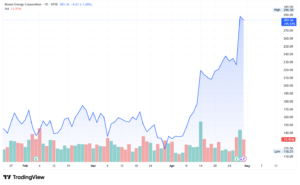
Meanwhile, Bloom’s stock performance has reflected investor optimism around AI electricity demand. Shares have risen more than 1,000% over the past year as markets increasingly view the company as a key provider of AI-era power infrastructure.
NextEra Energy (NEE): America’s Renewable Power Giant Scaling for AI Demand
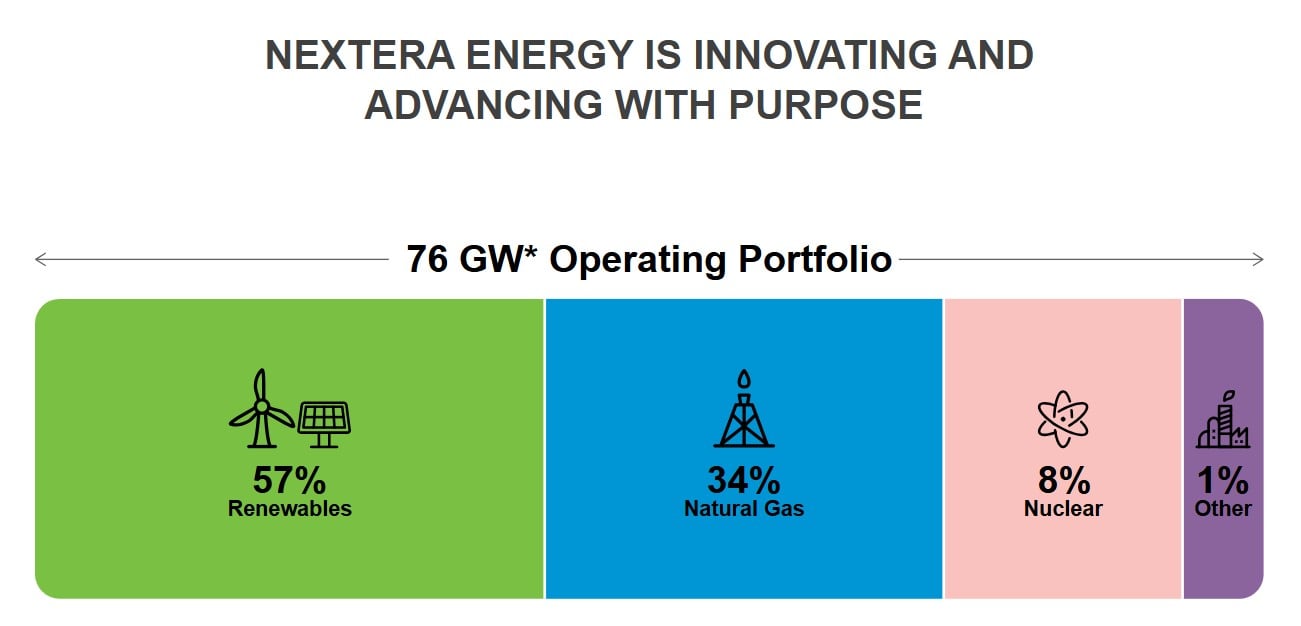
NEE remains one of the largest renewable energy companies in the world and a dominant force in the U.S. electricity market. The company operates Florida Power & Light, one of America’s largest utilities, while also developing massive solar, wind, and battery storage projects through NextEra Energy Resources.
Scale is one of NextEra Energy’s biggest advantages. The company currently has a renewable and energy storage project backlog of roughly 33 gigawatts. It added another 4 GW of new projects during the first quarter of 2026 alone.
NextEra is also benefiting from rising AI electricity demand. The company recently announced that its data center power pipeline hit 21 GW. More than half of this is already in advanced development phases, set for completion by 2028.
The company is exploring big projects in Pennsylvania and Texas. These could add nearly 10 GW of new power for data center customers and industrial users. Those projects may include solar, battery storage, natural gas, and transmission infrastructure.
Battery storage is another major focus. NextEra has become one of the largest battery storage developers in North America. Energy storage is vital. It stabilizes grids with lots of renewables. It also meets the constant electricity needs of AI facilities.
Financially, the company remains strong. Florida Power & Light generated net income of $1.46 billion during the first quarter of 2026, up more than 11% year over year.
NextEra also continues expanding its renewable footprint across the United States. The company runs tens of gigawatts of wind and solar assets. This makes it one of the largest producers of renewable electricity globally.
NEE’s stock price recently surged. This rise stems from a strong Q1 2026 earnings beat. Adjusted earnings hit $1.09 per share, beating analyst estimates of $0.97.
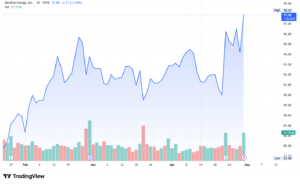
Analysts have raised their price targets, now as high as $112. This, along with a good outlook for lower interest rates, has boosted investor confidence in the company’s long-term growth.
Unlike many pure-play clean energy firms, NextEra offers a combination of growth and stability. That balance continues attracting long-term investors seeking exposure to both renewable energy expansion and rising electricity demand.
- SEE MORE: Google and NextEra Team Up to Build Gigawatt-Scale AI Data Centers Powered by Clean Energy
GE Vernova (GEV): The Grid Backbone of the AI Energy Revolution
GEV is rapidly emerging as one of the most important infrastructure companies in the energy transition. The company spun off from General Electric in 2024. It works in key areas like grid systems, gas turbines, wind turbines, electrification equipment, and power software.
As electricity demand rises, utilities and data center operators need more transformers, transmission systems, turbines, and grid technologies. That trend has sharply increased demand for GE Vernova’s products.
The company’s stock has climbed more than 200% over the past year.
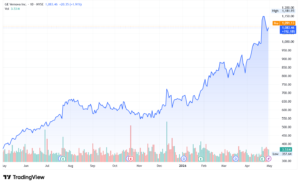
GE Vernova recently raised its 2026 guidance after reporting stronger demand tied partly to AI infrastructure expansion. Analysts observed that the company has secured over 90% of its gas turbine production capacity until 2030.
Gas turbines are vital for many utilities. They provide dispatchable power, which supports renewable-heavy electricity systems and large data centers. GE Vernova’s high-efficiency HA gas turbines are among the most widely used advanced turbines globally.
At the same time, the company continues investing heavily in renewable technologies. GE Vernova’s wind division remains one of the largest turbine manufacturers in the world. The company is expanding grid modernization technologies. These tools help utilities manage complex electricity systems.
A key initiative is the company’s Grid Solutions business. It provides transformers, substations, and high-voltage transmission systems. Grid investment is growing fast. Many countries need to update their old infrastructure and connect more renewable energy projects.
According to the IEA, global grid investment must rise above $600 billion annually by 2030 to meet climate and electrification goals. That trend could provide long-term demand for GE Vernova’s equipment and services.
Analysts say GE Vernova’s total backlog might reach $200 billion by 2027. This growth comes from rising utility and AI-related infrastructure projects.
First Solar (FSLR): America’s Solar Manufacturing Powerhouse Rides Policy Tailwinds
FSLR continues to stand out as one of the leading solar manufacturers in the United States. The company focuses on thin-film solar modules. It has gained significantly from incentives tied to the Inflation Reduction Act. These policies back U.S. clean energy manufacturing. They also aim to cut reliance on imported solar equipment.
First Solar’s domestic production footprint gives it a major advantage in the current policy environment.
The company has expanded its manufacturing across the U.S. It now has major facilities in Ohio, Alabama, and Louisiana. Its new Alabama plant added 3.5 GW of annual capacity, while its upcoming Louisiana facility is expected to add another 3.5 GW. Together, those projects could push the company’s U.S. manufacturing capacity above 14 GW by 2026.
FSLR is also increasing international production capacity in India to support growing global demand.

First Solar expects its global nameplate manufacturing capacity to exceed 25 GW by 2026. That makes it one of the largest non-Chinese solar manufacturers in the world.
The company also entered 2026 with a contracted backlog of more than 70 GW of solar module orders extending into future years. That big backlog gives clear revenue insights. This sets it apart from many rivals in the unpredictable solar sector.
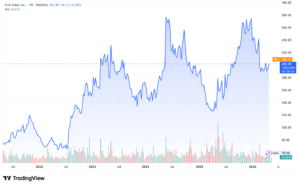
Financially, First Solar maintains one of the strongest balance sheets in the industry, with relatively low debt and substantial cash reserves. That financial strength has helped the company continue expanding despite broader market volatility, as shown in its share price movement.
Technology is another key advantage. First Solar uses cadmium telluride thin-film technology, not regular crystalline silicon panels. This tech works better in hot conditions and needs less water to make.
Solar demand also continues to rise globally. The IEA expects solar PV to become the world’s largest source of installed electricity capacity before the end of this decade.
Ultimately, big tech companies are signing more renewable power deals. They want to meet climate goals and support growing electricity needs from AI. That trend could further support long-term utility-scale solar demand in the United States and internationally.
AI and Electrification: The New Engine Driving Clean Energy Markets
The clean energy market in 2026 looks very different from previous investment cycles.
Earlier growth was driven mainly by electric vehicles, solar panels, and climate policy. Today, investors are also focusing on grid infrastructure, battery storage, distributed generation, and AI-related electricity demand.
That shift is creating new opportunities across the energy sector.
Bloom Energy is benefiting from the urgent need for fast, on-site power solutions for AI infrastructure. NextEra Energy continues scaling renewable generation and battery storage to meet surging electricity demand.
GE Vernova is supplying critical equipment for grid modernization and power expansion. First Solar remains a major beneficiary of domestic manufacturing incentives and global solar growth.
At the same time, the sector still faces challenges, including higher interest rates, supply chain risks, and policy uncertainty.
Still, long-term trends remain favorable. Global electricity demand is rising rapidly. Governments continue supporting decarbonization efforts. AI is accelerating the need for new power infrastructure worldwide. Those forces are likely to keep clean energy stocks in focus throughout 2026 and beyond.